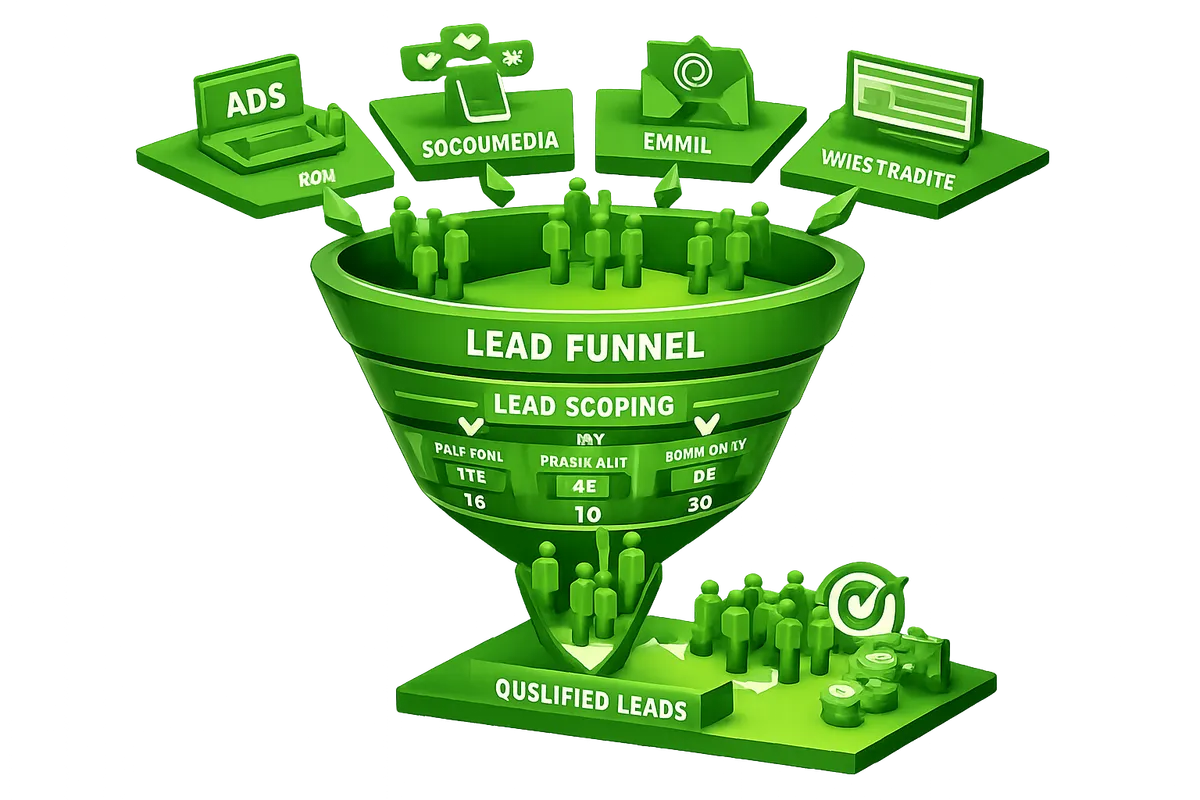
How AI Lead Scoring Works
Machine learning models analyze every data point associated with your leads and identify the patterns that predict conversion. The system examines behavioral signals like page visits, email opens, content downloads, and form submissions. It cross-references firmographic data like company size, industry, revenue range, and technology stack. Typical model architectures use gradient-boosted decision trees (XGBoost, LightGBM) for interpretability and accuracy, or neural networks when you have enough data (100,000+ leads) to justify the complexity.
The model training process starts with your historical data. Every closed-won deal teaches the algorithm what a successful buyer looks like. Every closed-lost opportunity teaches it what a dead end looks like. The model identifies correlations that humans would never catch. Maybe leads who visit your case studies page within three days of their first site visit close at 4x the average rate. Maybe leads from companies using a specific competing product convert 60 percent more often. Maybe leads who attend a webinar and then go dark for two weeks before returning are actually higher-probability than leads who respond immediately.
Unlike static scoring rules, AI models learn continuously. When a lead that scored low unexpectedly converts, the model adjusts. When high-scored leads consistently stall at a particular stage, the model recalibrates. The system gets smarter with every closed deal and every lost opportunity. This continuous learning is critical because markets shift. A buying signal that worked in 2023 may be meaningless in 2026, and a new signal your model identifies this quarter might become the dominant predictor next quarter.
We build these models as part of custom AI solutions trained specifically on your historical conversion data. Generic scoring tools apply generic patterns. Your model reflects your buyers, your sales cycle, and your market dynamics. Our AI integration services team handles the plumbing between your CRM, marketing automation, and the scoring model so scores flow to the rep at the moment of decision rather than living in a separate analytics tool nobody checks.
Key Features and Capabilities
Behavioral Pattern Analysis. AI tracks engagement across channels and identifies the specific actions that predict conversion in your business. Not generic benchmarks. Your actual patterns. If prospects who attend a webinar and then visit the pricing page within 48 hours close at 12x the average rate, the model learns that combination and scores accordingly. The failure mode here is overfitting to rare patterns that happen to correlate with conversion in your training data but lack causal meaning. Good implementations use cross-validation and hold-out sets to catch this before deployment.
Real-Time Score Updates. Scores adjust instantly as leads take new actions. A prospect who visits your pricing page at 2 AM gets flagged before your team arrives in the morning. A lead who goes from casually browsing blog posts to downloading a buyer's guide and requesting a demo gets an immediate score boost that triggers priority routing. The technical requirement here is an event streaming architecture (Kafka, Kinesis, or Segment) that delivers behavioral events to the scoring service within seconds of occurrence. Batch scoring on a nightly cadence, which many SaaS scoring tools still use, misses the window where intent-based outreach actually works.
Segment-Specific Models. Different products, markets, and buyer personas convert differently. AI builds separate models for each segment so a mid-market SaaS lead isn't scored the same as an enterprise services lead. A company selling both a $500 per month tool and a $50,000 implementation service needs different scoring logic for each. The AI handles that complexity without requiring separate manual rule sets. For companies with multiple products, the typical architecture is a primary ICP classifier that routes to product-specific scoring models, each trained on the relevant historical pipeline.
Lead Routing Intelligence. High-scoring leads automatically route to your best-fit reps based on industry expertise, territory, and current capacity. No manual assignment delays. When a lead scores above your threshold, the system can assign it to the right rep, send a Slack notification, and create a task in your CRM within seconds. Routing rules can also account for rep performance by segment. Your top enterprise rep might get first pick of enterprise-fit leads while mid-market leads route to reps with strong performance in that motion.
Decay and Re-Engagement Signals. AI detects when engaged leads go quiet and triggers re-engagement workflows before they go cold. It also identifies stale leads showing renewed interest. A lead that went dark six months ago and suddenly starts visiting your site again gets flagged immediately rather than sitting in a forgotten nurture sequence. Reopening engagement within 24 hours of a re-activation signal converts at roughly 3x the rate of reopening after two weeks. Speed matters specifically because the re-engagement window is short.
Intent Data Integration. Third-party intent signals from providers like 6sense, Bombora, G2 Buyer Intent, and ZoomInfo Intent integrate directly into the scoring model. A lead whose company is actively researching your category on third-party sites scores higher than a lead who just happens to visit your homepage. Intent data adds roughly 5 to 15 percent of model accuracy improvement when properly weighted. Overweighting it is a common mistake because intent signals are noisy at the individual lead level.
Integration With Your CRM and Marketing Stack
AI lead scoring connects directly to your CRM, marketing automation platform, and sales engagement tools. Scores sync to Salesforce, HubSpot, or Pipedrive in real time. Marketing platforms like Marketo, Pardot, Mailchimp, or ActiveCampaign feed behavioral data into the model. Sales engagement tools like Outreach, Salesloft, or Apollo consume scores to prioritize cadences and surface the hottest leads at the top of rep queues.
The integration layer matters as much as the model itself. Your lead scoring system needs to pull data from every touchpoint: website analytics showing page-level engagement, ad platforms revealing which campaigns sourced the lead, chatbot transcripts capturing buying intent signals, webinar attendance tracking engagement duration, product usage data showing feature adoption patterns, and email engagement data revealing content resonance. A realistic integration project touches 8 to 12 data sources for a mid-market B2B company.
Through our CRM and martech consulting services, we connect every data source that touches your leads. The result is a 360-degree view of each prospect that feeds the scoring model with comprehensive behavioral and demographic signals. Done poorly, this integration work produces a beautiful data model that nobody can operate. Done well, it produces a scoring signal that appears in the rep's CRM view at the moment they need to decide who to call next.
Your lead generation efforts become dramatically more efficient when every inbound lead gets an instant quality score. Marketing can optimize campaigns based on which channels produce the highest-scoring leads rather than just the highest volume. The channels that produce the most MQLs are often not the channels that produce the most revenue, and AI scoring makes that distinction visible in a way that lead volume metrics cannot.
Custom AI Scoring vs. Built-In CRM Scoring
HubSpot and Salesforce offer built-in lead scoring. These tools use generic models trained on aggregate data from thousands of companies. They don't know that in your business, attending a webinar is a stronger buying signal than downloading a whitepaper. They can't account for the fact that leads from the manufacturing sector close at 3x the rate of leads from retail in your specific pipeline.
Here is how the two approaches compare across critical dimensions:
Accuracy. Generic models achieve 55 to 65 percent accuracy in predicting conversions. Custom models trained on your data typically reach 75 to 85 percent accuracy within the first quarter and improve from there. The accuracy gap translates directly to rep time saved on unqualified leads.
Adaptability. Built-in scoring requires manual rule updates when your business changes. Custom AI models retrain automatically on new data, adapting to shifts in buyer behavior, market conditions, and product changes. A monthly retraining cadence catches market shifts within weeks rather than quarters.
Transparency. Many off-the-shelf scoring tools operate as black boxes. You see the score but not the reasoning. Custom models provide full explainability using SHAP values or similar feature attribution methods. You know exactly which factors drove each score and by how much, which builds rep trust and surfaces opportunities to optimize campaigns around the signals that actually drive conversion.
Cost. Built-in tools are included in your CRM subscription but deliver generic results. Dedicated platforms like 6sense, Demandbase, and MadKudu cost $40,000 to $150,000 annually. Custom implementations typically cost $15,000 to $45,000 upfront with $1,500 to $3,500 monthly maintenance. For companies with 1,000+ monthly leads, custom typically pays back within 4 to 6 months.
Measuring the Impact of AI Lead Scoring
Track these metrics to quantify your return on investment:
Conversion rate by score tier. Divide your leads into quartiles based on AI score. The top quartile should convert at 3 to 5x the rate of the bottom quartile. If the spread is smaller, the model needs more training data or additional signal sources.
Sales cycle length. High-scored leads that receive immediate attention should close 20 to 35 percent faster than leads handled through your previous process. Measure average days from first contact to closed-won for scored vs. unscored periods. Shorter cycles compound. A 20 percent reduction means your reps turn more pipeline per quarter, which means more revenue at the same rep count.
Rep productivity. Track the number of qualified meetings booked per rep per week before and after implementation. Most teams see a 25 to 40 percent improvement as reps spend less time on unqualified prospects. Also track rep satisfaction and retention, since working on qualified leads materially affects burnout rates in high-volume sales environments.
Marketing qualified lead accuracy. Compare the percentage of marketing-qualified leads that sales accepts before and after AI scoring. This metric reveals whether marketing and sales alignment improves. A 15 percent improvement in MQL acceptance rate signals real alignment progress.
Revenue per lead. Total closed revenue divided by total leads processed. This should increase as your team focuses on higher-value opportunities identified by the scoring model. Watch for shifts in average deal size, since scoring models sometimes systematically prioritize larger deals.
How to Evaluate Your Options
Start with your historical data. AI scoring needs at least 500 to 1,000 closed leads (mix of won and lost) to train a model that outperforms your current scoring. If your CRM has fewer than 500 closed-lost outcomes tagged properly, do the data cleanup first. Models trained on incomplete loss data systematically overscore the lead profiles that look like your won deals without accounting for the many similar-looking deals that didn't close.
Evaluate your current scoring accuracy honestly. Pull your MQL-to-closed-won conversion rate for the last 4 quarters. If that rate is above 15 percent, your current scoring is probably working reasonably well and the incremental gain from AI will be smaller. If it is below 8 percent, AI scoring is likely to produce dramatic improvement. Most B2B companies sit in the 3 to 10 percent range, where the ROI case is clearest.
Consider the integration effort required. If your data lives across Salesforce, a marketing automation tool, a product analytics platform, a webinar tool, and two ad platforms with no existing integration, the scoring project is 40 percent data engineering and 60 percent modeling. Budget accordingly. Companies that try to skip the data unification step end up with scoring models that miss the behavioral signals that matter most.
Frequently Asked Questions
How much does AI lead scoring cost?
Custom AI lead scoring implementations range from $10,000 to $40,000 depending on the number of data sources, integration complexity, and model sophistication. This includes model development, integration, testing, and initial optimization. Ongoing model tuning is available as a monthly retainer starting at $1,500 per month for continuous retraining and performance monitoring. Compare this to enterprise platforms like 6sense or Demandbase at $40,000 to $150,000 annually, which work well for companies with large intent data needs but may be overkill for mid-market B2B.
How long does implementation take?
Most AI lead scoring projects launch within 6 to 10 weeks. The first two weeks focus on data collection and analysis. Model training and validation take another three to four weeks. Integration and testing round out the timeline. You'll have a working scoring model in production within three months. For complex environments with 10+ data sources or segment-specific models, plan for 12 to 14 weeks.
What data do I need to get started?
You need historical lead data with conversion outcomes. At minimum, 500 to 1,000 leads with known results (closed-won, closed-lost, or still open) give the model enough to learn from. The more data points per lead (engagement history, firmographic info, source data), the more accurate the scoring becomes. Companies with 2,000+ historical leads and 12+ months of CRM data see the strongest initial model performance. Data quality matters more than quantity. 1,000 leads with clean, tagged outcomes produce better models than 10,000 leads with inconsistent lifecycle stage tracking.
Will this replace my existing lead scoring?
It enhances and eventually replaces static scoring rules. We typically run AI scoring alongside your current system for 30 to 60 days so your team can compare results. Once the AI model proves more accurate (and it will), you transition fully. Your existing CRM workflows and routing rules stay intact. Some teams keep a simplified static score as a sanity check layer, which helps reps trust the AI score during the adoption period.
How do I measure ROI from AI lead scoring?
Track conversion rate by score tier, average time to close for high-scored leads vs. low-scored leads, and the percentage of rep time spent on leads that actually convert. Most clients see a 15 to 30 percent improvement in sales efficiency within the first quarter as reps focus on higher-quality prospects. Calculate dollar impact by multiplying the increase in close rate by your average deal value and the number of leads processed per quarter. For a team processing 500 qualified leads per quarter at a $25,000 ACV, a 3-point close rate improvement is $375,000 in additional quarterly revenue.
Can AI lead scoring work for businesses with long sales cycles?
Yes, and it's particularly valuable for long sales cycles. When deals take 6 to 12 months to close, identifying high-probability opportunities early saves enormous amounts of wasted effort. The model may use different signals for long-cycle deals, weighting engagement depth and stakeholder involvement more heavily than simple page visits. We adjust the model architecture based on your typical sales cycle length. For 12+ month enterprise cycles, stakeholder breadth (number of contacts at the account engaging) is often the single strongest conversion predictor, which is invisible to most static scoring approaches.