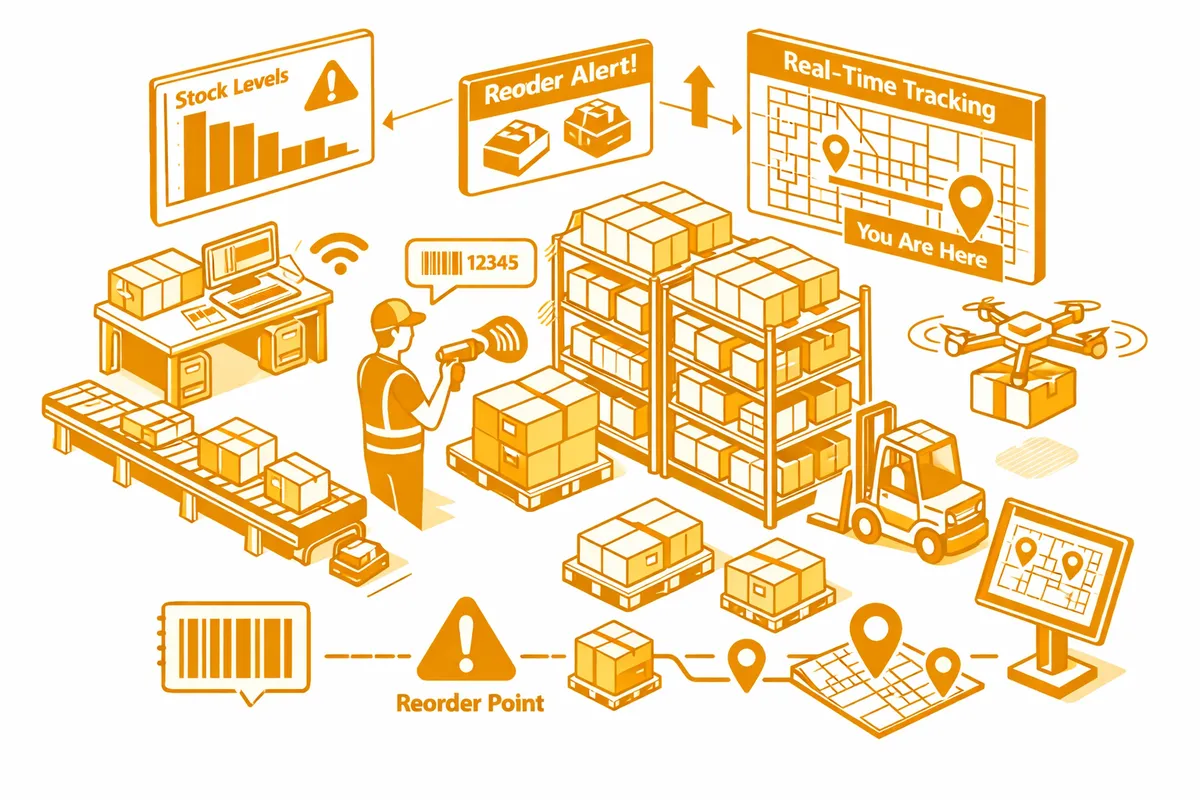
How AI Inventory Management Works
Machine learning models analyze historical sales data, seasonal patterns, market trends, and external signals to forecast demand at the SKU level. The system considers variables that humans cannot process simultaneously: weather patterns, competitor pricing, social media trends, economic indicators, and supplier lead times.
AI does not just predict what will sell. It optimizes three interconnected decisions.
How much to order. Economic order quantities adjust dynamically based on current demand velocity, carrying costs, and order costs. The model balances the cost of ordering too frequently against the cost of holding excess inventory. For a business paying $150 per purchase order in processing overhead and 25% annual carrying costs, the optimal order quantity shifts meaningfully as demand velocity changes. Classical EOQ formulas produce a static answer. ML-based approaches update daily.
When to order. Reorder points shift based on demand trends and supplier lead times. A product with accelerating sales gets reordered sooner. A product with decelerating sales gets delayed. The system accounts for supplier reliability, factoring in a longer lead time buffer for vendors who frequently ship late. A supplier promising 7-day lead times but averaging 11 days with a standard deviation of 3 days requires a very different safety buffer than a supplier delivering reliably in 7 days flat.
Where to allocate. For multi-location businesses, AI distributes inventory based on local demand patterns rather than applying uniform allocation. A product selling well in Dallas but slowly in Portland gets shipped accordingly, not split evenly between locations. This also powers internal transfer recommendations. Before placing a new order, the system checks whether excess stock at one location can fill demand at another more cheaply.
We build these systems as custom AI solutions through our AI integration services, integrating directly with your existing inventory and point-of-sale systems. Your model trains on your sales data and reflects your specific product mix, supplier network, and business constraints.
Key Features and Capabilities
Demand forecasting. AI predicts sales volume at the SKU level across daily, weekly, and monthly horizons. Models account for seasonality, trends, promotions, and external factors that static forecasts miss. A well-trained model achieves forecast accuracy (measured as weighted MAPE, mean absolute percentage error) of 85 to 95% at the weekly level, compared to 50 to 70% accuracy with traditional methods. Common modeling approaches include Prophet, ARIMA with exogenous variables, gradient-boosted trees like LightGBM, and for high-volume operations, deep learning architectures like Temporal Fusion Transformers.
Dynamic reorder points. Safety stock levels and reorder triggers adjust automatically based on current demand velocity and supplier lead times. No more manual threshold management. The system recalculates every day using the latest sales data, so a sudden spike in demand triggers a reorder within 24 hours rather than waiting until the next manual review. One outdoor apparel client recovered $340,000 in missed Q4 sales by switching from weekly to daily reorder recalculation, because the model caught a 3-day sales acceleration that would have been invisible under the old cadence.
Multi-location optimization. AI allocates inventory across warehouses, stores, and fulfillment centers based on local demand patterns. Transfer recommendations move stock from low-demand to high-demand locations before stockouts occur. For a business with five locations, this can reduce total inventory requirements by 10 to 20% while maintaining the same service levels. Tools like NetSuite Supply Chain Suite, SAP IBP, and newer purpose-built platforms like ToolsGroup and Relex ship this capability at enterprise scale.
Supplier performance tracking. The system monitors supplier reliability, tracks lead time variability, and factors delivery performance into ordering decisions. Unreliable suppliers get larger safety buffers automatically. The data also gives you leverage in vendor negotiations. When you can show a supplier that their average lead time is 12 days versus their promised 7, you have concrete data to demand improvement or seek alternatives. Many businesses discover during implementation that 15 to 20% of their supplier base is materially underperforming quoted terms.
Waste and expiry prevention. For perishable or time-sensitive inventory, AI prioritizes stock rotation, flags items approaching expiry, and adjusts ordering to minimize waste. A grocery retailer using AI-driven expiry management typically reduces waste by 20 to 30%. The system adjusts order quantities based on expected shelf life remaining at the point of sale. For a grocery chain with $50 million in annual food purchases and 4% baseline waste, a 25% reduction translates to $500,000 in annual savings.
Promotion impact modeling. Before launching a promotion, AI estimates the demand impact based on historical promotion performance, discount depth, and market conditions. Your purchasing team orders the right quantity before the promotion starts rather than scrambling to replenish during a surge. This is where marketing and operations must share data. A 20% discount paired with email and paid social drives very different demand than the same discount with no promotional push. Models that incorporate marketing spend as an input variable forecast promotional demand 30 to 50% more accurately.
The Forecasting Advantage
Traditional forecasting methods use moving averages or exponential smoothing. These approaches work reasonably well for stable products with predictable demand. They fail for products with irregular patterns, new products with no history, and situations where external factors shift demand dramatically.
AI forecasting handles complexity that traditional methods cannot.
New product forecasting. When you launch a new SKU with no sales history, AI uses attributes of similar products to generate initial forecasts. A new flavor variant of an existing product inherits demand patterns from the existing line, adjusted for typical new-flavor adoption curves. A new SKU in an existing category can be forecasted within 10 to 15% accuracy using attribute-based lookalike modeling.
Promotional demand. Traditional forecasting treats promotional spikes as anomalies that distort the baseline. AI models promotions explicitly, learning how different discount levels, promotion durations, and channels affect demand for specific products. A BOGO promotion on a high-velocity SKU drives different lift than a 15% off promotion on a long-tail SKU, and AI captures that difference.
External factor integration. Weather affects ice cream sales. Construction permits affect building material demand. Social media mentions affect trending products. AI models incorporate these external signals for more accurate forecasts. A home improvement retailer integrated weather forecasts and saw snow shovel forecast accuracy jump from 52% to 89%, which eliminated both stockouts during storms and overstock going into spring.
Cannibalization effects. When you introduce a new product that competes with existing ones, AI estimates how much demand shifts from old to new versus representing genuine growth. This prevents overordering across the combined portfolio. A consumer electronics brand launching a new SKU typically sees 40 to 60% of initial demand come from existing customers who would have bought a competing SKU, not incremental buyers.
Integration With Your Existing Tools
AI inventory management connects to your ERP, point-of-sale system, warehouse management system, and ecommerce platforms. Whether you run NetSuite, QuickBooks, Shopify, Microsoft Dynamics 365, SAP, or a custom ERP, we build seamless data pipelines. Integration patterns typically use REST APIs, webhook events for real-time updates, and nightly batch sync for larger datasets.
Inventory data flows in real time from every sales channel. Online orders, in-store transactions, and wholesale shipments all feed the AI model. Purchase orders generate automatically in your procurement system when reorder points trigger. Human approval gates can be added for high-value orders (for example, any PO over $25,000 requires review) while low-value orders flow through automatically.
For businesses that run an online storefront alongside inventory operations, this work pairs naturally with ongoing website design and web hosting and maintenance to ensure product availability data displays accurately at the point of purchase. Nothing frustrates a customer faster than adding an "in stock" item to cart only to receive a backorder email an hour later.
If you are managing inventory-dependent customer communications, email marketing capabilities automate back-in-stock notifications, low-stock alerts to wholesale customers, and pre-order campaigns for upcoming replenishments. Back-in-stock emails are among the highest-converting email types in ecommerce, with open rates often exceeding 50% and click-to-purchase rates above 15%.
Why Build Custom vs. Off-the-Shelf
Generic inventory tools apply one-size-fits-all algorithms. They do not understand that your Tuesday lunch rush drives different product demand than your Saturday evening traffic. They cannot factor in your specific supplier relationships or your unique product lifecycle patterns.
Custom AI inventory management trains on your data and your constraints. Minimum order quantities, shelf life limits, storage capacity, cash flow targets, vendor terms, and seasonal labor availability. The model optimizes within your real-world boundaries.
Consider the difference. A generic tool might recommend ordering 500 units based on average demand. A custom model knows that your supplier requires a 200-unit minimum, your warehouse has space for only 400 units, and your cash flow this month favors a smaller order with faster reorder. It recommends 350 units with a reorder triggered 5 days sooner than normal.
The practical threshold: businesses managing fewer than 500 SKUs in a single location can often get by with the native forecasting in Shopify or NetSuite. Businesses with 2,000 plus SKUs, multiple locations, or complex seasonality benefit substantially from custom modeling. The investment crossover typically happens around $20 million in annual revenue, though high-margin categories like cosmetics or high-velocity categories like grocery may justify custom work at lower revenue levels.
Measuring Inventory Performance
Effective AI inventory management should move these key metrics within the first six months.
Stockout rate. Should decrease 40 to 60%. Fewer missed sales and disappointed customers. Measure at the SKU-day level (what percentage of SKU-days had insufficient stock) rather than as a blended percentage across SKUs.
Inventory carrying cost. Should decrease 15 to 25%. Less capital tied up in excess inventory. Separate this into storage costs, capital costs, and obsolescence costs to understand which area is improving fastest.
Inventory turnover. Should increase 20 to 40%. Products move through your system faster. Best-in-class retailers achieve 8 to 12 turns per year for mainstream SKUs, though this varies significantly by category.
Dead stock percentage. Should decrease significantly as ordering becomes more precise and responsive to demand changes. Target under 5% of total inventory value.
Forecast accuracy. Should reach 85 to 95% at the weekly level, compared to 50 to 70% with traditional methods. Report accuracy as weighted MAPE, where higher-value SKUs are weighted more heavily than low-volume tail SKUs.
Order fill rate. Should increase to 95 to 99% as stock levels align more closely with actual demand.
What to Do Next
Start by quantifying your current baseline. Pull 12 to 24 months of historical sales data at the SKU level, current inventory valuations, and stockout incidents. Calculate your existing forecast accuracy if you have one (most businesses discover they have been flying blind on this metric entirely). Document supplier lead times as promised versus actual.
Next, evaluate your data infrastructure. Can you pull SKU-level sales data with timestamps? Do you track stockouts or only fulfilled orders? Is your inventory system connected to your POS, ecommerce platform, and any wholesale channels? Gaps in any of these areas need to be closed before modeling produces reliable results. Sometimes the first 6 weeks of an AI inventory project is pure data engineering with zero predictive modeling, and that is the correct sequence.
Finally, pick a high-value pilot category. Do not try to roll out AI forecasting across 10,000 SKUs at once. Choose a product category representing 15 to 30% of your revenue with decent historical data and clear demand patterns. Prove the model there over 90 days. Expand from there. The businesses that try to boil the ocean typically fail. The ones that ship incrementally see compounding returns.
Frequently Asked Questions
How much does AI inventory management cost?
Custom AI inventory management systems range from $20,000 to $80,000 depending on the number of SKUs, locations, sales channels, and integration complexity. Businesses with simple single-location setups fall on the lower end. Multi-location operations with thousands of SKUs and complex supplier networks require more investment. Monthly maintenance and optimization typically runs $1,500 to $4,000.
How long does implementation take?
Plan for 10 to 16 weeks from kickoff to full deployment. The first phase focuses on data integration and historical analysis (3 to 4 weeks). Model training and backtesting take several weeks (3 to 4 weeks). Pilot deployment on a subset of SKUs validates accuracy (2 to 4 weeks) before full rollout. Most businesses see actionable forecasts within the first two months.
What data do I need to get started?
You need at least 12 months of historical sales data at the SKU level, ideally 24 months to capture seasonal patterns. Supplier lead time data, current inventory levels, and any promotional calendars improve model accuracy. We handle data cleaning and preparation as part of the onboarding process. If your historical data is limited, we can build initial models using category-level patterns and refine as SKU-level data accumulates.
Will this replace my existing inventory system?
No. AI inventory management layers on top of your current system. Your ERP or inventory platform remains the system of record. The AI engine reads data from it, generates forecasts and recommendations, and pushes purchase order suggestions back into your existing workflow. Your team's process stays familiar with an intelligence layer added on top.
How do I measure ROI from AI inventory management?
Track stockout frequency (should decrease 40 to 60%), inventory carrying costs (should decrease 15 to 25%), and dead stock percentage (should decrease significantly). Also measure purchase order accuracy, supplier cost optimization, and inventory turnover improvement. Most businesses achieve full ROI within 6 to 9 months through reduced waste, fewer lost sales, and lower carrying costs.
Can AI inventory management handle seasonal businesses?
Yes. Seasonal demand patterns are one of the areas where AI significantly outperforms traditional methods. The model learns from historical seasonal data and adjusts for year-over-year trend changes. It also identifies early signals that this season may differ from previous years, such as changes in web traffic, pre-order volumes, or weather patterns. This allows you to adjust purchasing before the season starts rather than reacting mid-season.