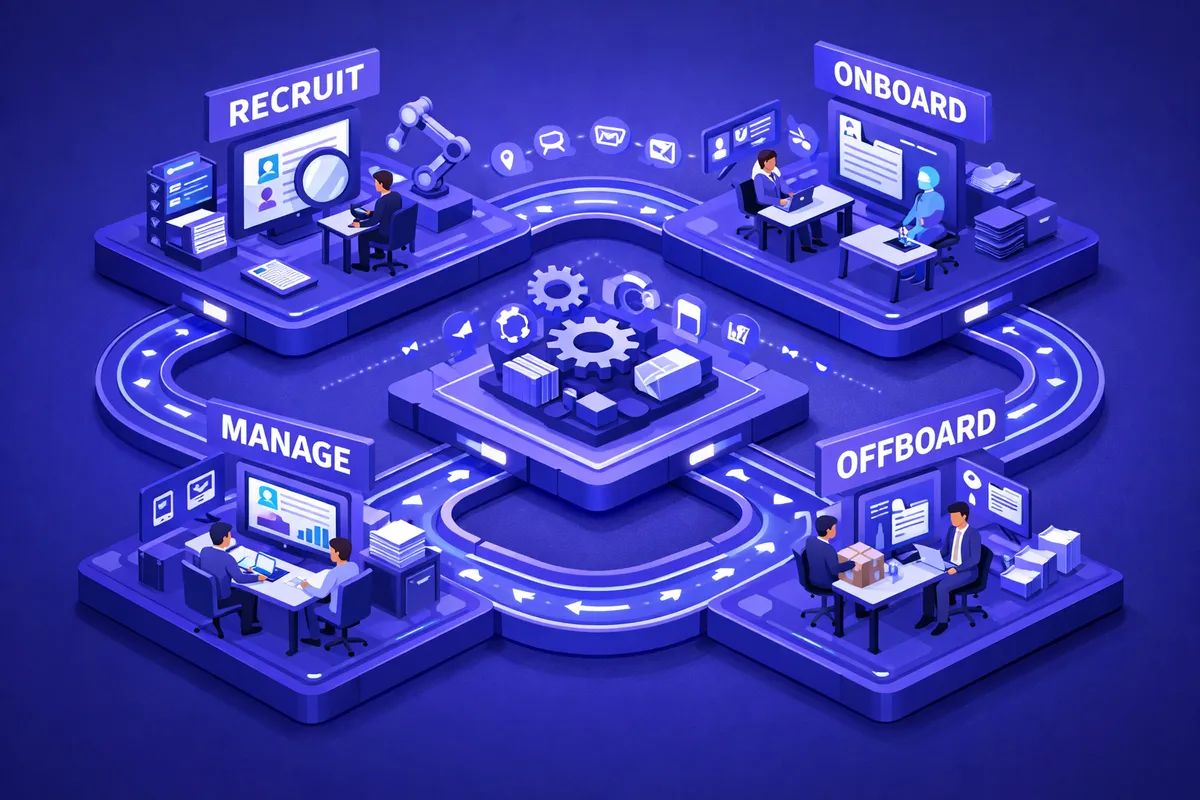
How AI Hiring Automation Works
AI hiring automation addresses each stage of the recruitment pipeline with targeted intelligence rather than brute-force keyword matching. The technology stack typically combines a large language model for reading free-form resume content, a supervised ranking model trained on your historical outcomes, and a workflow engine that orchestrates scheduling and communication.
Resume analysis. Natural language processing analyzes resumes and applications against your actual requirements. Instead of matching keywords like "project management," the AI evaluates relevant experience depth, skill progression, career trajectory, and contextual signals that indicate capability. A candidate who led a team through a product launch demonstrates project management experience even if those exact words never appear on their resume. Modern systems also parse LinkedIn profiles, GitHub contributions, and portfolio links to build a fuller picture than a resume alone can convey.
Candidate ranking. Machine learning models trained on your historical hiring data identify the patterns that predict successful hires in your organization. Which backgrounds lead to long tenure? Which skills correlate with high performance? Which career trajectories predict rapid growth? The model learns what great looks like at your company specifically, not at companies in general. The output is typically a calibrated score between 0 and 100, with confidence intervals that tell recruiters which candidates are worth a deeper human review versus which ones the model is certain about.
Pipeline orchestration. AI coordinates the logistics that slow hiring down. Scheduling, communication, feedback collection, and status updates happen automatically. Candidates receive timely updates. Interviewers get preparation materials including the candidate's resume, role requirements, and suggested questions tied to the competencies they are evaluating. Hiring managers see real-time pipeline status with stage conversion rates so they know where to intervene.
We build these systems as custom AI solutions that integrate with your ATS and reflect your unique hiring criteria. Generic screening tools apply generic standards. Your model reflects your team and culture, trained on your own outcome data.
Key Features and Capabilities
Intelligent resume screening. AI evaluates resumes holistically, assessing experience relevance, skill depth, and career trajectory. Candidates are ranked by fit, not filtered by keyword matches that miss strong applicants. The system processes 1,000 resumes in the time it takes a recruiter to read five, with more consistent evaluation criteria. A typical deployment reduces the manual screening load from 40 hours per 500 applicants to under 2 hours of spot-check review on the top 50.
Bias reduction safeguards. AI models are configured to evaluate qualifications without considering demographic information. Names, addresses, graduation years, and other demographic proxies are masked during evaluation. Regular bias audits ensure the system promotes fair evaluation across all candidate populations. This is not just ethical. It expands your talent pool by surfacing qualified candidates who might be overlooked by human reviewers. The failure mode to watch for is proxy bias, where the model learns to use ZIP code or alma mater as a stand-in for demographic signals. Good systems test for this explicitly and retrain when disparate impact appears.
Automated interview scheduling. AI coordinates availability across candidates and interviewers, sends calendar invitations, and manages rescheduling. No back-and-forth emails. No scheduling conflicts. The system accounts for time zones, interviewer preferences, and required panel composition. What typically takes 45 minutes of coordinator time per candidate happens instantly. Tools like Goodtime, Paradox, and custom agents built on top of Google Calendar and Zoom APIs handle the orchestration.
Structured feedback collection. After each interview, the system prompts evaluators with structured rubrics tied to the role's key competencies. AI aggregates and summarizes panel feedback, highlighting consensus and flagging disagreements. Hiring managers see a clear picture of each candidate instead of sorting through inconsistent notes. The rubric itself is the underrated piece. A good AI hiring system forces you to define what you are actually measuring before you start measuring it.
Pipeline analytics. Real-time dashboards show time-to-hire, stage conversion rates, source effectiveness, and diversity metrics. AI identifies bottlenecks and recommends process improvements. If candidates consistently drop out between phone screen and on-site interview, the system flags the gap and suggests schedule compression. If your referral source produces candidates with 2x the offer acceptance rate but 0.5x the retention, the dashboard makes that visible so you can rethink the incentive.
Candidate experience automation. Every candidate receives consistent, professional communication regardless of pipeline volume. Acknowledgment emails, status updates, interview confirmations, and follow-ups happen automatically. Rejected candidates get personalized feedback rather than silence, protecting your employer brand. Glassdoor and Comparably scores improve measurably within two quarters of deploying a mature candidate communication system, and the spillover affects your ability to close future candidates who research you before accepting.
The Screening Quality Problem
Traditional resume screening has a fundamental accuracy problem. Studies show that human reviewers agree on candidate quality only 60 percent of the time when evaluating the same resume independently. That means nearly half of screening decisions are inconsistent. The same resume, reviewed by the same recruiter, produces different decisions depending on whether it is resume number 8 or resume number 180 that day.
AI screening does not eliminate subjectivity, but it applies consistent criteria across every application. The same standards evaluate the first resume at 8 AM and the 200th resume at 5 PM. Fatigue, mood, and recency bias do not affect AI evaluation the way they affect human reviewers. The practical implication for a 500-applicant role is that you move from "maybe 40 of them got a real look" to "all 500 got a real look, and the top 50 got prioritized for human review." That shift alone produces measurably better hiring outcomes, independent of any gains from better ranking.
This consistency matters most for high-volume roles. When you receive 500 applications for a customer service position, the difference between AI screening and human screening is not just speed. It is the number of qualified candidates who actually get evaluated thoroughly rather than skimmed and discarded. For an enterprise sales role that receives 80 applications, the gain is smaller but still real. For an executive search with 15 candidates, the AI plays a different role as a structured note-taker rather than a filter.
Building Your Hiring Model
Custom AI hiring automation starts with your definition of success. This is not a generic model. It learns from your organization's specific patterns. The build sequence matters because skipping steps produces models that perform well on test data and fail in production.
Step 1: Define success metrics. What makes a great hire at your company? First-year retention? Performance review scores? Promotion velocity? Time-to-productivity? The model needs concrete outcomes to learn from, not vague notions of culture fit. A good starting point is a weighted composite of 12-month retention, first performance review rating, and manager satisfaction score at month 6.
Step 2: Analyze historical data. We examine your past hires, including both successful and unsuccessful outcomes. The model identifies patterns in backgrounds, skills, and experience that correlate with strong performance. This analysis often reveals surprising insights about what actually predicts success versus what hiring managers assume predicts success. One client discovered that candidates with non-traditional career paths had 34 percent better 2-year retention than candidates who fit the assumed profile. Their hiring criteria had been filtering out the people most likely to stay.
Step 3: Train and validate. The model trains on your historical data and validates against known outcomes. If it correctly identifies your top performers from their initial applications, it can identify similar patterns in new candidates. We use a holdout set representing the most recent 20 percent of hires to confirm the model generalizes, not just memorizes.
Step 4: Deploy with oversight. The AI ranks candidates, but your recruiters and hiring managers make final decisions. Human judgment remains essential for assessing interpersonal dynamics, cultural contribution, and intangible qualities that data cannot capture. The AI acts as a force multiplier, not a replacement.
Integration With Your Existing Tools
AI hiring automation connects to your applicant tracking system. Greenhouse, Lever, Workday, BambooHR, Ashby, or a custom ATS all integrate through standard APIs or Zapier-style middleware. Job boards and career pages feed applications directly into the AI screening pipeline. The integration depth varies. A lightweight build reads from the ATS and writes back scores and notes. A deeper build replaces the native ATS screening workflow entirely with a custom stage logic.
The hiring system connects with your HRIS, background check providers, offer letter tools, and onboarding platforms. When a candidate accepts, their data flows seamlessly into your employee systems without manual re-entry. This matters because the average new hire has their name and email retyped into 6 different systems during onboarding, each one a chance to introduce a typo that breaks payroll or benefits enrollment.
For businesses building their digital presence to attract talent, a strong careers site is a force multiplier that the AI cannot replace. Our website design and brand identity teams build career pages that convert the right applicants, and our SEO services help those pages rank for the role-specific queries that top candidates actually search.
Ethical Considerations in AI Hiring
AI hiring tools carry real ethical responsibilities. Bias in training data can perpetuate or amplify existing hiring disparities. We address this through multiple safeguards.
Demographic masking. The AI evaluates qualifications, experience, and skills. Names, photos, graduation years, and addresses are excluded from the scoring model. School names can be included or masked depending on the role, because elite school bias is a known failure mode.
Regular bias audits. Monthly analysis compares screening pass rates across demographic groups. Statistically significant disparities trigger model review and recalibration. We calculate four-fifths rule compliance on gender and race at each stage of the pipeline and flag deviations.
Compliance alignment. AI hiring tools must comply with emerging regulations including NYC Local Law 144 which requires bias audits for AI hiring tools, the EU AI Act which classifies AI hiring as high-risk, Illinois AI Video Interview Act, Maryland facial recognition consent rules, and EEOC guidance on AI-related discrimination. We build compliance into the system from day one, including documentation that satisfies the annual audit requirements.
Transparency. Candidates can request information about how AI was used in evaluating their application. The system maintains explainability so screening decisions can be justified with specific criteria, not a black-box score.
Why Build Custom vs. Off-the-Shelf
Generic AI screening tools apply the same model across tech companies, healthcare, retail, and manufacturing. They do not understand that your senior engineer role values open-source contributions more than Fortune 500 experience. They cannot factor in your team's specific collaboration style or technical stack. Tools like HireVue, Paradox, and Eightfold do solid work for large enterprises with thousands of annual hires, but they struggle with roles that have fewer than 50 historical data points to calibrate against.
Custom AI hiring automation learns from your successful hires and your company's definition of quality. It adapts to each role's unique requirements. The model for screening sales candidates looks fundamentally different from the model for engineering candidates, even within the same organization. For a 40-person company hiring 20 people a year, a generic tool costs $30,000 to $60,000 annually and delivers average results. A custom build costs $25,000 to $50,000 once, runs on $1,500 a month, and improves every quarter as your data accumulates.
What to Do Next
If you are hiring at volume and still doing manual resume review, start with a two-week audit. Pull the last 12 months of hiring data, label outcomes with retention and performance markers, and see whether the patterns are legible enough to train a model. If the data is messy, the first project is cleaning it, not automating on top of broken inputs. If the data is clean, a pilot on one role family, typically your highest-volume role, produces a proof point within 60 days.
If you hire for fewer than 10 roles a year, full AI automation is overkill. Focus instead on structured rubrics, bias-aware scorecards, and one or two workflow automations like scheduling and feedback collection. The AI layer can come later when volume justifies it.
Frequently Asked Questions
How much does AI hiring automation cost?
Custom AI hiring automation projects range from $15,000 to $60,000 depending on the number of roles, application volume, integration complexity, and depth of AI screening features. Companies hiring for 5 to 10 roles at a time fall on the lower end. High-volume recruiters processing thousands of applications monthly require more investment. Ongoing model maintenance runs $1,500 to $3,000 monthly, which covers retraining, bias audits, and infrastructure.
How long does implementation take?
Most AI hiring automation projects launch within 8 to 12 weeks. ATS integration and data collection take two to three weeks. Model training on historical hiring data requires three to four weeks. Testing with live applications runs for two to three weeks before full deployment. Your team will be using AI-assisted screening within three months.
What data do I need to get started?
Historical hiring data is the foundation including resumes received, interview outcomes, offers made, and employee performance after hire. At least 100 completed hire cycles give the model enough patterns to learn from. Job descriptions, evaluation rubrics, and any existing screening criteria accelerate the training process. If you have fewer than 100 completed hires, we can supplement with role-specific industry data while your proprietary data accumulates, then retrain once you cross the threshold.
Will this replace my recruiters?
No. AI handles high-volume screening, scheduling logistics, and data aggregation. Your recruiters focus on relationship building, cultural assessment, candidate experience, and closing offers. AI makes each recruiter effective enough to manage a larger pipeline without sacrificing quality. The human judgment in hiring remains essential for assessing qualities that data alone cannot capture, particularly at the final-round stage.
How do I measure ROI from AI hiring automation?
Track time-to-hire reduction, typically 30 to 50 percent faster. Measure cost-per-hire decrease. Track quality-of-hire improvement through first-year retention and performance review scores. Measure recruiter productivity in candidates processed per recruiter per month. Also measure offer acceptance rates, because faster processes and better candidate experience improve close rates. Most companies see measurable improvement within the first hiring cycle after deployment.
How does AI hiring automation handle niche or specialized roles?
For specialized roles with limited historical data, the model combines your company-specific patterns with role-specific industry data. The AI also weights transferable skills more heavily for niche positions where exact experience matches are rare. As you make hires in specialized roles, the model incorporates those outcomes and improves over time. For truly unique roles where you have made fewer than 5 hires, the AI still adds value on scheduling and feedback aggregation even if the ranking model needs more data to be reliable.