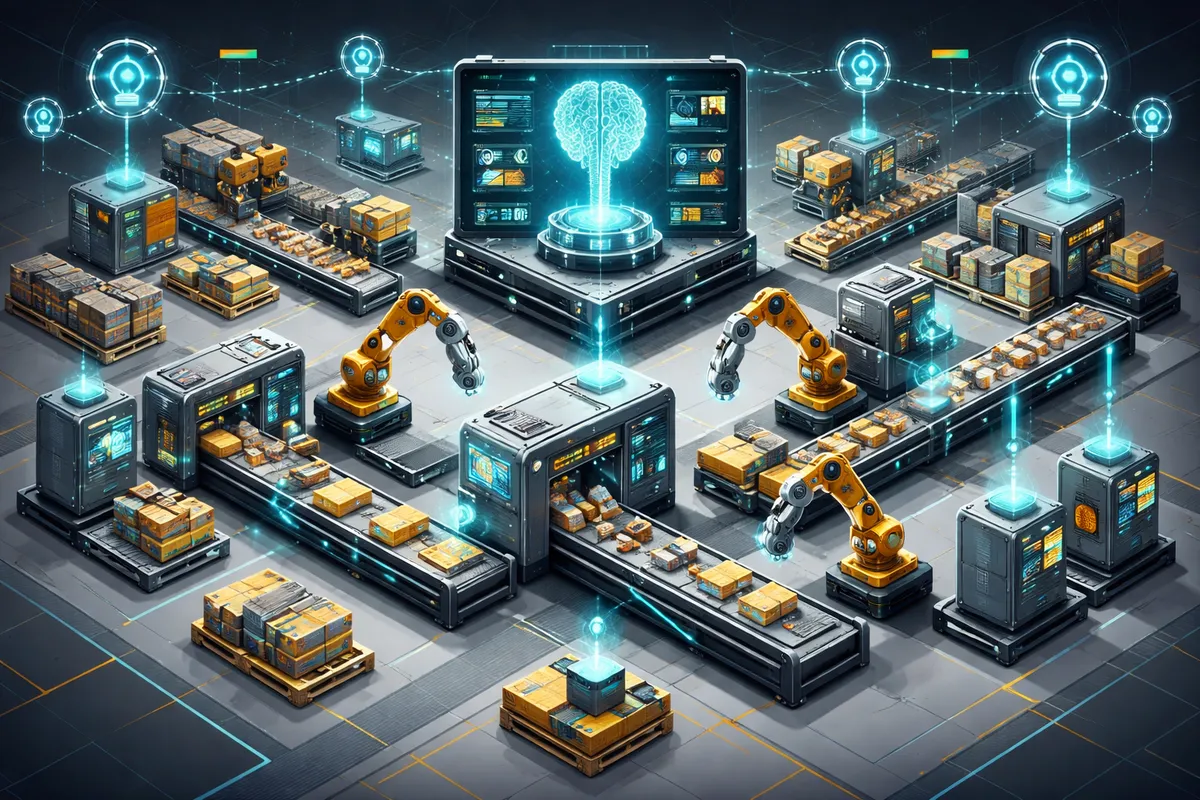
Key AI Applications for Manufacturing
- Predictive Maintenance: AI analyzes equipment sensor data to forecast failures before they happen. Reduces unplanned downtime by 30 to 50 percent and extends equipment life.
- AI Visual Inspection: Computer vision systems inspect 100 percent of production output at line speed. Catches defects humans miss and reduces scrap rates by 20 to 40 percent.
- Production Optimization: Machine learning models generate optimal schedules balancing orders, capacity, materials, and labor. Adapts in real time to disruptions.
- Supply Chain Intelligence: AI monitors supplier data, predicts delivery delays, and recommends alternative sourcing. Keeps production flowing when supply chains get volatile.
- Energy Consumption Optimization: AI analyzes production patterns and equipment usage to reduce energy costs by 10 to 25 percent without affecting output.
Our Approach to AI in Manufacturing
We start on the floor. Every manufacturing environment is different. The sensors available, the data infrastructure in place, the production challenges that matter most. Our discovery phase maps your equipment, data sources, and operational bottlenecks before we propose any technology. A typical discovery includes a two-day site visit, interviews with maintenance, quality, and production leads, a sensor audit, and a ranked list of AI use cases with projected dollar impact per asset.
Implementation follows a pilot model. We deploy AI on one line or one process first. Prove the value over 60 to 90 days. Measure the impact against a baseline captured before deployment. Then expand systematically across the facility. This approach minimizes risk and builds internal buy-in from operators and management alike. A predictive maintenance pilot on three critical assets that prevents one 12-hour outage pays for the entire first phase. Learn more in our guide on how to implement AI in small business.
We work with your existing infrastructure. PLCs, SCADA systems, MES platforms, ERP systems, historians like OSIsoft PI and AVEVA. AI connects to the data sources you already have. No rip-and-replace. No proprietary hardware lock-in. For clients who need a customer-facing portal to share production status or a supplier portal to exchange forecasts, we add website design that reads the same data layer driving the factory.
Common Failure Modes to Avoid
The biggest manufacturing AI failure is starting with the wrong asset. Teams often deploy predictive maintenance on the most expensive machine in the facility because they assume bigger equipment equals bigger savings. But if that machine is already over-maintained, the AI has nothing to catch. Start with assets that have the highest ratio of unplanned downtime to total run hours, not the highest price tag.
The second is ignoring operator knowledge. A 22-year machinist knows the sound of a failing gearbox better than any algorithm for the first year. The best AI programs capture that tacit knowledge through structured interviews and use it as ground truth for model training. Facilities that treat their operators as data sources outperform facilities that treat them as obstacles.
The third is deploying AI without a clear escalation path. A predictive maintenance alert that sits in a dashboard nobody checks is worthless. The alert has to reach the right maintenance tech on their phone or tablet with a clear action and a 24-hour response window. Build the notification and workflow path before you build the model.
Results You Can Expect
Manufacturing clients implementing our AI solutions see measurable operational improvements.
- 30 to 50 percent reduction in unplanned equipment downtime
- 20 to 40 percent decrease in defect and scrap rates
- 15 to 25 percent improvement in overall equipment effectiveness (OEE)
- 10 to 20 percent reduction in maintenance costs
- 10 to 25 percent decrease in energy consumption per unit produced
- 5 to 12 percent lift in throughput from smarter scheduling
Your specific results depend on equipment age, current monitoring capabilities, and production complexity. We establish clear baselines during the pilot phase and report against them monthly.
How to Evaluate Your Options
Before selecting a manufacturing AI vendor, work through five questions. Does the platform run at the edge or only in the cloud? Critical control loops need edge inference with under 50ms latency. A cloud-only vendor will not work for closed-loop quality control. Does it integrate with your historian and MES natively? If you are on Rockwell FactoryTalk or Siemens WinCC and the vendor only supports generic OPC UA, budget extra for middleware.
Who owns the models? Vendors that retain the trained models as IP will hold your operation hostage at renewal. Demand model portability in writing. What is the data gravity? AI models for predictive maintenance pull significant sensor data. If your facility has unreliable connectivity, design for local caching and scheduled sync. Finally, what is the support SLA? A predictive maintenance alert at 2 a.m. on a Sunday needs a response path. Vendors offering 8-by-5 support are not ready for 24-by-7 operations.
Pilot one use case on one line for 90 days. Measure against baseline. If the payback period is under 14 months and the operators trust the system, expand.
Frequently Asked Questions
### How much does AI implementation cost for manufacturing? Manufacturing AI projects typically range from $20,000 to $100,000 for initial deployment. A predictive maintenance pilot on a single production line with 3 to 5 critical assets starts at $22,000 to $30,000 including sensor additions if needed. Facility-wide implementations with visual inspection, production optimization, and supply chain intelligence across a plant doing $30M to $80M in revenue sit closer to $75,000 to $100,000. ROI from downtime reduction and quality improvements typically exceeds the investment within 6 to 12 months.
### How long does it take to see ROI from AI in manufacturing? Predictive maintenance pilots show measurable downtime reduction within 60 to 90 days as models learn your equipment patterns. The first prevented outage often covers the entire pilot cost. Visual inspection delivers immediate defect detection improvements upon deployment, with scrap reduction visible in the first full production week. Full production optimization ROI typically materializes within 4 to 6 months as the system accumulates enough operational data across product mix, shift patterns, and seasonal demand.
### Do I need a large dataset to use AI in my manufacturing facility? You need data, but probably less than you think. If your equipment has sensors generating readings, even basic ones like temperature, vibration, motor current, and cycle counts, that is enough to start predictive maintenance. Three to six months of production data provides a solid foundation for scheduling optimization. Visual inspection needs 500 to 2,000 labeled defect images to reach production accuracy, which we collect during the pilot. We assess your data readiness during discovery and recommend any sensor additions if needed, typically $150 to $800 per asset for retrofit vibration and temperature sensors.
### Can AI integrate with my existing manufacturing systems? Yes. We integrate with Siemens, Rockwell Allen-Bradley, Mitsubishi, and FANUC PLC and SCADA systems. We connect with MES platforms like Plex, Epicor, IQMS, and Tulip. We work with ERP systems including SAP, Oracle, NetSuite, and Microsoft Dynamics. Historians like OSIsoft PI, AVEVA, and Ignition feed directly into the AI layer. Data flows from your existing infrastructure over OPC UA, MQTT, or native API. No proprietary hardware required.
### How do we handle cybersecurity on the factory floor? Every deployment follows ISA/IEC 62443 principles. AI inference runs on segmented OT networks, not on the same subnet as your IT environment. Data moving between OT and cloud is encrypted in transit and at rest, and authentication uses certificate-based identity rather than shared credentials. We document the full security architecture in the statement of work and support your audit team during reviews.
### What is the first step to implementing AI in manufacturing? Start with a facility assessment. We will tour your operation, review your data infrastructure, and identify the highest-impact AI application for your specific environment. You will leave the visit with a written opportunity map showing projected savings by use case and a recommended pilot plan. Then we will scope a pilot that proves value before you commit to broader deployment. Contact us to schedule your assessment.