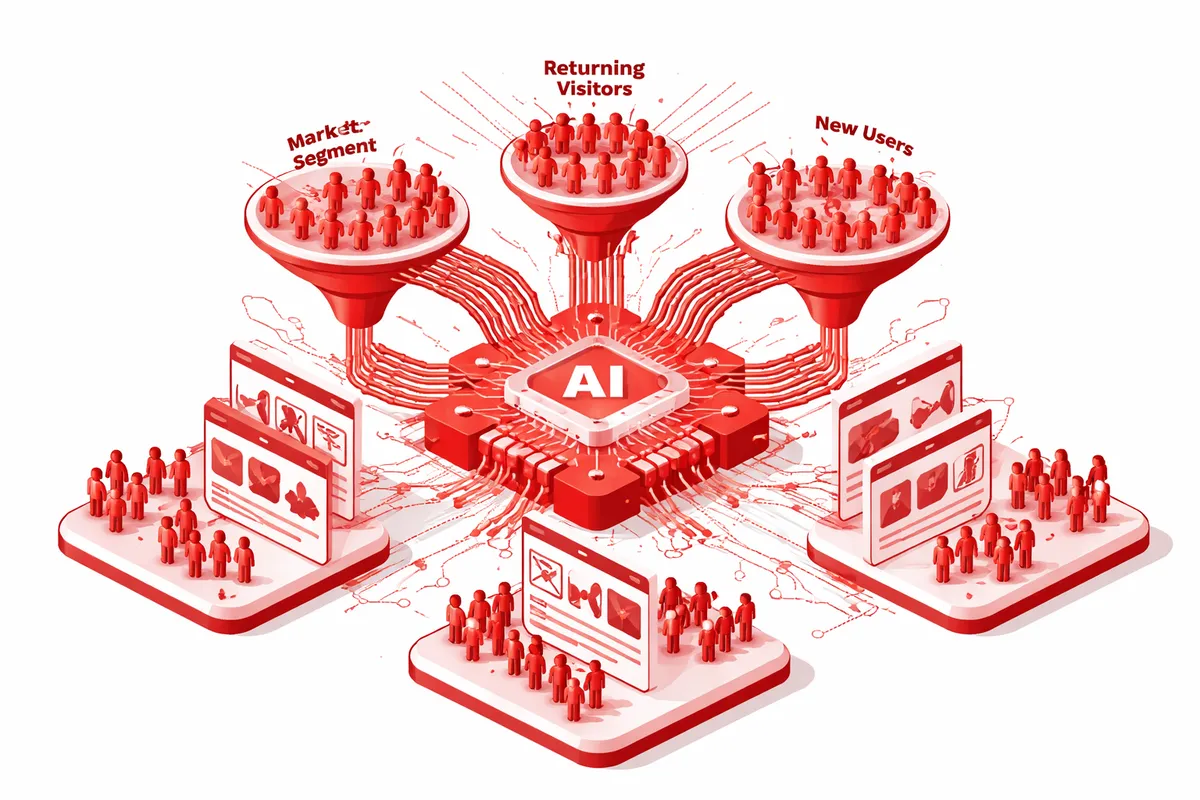
How AI Customer Segmentation Works
Machine learning algorithms analyze behavioral data across every customer touchpoint. Purchase patterns, browsing behavior, support interactions, email engagement, product usage, social activity, and referral behavior all feed the model.
Clustering algorithms identify natural groupings. Rather than you defining segments based on assumptions ("customers who spend over $500 are premium"), the AI discovers groups that share meaningful behavioral patterns. K-means clustering, DBSCAN, and hierarchical clustering methods test different grouping approaches and identify the segmentation that produces the most distinct, actionable groups.
The algorithm might discover that your most valuable segment is not defined by spend at all. It might be customers who purchase within 48 hours of opening an email, refer at least one other customer per year, and primarily buy from a specific product category. That segment has a lifetime value 4 times higher than average, but no manual segmentation would have identified them because the defining characteristics cross multiple data dimensions.
Behavioral sequences reveal intent. AI does not just look at what customers did. It analyzes the sequence and timing of their actions. A customer who visits your pricing page, then reads three case studies, then returns to pricing two days later is showing a specific buying signal pattern. A customer who visits pricing, then leaves and does not return for a month is showing a different pattern. These behavioral sequences predict future actions with much higher accuracy than individual data points.
Dynamic segmentation updates in real time. Unlike static rule-based segments that only change when you manually update the rules, AI segments evolve as customer behavior changes. A dormant customer who re-engages gets reclassified in real time, triggering the appropriate reactivation marketing sequence. A first-time buyer who exhibits high-value behavioral signals immediately enters a premium nurture track rather than waiting months to be manually reclassified.
We build these insights into custom AI solutions that connect segmentation directly to your marketing, sales, and product workflows. Segments are not just reports. They drive action.
Key Capabilities in Detail
Behavioral Clustering
AI identifies natural customer groups based on actual behavior patterns, not predefined rules. The system discovers segments your team has never considered, each with distinct needs and value profiles.
A typical analysis for an e-commerce business with 10,000 customers might reveal 8 to 12 distinct behavioral segments. Examples of segments AI commonly discovers.
The researcher. Browses extensively, reads reviews and comparison content, adds items to cart but delays purchase by 7 to 14 days. Responds to educational content and limited-time offers that create urgency.
The impulse loyalist. Purchases within minutes of opening a promotional email. Buys frequently but in small amounts. Responds to flash sales and new product announcements. Has high lifetime value despite low individual order values.
The seasonal cyclical. Purchases once or twice per year in predictable patterns (holidays, annual renewals, seasonal needs). Between cycles, appears inactive but is not churned. Respond to reminders timed to their specific cycle.
The silent advocate. Purchases regularly but never engages with marketing content. However, refers other customers at high rates. Their value is not in direct revenue growth but in acquisition cost reduction through referrals.
Each segment gets a distinct marketing strategy, messaging approach, and channel mix optimized for their specific behavior pattern.
Predictive Lifetime Value
Machine learning calculates expected lifetime value (LTV) for each customer and segment based on behavioral patterns, not just historical spend. The model factors in purchase frequency trends, average order value trajectory, engagement decay rates, and industry benchmarks for retention curves.
This enables smarter resource allocation. If Segment A has an average predicted LTV of $12,000 and Segment B has an average of $2,500, you can justify spending 4 times more on acquisition and retention for Segment A customers. Traditional segmentation might lump both into "active customers" and spend equally on both.
Predictive LTV also identifies customers whose trajectory is shifting. A customer whose engagement and purchase frequency are declining may still look like a "good customer" by historical spend, but the model predicts they are on a churn trajectory. Intervention now costs far less than winning them back later.
Churn Prediction by Segment
Not all churn looks the same. AI identifies which segments are at highest risk and what signals precede departure for each group.
For subscription businesses, the system might identify that Segment A churns when login frequency drops below twice per month and support tickets increase. Segment B churns when they stop opening email newsletters and their feature usage shifts to basic functionality only. Segment C churns after exactly 90 days if they have not been contacted by a customer success rep.
Each churn pattern requires a different intervention strategy. Generic "we miss you" emails are a waste. Segment-specific interventions based on actual churn predictors convert at 3 to 5 times the rate of broad retention campaigns.
Segment-Specific Insights and Narratives
AI generates narrative explanations of what makes each segment unique: their preferences, purchase triggers, timing patterns, content affinities, and channel preferences. Your marketing team understands the "why" behind each group, not just the statistical definition.
Instead of telling your team "Segment 3 has a 23% higher conversion rate on email," the system explains that Segment 3 consists primarily of mid-career professionals who purchase during lunch breaks (11 AM to 1 PM), respond to case study content featuring companies in their industry, and convert best when offered free trials rather than discount codes.
That narrative gives your creative team enough context to craft genuinely resonant campaigns rather than slightly adjusted versions of one generic message.
Integration With Your Marketing Stack
AI segmentation feeds directly into your marketing automation platform, CRM, and advertising tools. Segments sync to Mailchimp, Klaviyo, HubSpot, or ActiveCampaign for targeted campaigns. Custom audiences push to Facebook, Google, and LinkedIn ad platforms for segment-specific advertising.
Through our workflow automation services, segmentation data flows into every system that touches customers.
Email marketing. Segments trigger specific email sequences. New members of a high-value segment enter a premium onboarding flow. Customers showing churn signals enter a retention sequence. The content, timing, and frequency of emails adapt to each segment's engagement preferences.
Website personalization. Your website displays different content, offers, and CTAs based on visitor segment. A returning high-value customer sees loyalty rewards. A researcher sees comparison content and reviews. A price-sensitive browser sees value propositions and social proof.
Paid advertising. Custom audiences built from segments improve ad targeting precision. Instead of targeting broad demographics, you target behavioral lookalikes of your highest-value segments. Cost per acquisition typically drops 20 to 40% with segment-informed targeting.
Customer success. Support teams see segment context on every ticket. A high-LTV customer gets prioritized response. A customer in a churn-risk segment gets proactive outreach. Our CRM and martech consulting ensures these integrations work across your entire tool stack.
Measuring the Impact of AI Segmentation
Track these metrics to quantify the value of AI-powered segmentation versus your previous approach.
Campaign performance lift. Compare open rates, click rates, conversion rates, and revenue per recipient for segment-targeted campaigns versus your previous broad campaigns. Most businesses see 20 to 35% improvement in overall campaign performance within the first quarter.
Customer lifetime value trend. Track average LTV by segment over time. Segment-specific strategies should increase LTV in your highest-value segments and reduce churn in at-risk segments. A 10% LTV improvement across your top 20% of customers often represents the largest revenue impact.
Acquisition cost by segment. Measure cost per acquisition when using segment-informed targeting versus broad targeting. Lookalike audiences built from high-value segments consistently produce lower CPAs and higher customer quality.
Churn rate by segment. Monitor whether segment-specific retention strategies reduce churn in the segments where interventions were deployed. Compare churn rates in intervened-upon segments versus control groups (if possible) or historical baselines.
Revenue per email. This single metric often captures the most tangible impact. Revenue per email sent typically increases 25 to 50% when moving from broad to segment-targeted campaigns, because the right message reaches the right person at the right time.
Custom-Built vs. Off-the-Shelf Segmentation
Marketing platforms like Klaviyo, HubSpot, and Salesforce offer built-in segmentation. These tools segment by demographics, purchase recency, and engagement level. They are useful starting points and sufficient for businesses with straightforward customer bases.
They have limitations that matter as your needs grow. They segment based on the data within their own platform, missing signals from other sources. They use predefined algorithms that cannot be tuned to your specific business dynamics. They discover broad patterns but miss the non-obvious behavioral correlations that create competitive advantage.
Custom AI segmentation analyzes your complete customer dataset across every touchpoint. It finds patterns specific to your business and your market. The segments reflect your customers, not industry averages. The models can be tuned to prioritize the business outcomes you care most about (retention, upsell, referral, whatever drives your growth).
For businesses with fewer than 5,000 customers and a single primary sales channel, platform-native segmentation is often sufficient. For businesses with larger customer bases, multiple channels, and diverse product lines, custom segmentation delivers insights that generic tools cannot. Our predictive analytics capabilities extend segmentation into forecasting, helping you anticipate segment behavior rather than just reacting to it.
Frequently Asked Questions
### How much does AI customer segmentation cost? Custom AI customer segmentation projects range from $12,000 to $50,000 depending on the number of data sources, customer base size, and depth of analysis required. Businesses with a single primary data source (e-commerce transactions, for example) fall on the lower end. Multi-channel businesses with complex customer journeys and diverse data sources require more investment. Ongoing model maintenance typically runs $2,000 to $5,000 per quarter.
### How long does implementation take? Most AI segmentation projects deliver initial insights within 6 to 10 weeks. Data integration and cleaning take two to three weeks. Model training and clustering analysis require three to four weeks. Validation, visualization, and integration into your marketing tools complete the project. You will have actionable segments driving campaigns within three months.
### What data do I need to get started? You need customer transaction data (purchases, order values, frequency) and at least one behavioral data source (website activity, email engagement, app usage, or support interactions). A minimum of 1,000 active customers provides enough data for meaningful segmentation. More data sources and larger customer bases produce richer, more granular segments. The ideal starting dataset includes 12 months of transaction history and six months of behavioral data.
### Will this replace my existing segmentation? It evolves your segmentation. Your current segments continue to work while AI segments are validated alongside them. Most businesses find that AI uncovers 2 to 3 segments they never identified manually, often with significant revenue implications. Over time, AI-driven segments replace static rules because they are more precise and update automatically as customer behavior shifts. The transition is gradual, not a sudden switch.
### How do I measure ROI from AI customer segmentation? Track campaign performance by segment: open rates, click rates, conversion rates, and revenue per customer. Compare segment-targeted campaigns against your previous broad campaigns. Also measure customer lifetime value trends and churn rate by segment. Most businesses see a 20 to 35% improvement in campaign performance within the first quarter of segment-targeted marketing. The revenue impact depends on your customer base size and average order value, but a business with $2M in annual revenue typically sees $200,000 to $400,000 in incremental revenue from improved segmentation within the first year.
### Can AI segmentation work for B2B businesses? Yes, though the data inputs differ. B2B segmentation uses account-level data: company size, industry, tech stack, contract value, usage patterns, support ticket volume, and expansion signals. The segments describe account types rather than individual consumers. A common B2B discovery is identifying which account characteristics predict expansion revenue versus which predict churn, allowing customer success teams to prioritize their outreach based on predicted outcomes rather than gut feel.