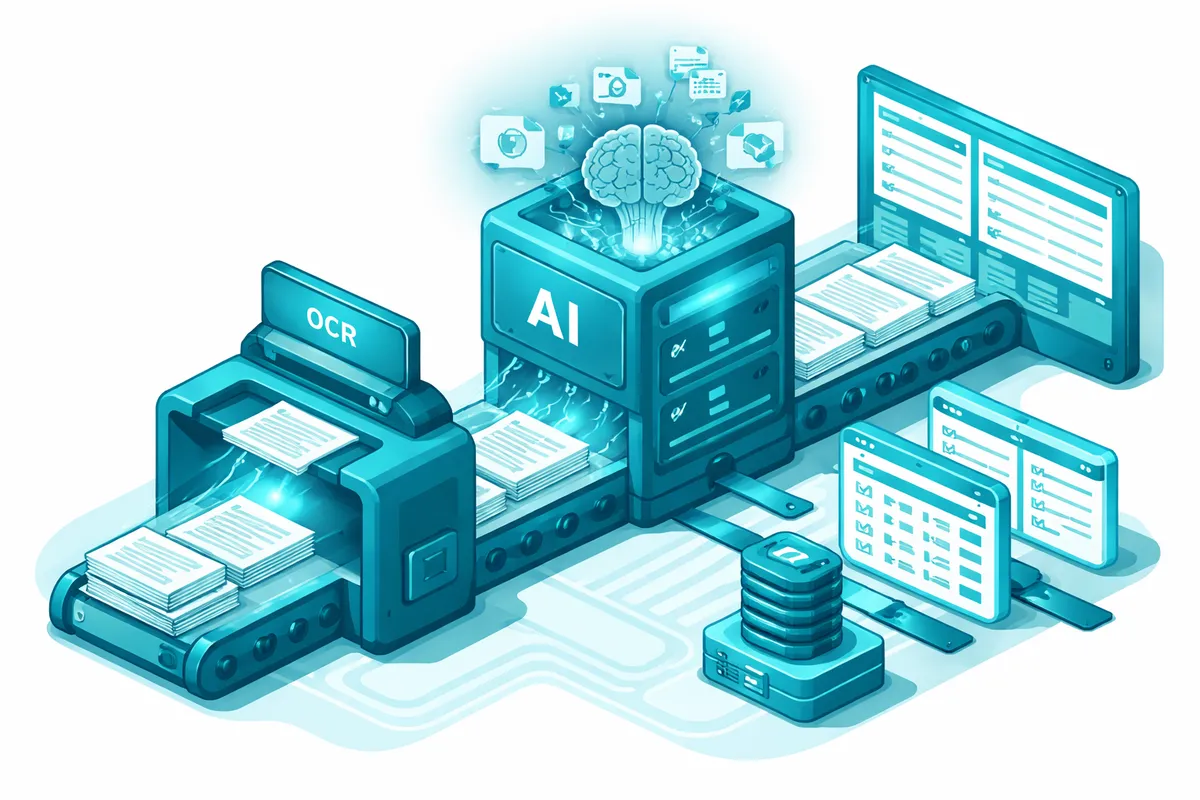
How AI Contract Analysis Works
AI contract analysis uses three layers of technology to transform unstructured legal documents into structured, actionable intelligence.
Document ingestion and OCR. The system accepts contracts in any format: PDF, Word, scanned images, even photographs of signed documents. Optical character recognition converts non-digital documents into machine-readable text. Modern OCR handles handwritten annotations, stamps, and poor-quality scans with 95%+ accuracy.
Natural language processing and extraction. NLP models trained on legal language read contract text and identify clauses, obligations, rights, and risks. The system maps every provision to a structured framework: payment terms, liability limits, termination conditions, IP ownership, confidentiality requirements, governing law, and 40 to 60 other standard clause categories depending on contract type.
This is not keyword matching. The system understands legal meaning. It identifies an indemnification clause whether it is titled "Indemnification," "Hold Harmless," or embedded within a broader liability section without a heading. It recognizes that "Net 30" and "payment due within thirty (30) calendar days of invoice receipt" express the same obligation.
Machine learning comparison and scoring. ML models compare each contract against your standard templates and flag deviations. The system learns which deviations your team typically accepts and which they reject, reducing noise in future reviews. After processing 50 to 100 of your contracts with human feedback, the system's risk scoring aligns closely with your legal team's judgment.
We build these tools as part of our AI document processing services, trained on your specific contract types, industry terminology, and risk tolerance. A SaaS vendor agreement requires different analysis than a construction subcontract or an employment agreement.
Key Capabilities in Detail
Automated Clause Extraction
AI identifies and categorizes every key clause across your contract portfolio. For a standard commercial agreement, the system extracts 30 to 50 distinct data points.
Payment terms: net days, currency, late payment penalties, price escalation mechanisms. Termination provisions: for cause triggers, convenience termination notice periods, survival clauses. Indemnification: scope, caps, carve-outs, defense obligations. Limitation of liability: aggregate caps, per-incident caps, exclusions for IP infringement or willful misconduct. Confidentiality: definition scope, duration, permitted disclosures, return or destruction requirements. IP rights: ownership of work product, license grants, pre-existing IP carve-outs. Governing law and dispute resolution: jurisdiction, arbitration versus litigation, venue.
All extracted data flows into a structured database. Instead of reading pages of legal text, your team sees a dashboard showing every material term across every contract. Filter by clause type, risk level, counterparty, or expiration date.
Risk Scoring
Each contract receives a risk score based on three factors. Deviation from your standards (how different is this contract from your approved template). Unusual provisions (clauses that appear in fewer than 10% of your contracts may warrant extra scrutiny). Missing protections (standard clauses that your template includes but this contract lacks).
Risk scores are not binary pass/fail. The system assigns granular scores by clause category. A contract might score low risk on payment terms but high risk on liability limitations. This lets your legal team prioritize their review time on the specific provisions that matter.
One professional services firm reduced their average contract review time from 3.2 hours to 45 minutes by focusing human review on clauses flagged as medium or high risk. Low-risk contracts with scores below a defined threshold went through an expedited approval process.
Obligation Tracking and Calendar Management
The system extracts every obligation, deadline, and milestone from executed contracts. Automated alerts ensure nothing falls through the cracks: renewals, notice periods, delivery dates, payment schedules, compliance certifications, and reporting requirements.
This is where AI contract analysis delivers ongoing value beyond the initial review. A company with 300 active contracts might have 1,500 to 2,000 distinct obligations and deadlines spread across those agreements. No spreadsheet, no calendar, and no paralegal can reliably track that volume.
The system generates a unified obligation calendar. Upcoming deadlines surface 30, 60, and 90 days in advance. Renewal decisions trigger review workflows before auto-renewal windows close. Payment milestones sync with your accounting system through workflow automation integrations.
Bulk Portfolio Analysis
AI processes your entire contract library to identify patterns, exposure, and optimization opportunities across your portfolio.
Vendor consolidation. Identify overlapping vendor agreements, inconsistent pricing across similar services, and opportunities to consolidate spend. One company discovered they had 11 separate agreements with different divisions of the same parent company, each with different pricing and terms.
Risk exposure mapping. See your total liability exposure by clause type, counterparty, and contract category. Understand where your highest concentrations of risk sit and whether your insurance coverage aligns.
Term consistency analysis. Identify contracts where terms deviate significantly from your current standards. Prioritize renegotiation of the most unfavorable agreements at their next renewal.
Compliance scanning. When regulations change or your internal policies update, scan your entire portfolio for affected clauses. A GDPR update does not require manually reading every data processing agreement. The system identifies every contract with relevant data handling provisions in seconds.
Implementation: What the Process Looks Like
A typical AI contract analysis implementation follows five phases over 8 to 14 weeks.
Phase 1: Discovery (weeks 1-2). We inventory your contract types, review your standard templates and playbooks, understand your risk tolerance, and identify the highest-value use cases. This phase determines the scope and priorities for the build.
Phase 2: Document preparation (weeks 2-4). Your existing contract library is ingested into the system. OCR processes scanned documents. The system creates initial extractions that your team validates. This validation data trains the models on your specific language and standards.
Phase 3: Model training (weeks 4-8). Using validated extractions and your team's feedback, the AI learns your specific clause categories, risk thresholds, and deviation tolerances. We train separate models for each contract type if your portfolio is diverse.
Phase 4: Integration (weeks 8-12). The system connects to your document management platform, CRM, and internal tools. Review workflows, alert rules, and dashboard views are configured to match your team's processes.
Phase 5: Validation and launch (weeks 12-14). Your legal team runs the system in parallel with manual review for two weeks. Discrepancies are investigated and the model is refined. Once accuracy meets your threshold (typically 95%+ on key clause extraction), the system goes live.
Integration With Your Existing Tools
AI contract analysis connects to your document management system, CRM, and procurement platform. SharePoint, Google Drive, DocuSign, or a custom repository all serve as document sources. Extracted data flows into your existing tools through our workflow automation services.
Sales reps see risk flags in their CRM before sending a contract for signature. Procurement teams get obligation alerts in their project management tools. Finance receives payment term extractions in their accounting system. Legal dashboards display portfolio risk metrics alongside review queue status.
The system also integrates with e-signature platforms. When a new contract is executed in DocuSign or similar tools, it automatically enters the analysis pipeline. Extraction and risk scoring happen within minutes of signature, not weeks later when someone remembers to file it.
Custom-Built vs. Off-the-Shelf CLM Platforms
Generic contract AI tools like Ironclad, Kira Systems, or ContractPodAi offer broad capabilities. They handle common contract types well and provide reasonable extraction accuracy out of the box. For businesses with standard commercial contracts and straightforward review needs, they are a viable starting point at $500 to $2,000 per month.
They have limitations for businesses with specialized needs. They struggle with industry-specific language, custom clause structures, and unique business logic. They cannot encode your specific risk tolerance or your legal team's institutional knowledge about which deviations matter and which do not. A healthcare company's BAA requirements differ fundamentally from a construction company's lien waiver provisions.
Custom AI contract analysis trains on your contracts, your standards, and your team's review patterns. It speaks your industry's language and applies your rules. The investment is higher upfront but the accuracy and relevance are significantly better for specialized use cases.
For businesses processing fewer than 100 contracts per year with standard commercial terms, an off-the-shelf tool may be sufficient. For businesses with specialized contract types, high volumes, or complex risk requirements, custom solutions deliver ROI that generic tools cannot. Our custom AI solutions team can assess which approach fits your situation.
Frequently Asked Questions
### How much does AI contract analysis cost? Custom AI contract analysis systems range from $20,000 to $70,000 depending on the variety of contract types, volume of documents, and depth of analysis required. Businesses focusing on a single contract type (like vendor agreements) fall on the lower end. Organizations processing diverse contract portfolios with complex risk assessment and obligation tracking need more investment. Annual maintenance and model refinement typically runs 15 to 20% of the initial build cost.
### How long does implementation take? Most AI contract analysis projects launch within 8 to 14 weeks. Document collection and annotation take two to three weeks. Model training on your specific contract types and standards requires four to six weeks. Testing and validation with your legal team round out the timeline. Your team will be processing contracts with AI assistance within three months. Faster timelines are possible for single-contract-type implementations.
### What data do I need to get started? You need a collection of your executed contracts (at least 50 to 100 agreements of each type you want to analyze) and your standard templates or playbooks. Redlined versions showing your team's typical edits accelerate training significantly because they show the model which deviations your team negotiates versus accepts. Any existing clause libraries or risk matrices help the AI understand your standards faster.
### Will this replace my legal team? No. AI handles the time-consuming extraction, comparison, and flagging work that consumes 60% of a typical legal team's time. Your lawyers focus on judgment calls: negotiation strategy, risk assessment for novel provisions, and relationship management. AI reduces review time from hours to minutes, freeing your legal team to focus on high-value work instead of document processing. Most firms find they can handle 3 to 4 times the contract volume with the same team after implementation.
### How accurate is AI contract extraction? After training on 50 to 100 of your contracts with human validation, extraction accuracy typically reaches 92 to 97% for standard clause types. Novel or highly unusual provisions may require human review. The system improves over time as your team provides ongoing feedback. Accuracy is highest for clause types with consistent language patterns (payment terms, termination) and slightly lower for clauses with high variability (custom indemnification carve-outs).
### How do I measure ROI from AI contract analysis? Track contract review time reduction (typically 60 to 80% faster), risk incidents avoided (missed deadlines, unfavorable auto-renewals), legal team throughput (contracts reviewed per week), and deal cycle acceleration (time from contract receipt to execution). Also measure the dollar value of unfavorable terms caught that would have been missed in manual review. Most businesses achieve ROI within 4 to 6 months through time savings and risk reduction alone.