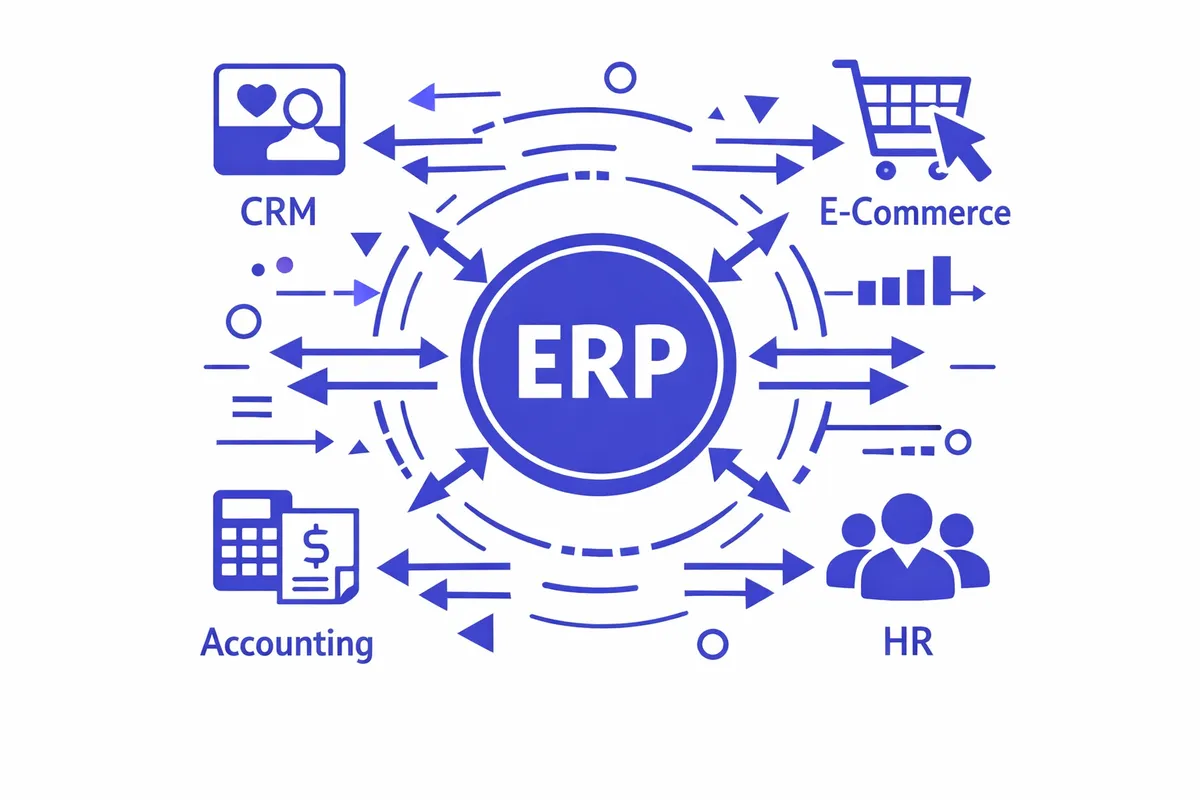
How We Build ERP Integration for Sioux Falls
We start by inventorying every system the business pays for. A typical Sioux Falls operator surfaces five to seven we expected and two we did not, including the spreadsheet on the office manager's hard drive that nobody else has access to but the entire operation depends on. We document what each system holds, who uses it, what it sends out, what it can take in, and how stale the data is when it crosses to the next system today.
From there we design the integration architecture. For most Sioux Falls SMBs the right answer is a lightweight integration layer (Fivetran, Workato, or a custom Python pipeline) with a small data warehouse on BigQuery or Postgres, plus direct system-to-system integrations where the volume justifies them. A roofing company on the East Side does not need a Snowflake warehouse. It needs ServiceTitan job data flowing into QuickBooks as proper invoices and class-coded expenses, plus a daily extract feeding a single Looker Studio dashboard. The architecture matches the operation.
We build the pipes, test against six months of historical data as a regression set, and ship with monitoring so any failed sync surfaces inside fifteen minutes. Every integration is documented for the actual person who has to administer it, which is usually the existing controller or operations manager, not a dedicated IT specialist.
Industries We Serve in Sioux Falls
Construction and Home Services Sioux Falls construction and home services operators across Brandon, Tea, Harrisburg, Crooks, and the East Side run on combinations of ServiceTitan, Jobber, Housecall Pro, BuilderTrend, Procore, QuickBooks, Sage 50, and a dozen marketing platforms. We build integrations that pull job-level data into proper class-coded accounting, push customer data into the marketing platform automatically, and feed a single owner dashboard from all of it. Construction season visibility lifts from monthly to daily.
Real Estate Sioux Falls brokerages, large agent teams, and developers run on combinations of MLS feeds, transaction management platforms (Dotloop, Brokermint), CRMs (Follow Up Boss, Sierra Interactive, kvCORE), Mailchimp or Constant Contact, and QuickBooks. We build integrations that move buyer leads from the website into the CRM with proper agent routing, sync transaction data into the brokerage's accounting, and trigger marketing automation against real activity rather than imported lists.
Specialty Healthcare Dental, ortho, chiropractic, PT, OB-GYN, and med spa practices along the Western Avenue corridor and 41st Street run on combinations of Open Dental, Dentrix, Eaglesoft, ChiroTouch, Jane App, QuickBooks, and various marketing tools. We build integrations that sync patient flow data with the marketing platform without HIPAA exposure, feed insurance ERA reconciliation into the accounting system, and produce daily owner dashboards from systems that currently do not talk.
Financial Services Sioux Falls insurance brokerages, wealth managers, mortgage brokers, accounting firms, and credit unions run on combinations of agency management systems, custodian platforms, Salesforce or HubSpot, document management, and QuickBooks or specialized accounting. We build integrations with the audit logging and access controls the SD Division of Insurance, FINRA, and the SEC expect for any system touching client data.
Senior Care Sioux Empire senior care operators running assisted living, memory care, home care, and hospice run on combinations of PointClickCare or MatrixCare, payor-specific portals, QuickBooks, and family communication platforms. We build integrations that move census data into billing automatically, reconcile Medicare and Medicaid receipts against the EHR, and surface occupancy and payor mix in real time.
Manufacturing and Professional Services Mid-market manufacturers in the Smithfield, Raven Industries, and Daktronics regional ecosystem run on combinations of QuickBooks Enterprise or Sage, shop floor systems, EDI partners, and CAD or PLM tools. Law firms and accounting firms in the Cathedral Historic District run on practice management, document management, time tracking, and accounting platforms that rarely speak to each other natively. We build integration layers for both.
What to Expect Working With Us
1. System Inventory and Audit One week mapping every system, every data flow, every integration that exists today, and the cost in hours of the manual work currently bridging the gaps. The audit is $500 and credits against any larger engagement.
2. Architecture and Pricing We propose the integration architecture, the platforms we will use, the integrations we will build in priority order, and a fixed implementation price. You approve before we connect a single API.
3. Build, Test, Deploy Phase one (typically the highest-value two or three integrations) ships in four to eight weeks. We test against six months of historical data and run shadow mode against current production for one to two weeks before cutover. Your team continues operating on existing manual processes during the cutover, not after.
4. Monitor and Refine Every integration runs with alerting. We meet monthly the first quarter, then quarterly, to add integrations as the operation evolves and refine the ones in production.