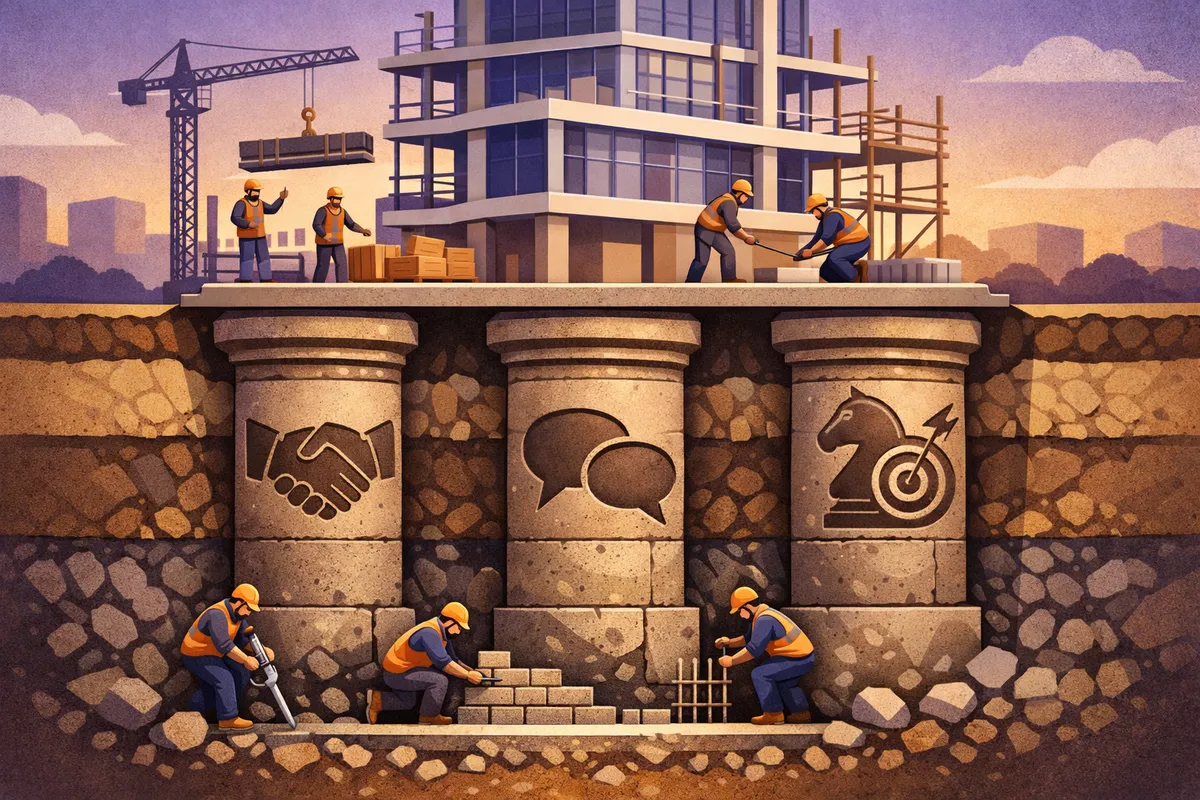
Culture Is Behavior, Not Slogans
The first mistake founders make is confusing culture with values statements. You sit down with your team and write down "integrity" and "velocity" and "customer obsession." You make them into a poster. You feel like you've done something important.
Then someone shipped something that solved their problem but not the customer's. Someone cut corners to hit a deadline and created security debt that haunts you for a year. Someone new joins and doesn't understand why certain decisions were made because the values are slogans without behavior attached.
What Real Culture Looks Like
Real culture is what people do when you're not looking:
- The engineer who caught a bug they didn't introduce because they care about the product
- The salesperson who told a prospect your product wasn't right for them instead of pushing a bad deal
- The operations person who documented a process nobody asked them to document
- The designer who asked three clarifying questions before starting work instead of just building
These behaviors don't emerge from slogans. They emerge from:
- How the founder behaves. Your own behavior is the culture-building tool. Not documents. Not speeches.
- What you praise. The things you celebrate publicly become the things people repeat.
- What you fire people for. The behaviors you refuse to tolerate define your floor.
- The small choices you make in public that signal what actually matters.
The Founder as Culture Architect
Culture doesn't happen. You architect it.
This starts before you hire anyone. You decide what kind of place you want to work. What kind of decisions should people make without asking you? How much process is useful versus theater? When someone fails, what happens? When someone succeeds, what happens?
These aren't rhetorical questions. You answer them with behavior, again and again, until the patterns become clear to everyone around you.
Three Founders, Three Signals
Founder A runs every meeting with a standing question: "Who changed their mind and why?" She's signaling that thinking matters more than defending old positions. Over time, her team stops worrying about being right and starts competing to have the best idea right now.
Founder B has a rule: any decision that affects how other people work has to be communicated by the person who made it, directly, not through email. He walks around, explains, answers questions. He's signaling that explanation and understanding matter more than efficiency.
Founder C fires people who are brilliant but make others miserable. He does this visibly. He lost a top performer because that person treated junior developers badly. He hired someone younger and less experienced but kinder. The signal was clear: here's what we value more than raw talent.
These choices compound. Over months and years, your team stops asking what's allowed and starts internalizing why certain ways of working matter.

Three Pillars That Actually Matter
Most culture conversations are too abstract. Here are the three things that actually shape how your company operates.
Pillar 1: How You Communicate
Not the tools. How.
- Are decisions explained after they're made or before people weigh in?
- When bad news comes, is it delivered immediately or buried in spin?
- When you don't know something, do you say "I don't know yet" or pretend?
- When data contradicts your assumption, do you acknowledge it or ignore it?
The communication style you establish now becomes the default. If you explain decisions, people expect explanation. They ask more questions. They make better decisions themselves. If you announce decisions, people stop asking why. They stop thinking. They follow orders.
Pillar 2: How You Make Decisions
- Data-driven or intuition-driven?
- Committee or individual authority?
- How much disagreement before a decision gets made?
- What happens when a decision turns out wrong?
- Can people disagree in public?
If you solicit input and then decide alone, people feel unheard. If you require consensus, you create politics. If you decide through debate and you're willing to be wrong, people think harder and disagree more directly.
Pillar 3: How You Handle Failure
- Do people hide mistakes or surface them?
- Do you investigate why something failed or just punish the failure?
- When someone misses a target, do they get a chance to understand what happened?
This pillar determines how fast you move. If people hide mistakes, you keep making the same mistake in different ways. If you investigate and learn, you move faster. If people are afraid to fail, they optimize for not failing instead of shipping.
These three pillars are not independent. Open communication requires being okay with disagreement. Good decision-making requires data, which comes from communication. Learning from failure requires being willing to communicate what went wrong.
Writing Down Your Values (So They're Actually Useful)
Eventually you need to write something down. Not for a poster. For clarity.
What Bad Values Look Like
Adjectives with no behavior attached. "Integrity." "Excellence." "Innovation." These mean nothing until you specify the behavior.
What Good Values Look Like
Example: "Write once, read many times." This sounds boring. But what it actually means: the engineer who solves something writes it down so the next person doesn't have to figure it out. The salesperson who learns something about the market tells the team. Everyone writes a little so everyone else reads a little less.
This value clarifies decisions. When someone wants to skip documentation, you point to the value: "That creates debt for the next person."
Example: "Strong opinions, loosely held." Come to the table with your best thinking. Argue for your position. But once the decision is made, execute it fully. Don't agree in the meeting and then ship it half-heartedly.
The Format That Works
For each value, document: - What does it look like in a meeting? - What does it sound like in a decision? - What does it feel like when someone is living it? - What does it look like when someone is violating it?
How Culture Changes at Each Stage
| Stage | Communication | Decision-Making | Key Shift |
|---|---|---|---|
| 5 people | Everyone knows everything | Founder in every conversation | Shared understanding |
| 15 people | Some people work on things the founder doesn't touch | Leaders make decisions others trust | "Everyone understands why" replaces "everyone knows all" |
| 50 people | Teams have leaders who talk to each other | Documentation and structured meetings | "The structure communicates" replaces "we all understand" |
The core values don't change. But how you operationalize communication, decision-making, and failure changes at each stage. If you run a fifty-person company like it's a five-person company, you create chaos. If you run a five-person company like it's a fifty-person company, you kill the speed that makes small teams powerful.
Hiring for Culture Fit Without Creating a Monoculture
You want people who understand what you're building and how you're building it. But you don't want a team of identical people who all think the same way.
The people who fit your culture are not people who are all like you. They're people who care about the same pillars even if they execute them differently:
- The introverted engineer who communicates beautifully in writing
- The salesperson who makes decisions analytically instead of relationally
- The designer who embraces failure differently than the founder
If your value is "communicate clearly," you can hire someone who communicates through writing, speaking, or visuals. The medium doesn't matter. The clarity does.
Who Doesn't Fit
People who violate the pillars fundamentally:
- The person who communicates through ambiguity
- The person who makes unilateral decisions and hides the reasoning
- The person who punishes mistakes instead of learning from them
These people break culture. Not because they're bad people. But because they're operating by different rules and it confuses everyone around them.
Remote and Hybrid Culture: Building Trust Without Proximity
Physical proximity creates false culture. You feel cohesive because you're in the same room. Go remote and the feeling evaporates. But real culture doesn't depend on proximity.
What Remote Culture Requires
- Clearer communication because you don't have hallway conversations
- More documentation because you can't rely on someone being in the office for a quick question
- More structure because you can't have culture by osmosis
- Regular communication rhythms: weekly syncs about decisions and reasoning, regular one-on-ones, written communication that's clear and complete
The Hybrid Trap
Don't create a two-tier system where office people have more information and influence than remote people. The simplest fix: run all-remote meetings even when some people are in the office. Everyone is on their own screen. No one has the advantage of proximity.
Rituals That Replace Proximity
Not forced fun. Substantive things: - A meeting where people share what they learned - A meeting where you celebrate wins - A meeting where you share mistakes and what you learned from them
These rituals replace the casual conversations that happen in offices.
Rituals That Reinforce Culture
Culture happens in the things you do repeatedly that signal what matters.
Standups can reinforce collaboration or hierarchy. If you use them to share blockers and ask for help, you reinforce collaboration. If you use them to let the founder know what everyone's doing, you reinforce hierarchy.
All-hands meetings can reinforce shared understanding or become broadcasts. If you explain reasoning and hear feedback, you reinforce communication. If you just announce decisions, you don't.
How you celebrate wins matters. If you only celebrate company-wide wins, you signal that individual achievements don't matter. Celebrate at different scales.
How you handle failure publicly matters. Asking someone what they learned in front of the team signals that failure is a learning event. Addressing it privately signals that failure is shameful.
The rituals that last are the ones that feel natural. You don't force culture. You design the conditions where the culture you want emerges naturally.
How to Course Correct When Culture Drifts
Culture drifts slowly. You don't notice it until it's substantially different from what you intended.
How Drift Happens
The change happens because people watch what's rewarded. Someone ships without documentation. It ships fast. Speed gets rewarded. The next person skips documentation too. Someone disagrees with a decision but undermines it in execution. Nobody addresses it. Someone else does it. Soon you have passive-aggressive culture.
How to Correct It
See the drift. What behavior are you seeing that wasn't there before? What's rewarded now that wasn't? What's tolerated that used to be called out?
Address it with behavior, not policy. The founder calls out the drift directly:
- "I notice we're skipping documentation because shipping fast is easier. And it's working short-term. But it's creating debt. Let's think about when documentation matters."
- "I've noticed that when we decide on something, some people don't fully execute. That breaks my trust in our decision-making. I need people to either argue harder before the decision or fully commit after."
Address it early. Drift that's been happening for a month is easier to correct than drift that's been happening for a year. By the time you notice big culture problems, the people who came in with the original culture are often ready to leave.
Firing People Who Damage Culture
This is the hardest decision a founder makes. You have a brilliant engineer who solves hard problems but makes other people miserable. A salesperson who closes deals but bullies people in meetings. Someone productive but who undermines decisions.
Here's the truth: firing them is the culture decision. Not firing them is also a culture decision. You're telling everyone that you value their contribution more than how they treat people. You're signaling that culture is a nice-to-have, not a must-have.
Some of the best culture decisions are the moments when a founder fires someone productive because they don't fit. The organization collectively takes a breath. The signal is clear: here's what we actually value.
How to Do It Well
You don't fire someone because you don't like them. You fire them because they violate the pillars. You can point to specific behavior that violates what the team has agreed matters.
When you make this decision, explain it to the remaining team. Not to shame the person leaving, but to reinforce the culture: "We are parting ways because how we make decisions and how we communicate didn't align. That's core to who we are."
Related Guides
Equity Compensation: How to Structure Startup Offers
Equity is how startups compete with big salaries. Learn vesting schedules, option pools, and how to make offers that attract without giving away the company.
Your First Five Hires: Who to Bring On and When
Your first five hires define your company more than your product. Learn which roles to fill first and what to look for at each stage.
The Founder's Guide to Giving Feedback That Lands
Bad feedback destroys teams faster than bad strategy. Learn the frameworks, timing, and delivery that make feedback a tool instead of a weapon.