
Why Most Founders Are Bad at Feedback
There are a few reasons founders struggle with feedback:
- You don't have much practice receiving it. You've been right more often than wrong, or at least that's what the market told you. When someone questions your instinct, your brain interprets it as "they don't get it" instead of "they have useful information."
- You're under time pressure. Someone made a mistake and you need them to not make it again immediately. So you point it out sharply. The time you save being blunt costs you twice over in lost trust.
- You're scared. You're building something that might fail. When someone drops the ball, your fear comes out as criticism. You criticize harder because you think it will change behavior. It doesn't. It just makes people more nervous.
- You confuse feedback with evaluation. You think feedback is about ranking performance. But feedback is about helping someone improve right now. Those are different things.
- You assume everyone processes information like you do. You want the blunt truth. So you give blunt feedback assuming that's what everyone wants. But many people need context first. They need to understand why before they hear the what.
The Difference Between Feedback and Criticism
Feedback is data. Criticism is judgment.
Feedback says: "Here's what I observed. Here's how it landed. Here's what I'd like to see instead."
Criticism says: "You did this wrong. You're not good at this. Other people are better at this than you."
Feedback is about behavior. Criticism is about character. The brain processes these differently. Feedback activates problem-solving: "here's something to fix." Criticism activates defense: "here's something wrong with me." When someone hears criticism, they stop listening to the content and start thinking about how to protect themselves.
Criticism Disguised as Feedback
As a founder, you probably deliver a lot of criticism disguised as feedback:
- "Your proposal doesn't make sense" (sounds analytical, feels like an attack)
- "Anyone can see this won't work" (sounds objective, feels dismissive)
- "I expected more from you" (sounds disappointed, feels like a character judgment)
Real feedback is specific. Real feedback has an invitation in it. It leaves room for the other person to be right and you to be wrong.
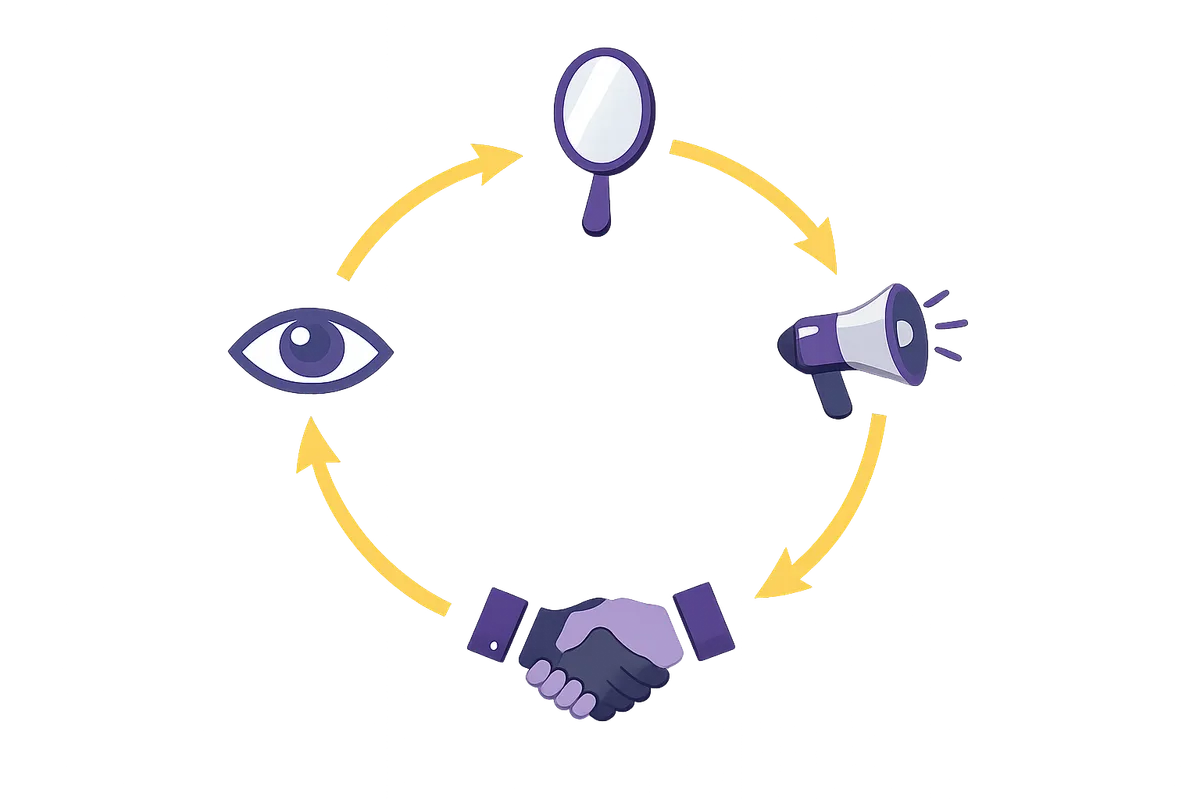
The SBI Framework: Situation, Behavior, Impact
There's a simple structure that makes feedback land better. Situation. Behavior. Impact.
Step 1: Situation
Establish the specific moment. Not in a judgmental way. Just the facts.
- "In the meeting with the client yesterday."
- "When we reviewed the code this morning."
- "In the Slack thread about the timeline."
This anchors the feedback so there's no confusion about what you're referencing.
Step 2: Behavior
Describe what you observed. Again, just the facts.
- "You pushed back on the timeline estimate without asking why we came to that estimate."
- "You shipped the feature without testing on the staging environment."
- "You told the client we could build it in two weeks when our capacity is one week."
Precision matters here. Not "you're careless" (criticism). Not "you always shoot from the hip" (pattern judgment). Specific behavior in that moment.
Step 3: Impact
What happened as a result?
- "The client felt rushed and didn't trust our estimate."
- "We caught the bug in production instead of staging, which cost us four hours and embarrassed us."
- "Now the client expects something we might not be able to deliver, and we'll either overwork or disappoint them."
Step 4: The Ask
Then you say what you'd like to see instead:
- "Next time, ask me about the estimate before suggesting a different one."
- "Next time, check staging is up before assuming it's broken."
- "Next time, loop me in before committing to timelines with clients."
The structure is powerful because it's objective. You're not saying the person is bad. You're saying "here's what happened and here's what it caused." The person can process that without defensiveness.
Timing: When to Give Feedback and When to Wait
Timing is half of feedback. Give feedback at the wrong moment and even good feedback lands badly.
The Timing Rules
| Situation | When to Give Feedback |
|---|---|
| Mistake in a meeting | After the meeting, once emotions settle. Never during. |
| Bad code | After the code review is done, not when they're defensive about their design |
| Bad client email | Same day or next morning, before they send more in that thread |
| Someone visibly upset | Wait overnight |
| Pattern of behavior | Wait a few days to confirm it's a pattern, then address |
The general rule: give feedback as soon as possible after the behavior, but late enough that the person isn't in fight-or-flight mode.
Public vs Private
- Public feedback is only for positive recognition or behavioral standards that affect the group
- Individual performance feedback is always private
- One-on-ones are the best venue for corrective feedback
Positive Feedback Is Not Optional
This is the thing founders miss. You think feedback is about correcting mistakes. It's 50% correcting mistakes and 50% reinforcing what's working.
People need to know what to repeat. If someone does something right and you never mention it, they don't know whether you noticed or whether it matters. Then they might stop doing it.
Examples of Good Positive Feedback
- "You asked great questions in that design review and it led to a better outcome. I noticed you did that yesterday too. Keep doing that."
- "Your code is clean. It's easy to understand and modify. That matters."
- "The way you handled that customer complaint turned a churning user into an advocate. That's exactly the kind of ownership I want to see."
Short. Direct. Specific. People feel that and they repeat it.
The 5:1 Ratio
Research says people need about five positive feedback moments for every one critical feedback moment to feel supported. Most founders operate at the opposite ratio. They point out problems constantly and say nothing when things work.
If you want your team to trust your feedback, you need to give five times as much positive feedback as critical feedback. That might feel like coddling. It's not. It's how the human brain actually works.
Difficult Conversations: Performance Issues, Attitude Problems, Missed Expectations
Sometimes feedback is harder. Someone's performance is slipping. Someone's attitude is affecting the team. Someone keeps missing expectations.
These conversations are scary. You're worried about hurting someone's feelings, worried about legal issues, worried that you're wrong. So you get fuzzy and indirect.
How to Have the Hard Conversation
Use the same SBI structure but make it more serious.
Situation: "Over the last month, we've discussed missing deadlines three times."
Behavior: "Each time, you didn't raise it until the deadline was already passed. You shipped work that wasn't tested. And you didn't ask for help when you were blocked."
Impact: "This puts pressure on the rest of the team to fix things. It makes clients frustrated. It makes me wonder if the role is right for you."
Then you pause. You give them space to respond. Maybe they say: - "I was scared to ask for help because I thought it meant I was failing." - "I didn't know testing was my responsibility." - "I've been dealing with a family issue and I'm overwhelmed."
Any of these changes the conversation. But you had to have the conversation to find out.
Setting Clear Expectations After
Be specific about what needs to change:
- "Communicate blockers 24 hours before deadlines, not the day of."
- "Test everything on staging before shipping."
- "Ask for help when you're stuck for more than two hours."
Then set a timeline: "Let's check in in one week. Here's what success looks like."
If things improve, great. If they don't, you know you've tried. The next step might be a performance plan or parting ways. The key is clarity. No fuzz. No ambiguity. That's kindness disguised as directness.
How to Receive Feedback as a Founder
If you want people to give you feedback, you need to receive it well.
Someone gives you feedback about how you handled something. Your instinct is to explain why they're wrong. But that shuts down the conversation. If you explain why you're right every time someone gives you feedback, they'll stop giving it. And then you don't improve.
The Magic Move
When someone gives you feedback: "That's useful. I hadn't thought about it that way. Let me think about that."
Then you actually think about it. Sometimes you change. Sometimes you don't. But you take it seriously.
When you model receiving feedback well, your team learns to give it. They see that you don't get defensive. They see that you change sometimes. They see that feedback is safe. Then they give each other feedback too.
Creating a Feedback Culture Where People Give Each Other Feedback
The endgame is a team where people give each other feedback without waiting for you.
This happens when the team sees that feedback is safe. You've given critical feedback that lands well. People have received it and improved. You've received feedback gracefully.
Structures That Accelerate Feedback Culture
- Weekly one-on-ones where you ask "what could I be doing better?"
- Sprint retros where you ask "what worked and what should we change?"
- Peer feedback sessions where people give each other feedback formally
- Post-mortem reviews after incidents, focused on systems not blame
But the structures only work if the culture is safe. If you punish people for critical feedback, no structure will help. If you take feedback gracefully, even simple structures create a feedback culture.
The goal is a team where someone says "hey, I noticed something in that decision that might be worth thinking about" and nobody gets defensive. That's a high-performing team. That's a team that doesn't need you to fix everything. That's a team that improves itself.
Related Guides
Equity Compensation: How to Structure Startup Offers
Equity is how startups compete with big salaries. Learn vesting schedules, option pools, and how to make offers that attract without giving away the company.
Your First Five Hires: Who to Bring On and When
Your first five hires define your company more than your product. Learn which roles to fill first and what to look for at each stage.
Leading Through Uncertainty: What Nobody Tells First-Time Founders
Nobody prepares you for the loneliness of leading. The honest conversation about founder leadership that most startup advice skips.