Our Business Intelligence Services in Detroit
- Data source audit mapping every system in your technology stack, the data each generates, its quality and consistency, update frequency, and integration requirements for consolidation
- Data warehouse architecture and implementation: selecting the right platform for your data volumes and environments, with Power BI and Azure Synapse as common choices for Michigan manufacturing clients already in the Microsoft ecosystem, and Snowflake or BigQuery for those who want platform-agnostic infrastructure
- ETL and data pipeline development: automated flows that extract from source systems, apply cleaning and transformation logic, and load current data into your warehouse on schedules appropriate to each source
- Manufacturing and operational analytics dashboards: OEE and production throughput by line and shift, quality metrics and defect tracking, planned versus unplanned downtime analysis, and labor cost per unit across facilities
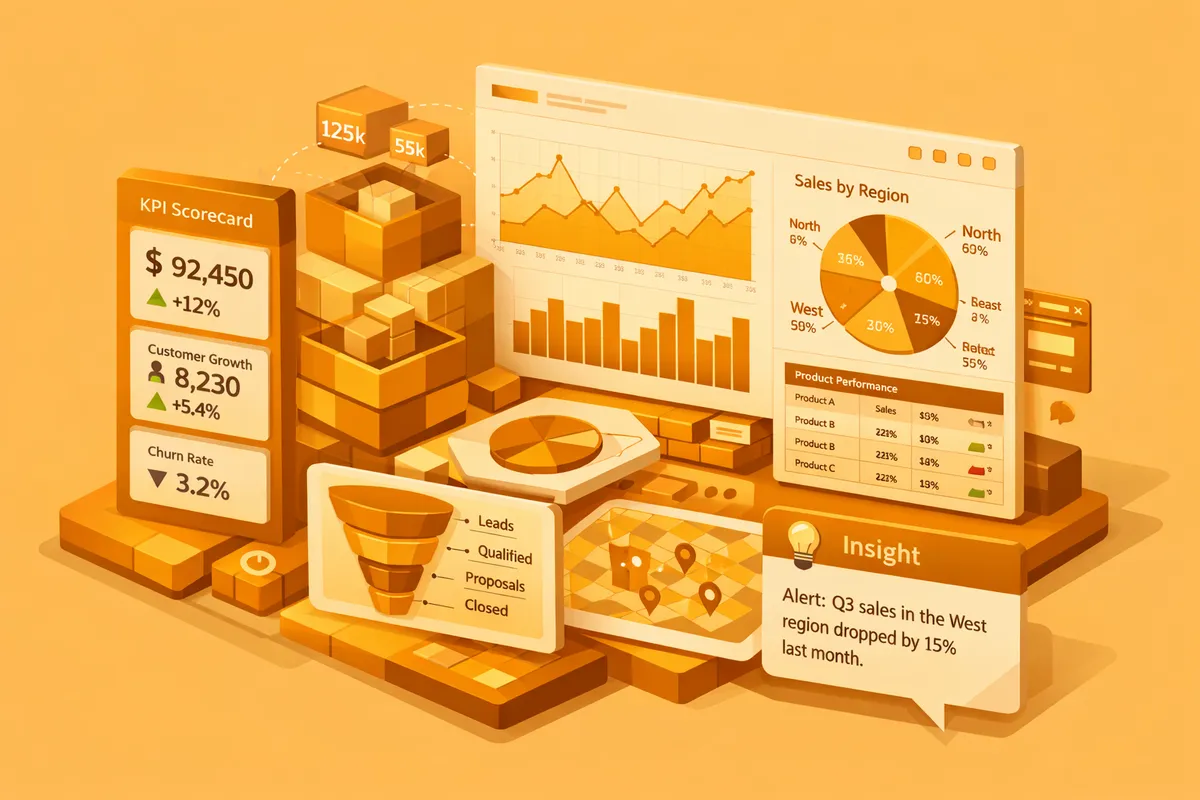
- Executive KPI dashboard design: working with your leadership team to identify the eight to twelve metrics that drive the most consequential decisions, then building dashboards that present those metrics clearly with current data and trend context
- Financial performance analytics: revenue and margin by product line, customer, and division; cost center performance; cash flow visibility; and the financial KPIs that Michigan investors, boards, and lenders expect in reporting packages
- Supply chain and procurement analytics: supplier delivery performance, inventory turnover, purchase price variance, and demand signal tracking that informs production scheduling decisions
- Sales pipeline and performance reporting: deal stage conversion rates, rep performance benchmarks, win/loss analysis, and forecasting models appropriate to Michigan B2B sales cycles including the long-cycle supplier qualification processes that automotive manufacturers require
- Healthcare analytics for Detroit-area practice networks and health systems: patient acquisition by channel, appointment conversion and no-show rates, referral pattern analysis, and operational performance tracking within HIPAA-compliant data architecture
- Self-service analytics implementation: enabling operational managers, finance teams, and sales leaders to explore data, build their own views, and answer ad-hoc questions without engineering support
Industries We Serve in Detroit
Automotive Manufacturing and Tier 1 Suppliers The automotive supply chain stretching through Dearborn, Auburn Hills, Sterling Heights, and Warren needs BI that connects MES production data, quality management system data, ERP purchasing and inventory data, and customer EDI data into a single operational picture. Tier 1 suppliers delivering to Ford, GM, and Stellantis face increasing customer demands for production data sharing, quality performance transparency, and capacity utilization visibility. BI infrastructure that can satisfy both internal management reporting and customer-facing performance data requirements has become a supplier qualification differentiator, not just an operational convenience.
Industrial Manufacturing Metro Detroit's industrial manufacturers, spanning aerospace components, defense systems, heavy equipment, and precision machined parts, need BI that surfaces the operational metrics their customers and quality management systems require alongside the financial performance visibility their owners and lenders demand. Industrial manufacturing BI often involves significant data quality remediation work: decades of ERP data with inconsistent part number conventions, cost center structures that evolved without governance, and quality records that were entered differently across facilities. We do that remediation work first, then build the analytical layer on a reliable foundation.
Healthcare Systems and Medical Practices Henry Ford Health, Corewell Health, Detroit Medical Center, and the network of specialty practices across Metro Detroit serve patients who evaluate providers with increasing sophistication and switch when their expectations are not met. Healthcare BI for Detroit-area health systems must navigate HIPAA requirements while surfacing the patient flow patterns, capacity utilization data, referral performance trends, and operational cost metrics that health system executives need to make resource allocation decisions. We design healthcare data architecture with PHI separation, role-based access controls, and audit logging as foundational requirements, then build analytical capabilities within that compliant framework.
Technology Startups and Software Companies TechTown Detroit, Bamboo Detroit, and the Corktown startup community are producing Michigan technology companies that need to compete nationally for talent, investment, and enterprise customers. A startup dashboard that tracks trial conversion, feature activation, cohort retention, and net revenue retention in real time gives founders and growth teams the visibility to make product and marketing decisions confidently rather than waiting for a quarterly analysis. We build SaaS BI for Detroit technology companies that connects marketing acquisition data to product usage to revenue outcomes, including customer-facing reporting capabilities for the enterprise accounts that require it.
Logistics and Supply Chain Detroit's logistics sector, including the carriers, 3PLs, and distribution operations serving the automotive supply chain and broader Midwest freight market, needs BI that provides real-time operational visibility across shipment status, carrier performance, warehouse capacity, and customer delivery scorecards simultaneously. Logistics companies managing automotive supplier-to-plant shipments face customer visibility requirements that demand live data, not end-of-day summaries. We build logistics BI that meets those requirements while giving operational managers the situational awareness to address problems before they become customer escalations.
Financial Services and Banking Michigan's regional banks, credit unions, and financial advisory firms serving Metro Detroit businesses and consumers need BI that tracks product performance, customer acquisition cost, loan portfolio quality, and operational efficiency across branches and product lines. For financial institutions with regulatory reporting obligations, BI architecture must include data governance, audit trails, and access controls that satisfy examiner requirements alongside the management reporting that drives business decisions. We build financial services BI with both sets of requirements as design foundations.
What to Expect
Discovery and Data Audit We begin by mapping your complete data landscape: every system generating business data, the quality and completeness of that data, how frequently it updates, and the integration complexity for each source. For manufacturing clients, this includes MES and quality management systems alongside standard business applications. For healthcare clients, we include a HIPAA compliance context assessment. We interview your leadership and operational teams to understand the decisions they currently make without sufficient data visibility, which drives BI prioritization.
Architecture Design We design the data warehouse architecture, ETL pipeline structure, and dashboard framework before building anything. For Detroit manufacturing and enterprise clients in the Microsoft ecosystem, we assess whether Power BI and Azure Synapse or Microsoft Fabric are the right platform choices versus platform-agnostic alternatives like Snowflake with Looker or Metabase. For healthcare clients, we include data governance and access control design at this stage. You review and approve the architecture before implementation begins.
Phased Development We build in phases, delivering working dashboards at each milestone rather than waiting for the complete system. Manufacturing clients typically see production performance dashboards in phase one, financial and sales analytics in phase two, and supply chain and customer-facing capabilities in phase three. This incremental approach means your team gets value from the investment from the first phase while the complete system is built alongside, and feedback from early dashboards sharpens the design of later ones.
Training and Ongoing Support Every BI implementation includes training for the teams using the dashboards and, for self-service deployments, training on how to explore data and build custom views independently. Monthly maintenance retainers cover pipeline monitoring and error resolution, BI platform updates, new metric additions, and dashboard refinements. Quarterly strategy reviews assess what new analytical capabilities would deliver the most value as your business and its data needs evolve.