Marketing Channels That Work for Moving Companies
Local SEO: Rank for the Searches That Drive Revenue
Local SEO is the highest-ROI channel for moving companies. When someone searches "movers in [city]" or "moving company near me," the businesses in the Google Map Pack receive the majority of calls. Ranking in those top three local results is the difference between a full schedule and empty trucks.
Moving company SEO starts with your Google Business Profile. Optimize it completely. Select the right categories (moving company, moving and storage service, local moving service, long distance moving service). Upload photos of your team, trucks, and completed moves. Post weekly updates about moving tips, seasonal availability, or recent positive customer experiences. Respond to every review.
Create dedicated landing pages for each service type and each location you serve. "Local Movers in [City]," "Long Distance Moving from [City]," "Office Moving in [City]," and "Apartment Movers [City]" pages target the specific searches customers make. These pages need unique content that addresses the particular needs of that move type in that location. Moving from a third-floor walkup in a dense urban area is different from moving from a suburban house with a two-car garage. Your content should reflect that.
Reviews are the most powerful ranking factor for moving company local SEO. Google's algorithm uses review volume, average rating, and recency to determine local rankings. Moving companies with 200-plus reviews and a 4.5-plus rating dominate the Map Pack in most markets. Because moving is a one-time event, you need to capture the review immediately after the move while the positive experience is fresh. An automated text or email within 24 hours of completing the move generates the highest response rates.
Build topical authority through blog content about moving. Cost guides, packing tips, city-specific moving guides, and checklists rank in organic search and drive visitors to your site who need a mover. A "Cost of Moving in [City]" guide that ranks on page one generates leads passively for months or years.
PPC Advertising: Win the Race for Summer Leads
Pay-per-click advertising is critical for moving companies because of the intense competition and seasonal demand patterns. PPC puts your company at the top of search results immediately, bypassing the months it takes to build organic rankings.
Google Local Service Ads (LSAs) are the number one paid channel for moving companies. They appear above all other search results with your Google review rating front and center. The "Google Guaranteed" badge provides instant credibility in an industry where trust is the primary concern. You pay per lead, and LSA leads tend to have higher booking rates than standard PPC leads because the Google vetting process pre-qualifies the customer.
Standard Google Search Ads complement LSAs by capturing searches across more keyword variations. Build campaigns around high-intent terms: "moving company [city]," "local movers near me," "long distance movers [city]," "apartment movers [city]." Each campaign should direct to a landing page specific to the search intent with a prominent quote request form, your phone number, pricing context, and trust signals.
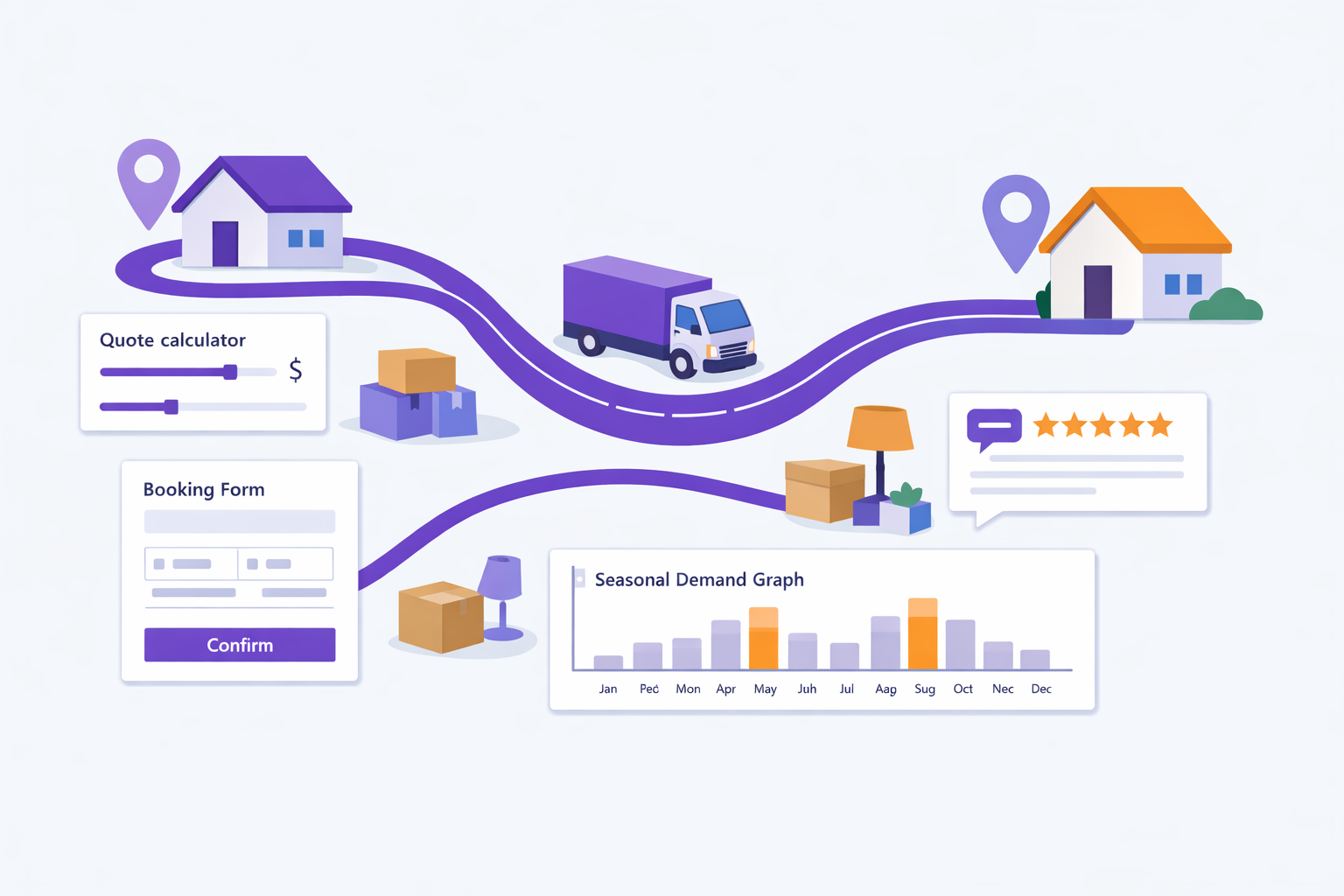
Seasonal budget management is essential. Moving company PPC costs increase significantly during summer months as competition heats up. Cost-per-click for "movers near me" can jump from $8 in January to $25 or more in June. Plan your annual budget to invest most heavily in March through August. Launch campaigns early in the season when costs are lower and competition has not fully ramped up. This early investment in brand visibility pays off as the peak months arrive.
Remarketing ads on Google Display Network and Facebook help you stay top of mind with people who visited your site but did not request a quote. Moving is a researched purchase. Customers visit multiple websites before choosing. Remarketing keeps your brand in front of them during the comparison shopping phase and increases the likelihood they return to your site when ready to book.
Web Design: Quote Speed and Trust Signals Win Bookings
For moving companies, your website serves one primary purpose: converting visitors into quote requests. Every design decision, every piece of content, and every page element should be evaluated against that goal. Does this help the visitor trust us enough to request a quote? If not, it does not belong.
The most critical element of a moving company website is the quote request form. It should appear above the fold on every key landing page. Keep it short. Name, phone number, email, move-from zip code, move-to zip code, approximate move date, and home size. That is enough to start the conversation. Long, complicated forms kill conversion rates. You can collect detailed inventory information during the follow-up.
Professional website design for movers must load fast. Extremely fast. Moving searchers are often comparing three to five companies simultaneously. If your site takes four seconds to load while a competitor's loads in two, you have already lost. Optimize images, minimize scripts, and use a fast hosting solution. Test your mobile speed regularly. Over 60% of moving searches happen on mobile devices.
Trust signals are paramount. Display your USDOT number, state licensing, insurance coverage, and any industry certifications (AMSA membership, BBB accreditation, ProMover designation) prominently. Include a pricing methodology explanation. "We charge by the hour" or "We provide flat-rate quotes based on inventory" sets expectations and reduces the fear of hidden fees. Customer testimonials with specific details ("They moved our 4-bedroom house in [City] in 6 hours with zero damage") are more convincing than generic praise.
A pricing page or pricing calculator is a powerful conversion tool. Customers searching for movers are price-comparing. A page that provides transparent pricing context ("Local moves start at $X per hour for a 2-person crew" or a simple cost estimator tool) keeps visitors on your site instead of bouncing to a competitor who provides pricing more openly.
Content Marketing: Answer Questions, Capture Searches, Build Authority
Content marketing for moving companies targets the massive volume of informational searches related to moving. "How much does it cost to move a 3-bedroom house," "packing tips for moving," "moving checklist," and "how to choose a moving company" are searched thousands of times per month. Ranking for these terms puts your company in front of people who are actively planning a move.
City-specific moving guides are the highest-performing content type for moving companies. "The Complete Guide to Moving to [City]" articles that cover neighborhoods, cost of living, schools, commute times, and practical moving tips rank well in search and attract people relocating to your service area. These visitors have confirmed moving plans and need a moving company. The guide positions you as the local expert and the obvious choice.
Cost content performs exceptionally well. "How Much Do Movers Cost in [City]?" pages consistently rank on page one because this is one of the most searched queries in the moving industry. Provide genuine, helpful cost breakdowns. Hourly rates, flat-rate ranges by home size, long-distance per-mile pricing, and factors that affect cost. Transparency in your content builds the same trust your reviews build.
Seasonal content drives traffic peaks. "Summer Moving Tips," "How to Move During Winter," "Holiday Moving Guide," and "Back-to-School Moving Checklist" capture seasonal search interest. Publish this content two to three months before the relevant season to allow time for indexing and ranking.
Video content is highly effective for moving companies. A 60-second video showing your crew carefully wrapping furniture, loading a truck efficiently, and delivering belongings safely builds confidence faster than any written content. Customer testimonial videos where satisfied clients describe their experience provide powerful social proof. Publish videos on YouTube, embed them on your website, and share clips on social media.
Review Management: Your Reputation Is Your Business
In the moving industry, your online reputation is your most valuable marketing asset. Period. Moving scams, hidden fee complaints, and damage claims are so common in the industry that consumers are hyper-vigilant about reviews. A 4.2-star rating might seem adequate in other industries. In moving, it raises red flags. Customers look for 4.5 stars or higher with substantial review volume.
Review management for moving companies needs to be proactive and systematic. Send an automated review request via text within two hours of completing a move. The timing matters. Right after a successful move, the customer is relieved, grateful, and most likely to leave a positive review. Waiting a week lets the emotion fade. Include a direct link to your Google Business Profile review page.
Respond to every review. Positive reviews deserve a personalized thank-you that reinforces the quality of service. Negative reviews require a professional, empathetic response that acknowledges the concern and offers resolution. How you respond to negative reviews matters more than the review itself. A thoughtful response demonstrates that you take responsibility and care about customer satisfaction.
Monitor reviews across all platforms: Google, Yelp, Facebook, BBB, and industry-specific sites like MovingReviews.com. Negative reviews on any platform can influence a customer's decision. Address them consistently regardless of where they appear.
Encourage detailed reviews. A review that says "Great movers!" helps less than one that says "They moved our 3-bedroom house on time, nothing was damaged, and the final price matched the estimate exactly." Specific reviews address the exact concerns prospective customers have: punctuality, care with belongings, and pricing honesty.
Results You Can Expect
Moving companies that implement comprehensive digital marketing see significant and measurable results. Local SEO improvements drive a 40% to 70% increase in organic visibility within six months. Google Business Profile optimization and consistent review generation improve Map Pack rankings within 60 to 90 days.
PPC campaigns through Google LSAs and Search Ads generate leads immediately. Cost-per-lead for moving companies typically ranges from $30 to $80 depending on market competition and season. With average local move values of $800 to $2,500 and long-distance moves averaging $3,000 to $7,000, closing even a small percentage of PPC leads produces strong returns.
Website optimization with fast load times, prominent quote forms, and trust signals increases quote request conversion rates by 30% to 60%. Companies that add a pricing page or instant estimate tool see even higher conversion improvements because they address the customer's primary concern before asking for contact information.
Content marketing builds compounding organic traffic. City moving guides, cost pages, and packing tip articles continue to generate leads for months or years after publication. Over time, organic content reduces your dependence on paid advertising and lowers your overall cost per acquired customer.
The bottom line for moving companies is straightforward. Digital marketing fills trucks. Every week your trucks are sitting idle represents lost revenue that cannot be recovered. A marketing system that generates 30 to 50 qualified leads per month gives your sales team enough volume to keep every truck moving during peak season and maintain a healthy baseline during slower months.
Frequently Asked Questions
How much should a moving company spend on digital marketing?
Moving companies typically invest 7% to 12% of gross revenue in marketing. For a company generating $1 million annually, that translates to $5,800 to $10,000 per month across all channels. Seasonal budget allocation is important. Plan to spend 40% to 50% of your annual marketing budget during March through August when demand peaks. Start-up moving companies or those entering new markets may need to invest more aggressively in the first year to establish visibility and review volume.
How do moving companies compete with lead aggregator sites?
The best strategy is to build your own direct lead generation channels that bypass aggregators entirely. Invest in SEO so your website ranks organically for "[city] movers" searches. Run your own Google Ads and LSAs. Build a review profile that makes customers choose you directly. Aggregator leads are shared with multiple competitors, which drives down close rates and forces price competition. Direct leads from your own website convert at two to three times the rate of aggregator leads because the customer already chose you.
What is the best way for moving companies to get more reviews?
Timing and simplicity are everything. Send an automated text message with a direct Google review link within two hours of completing the move. The message should be brief and personal: "Hi [Name], we hope your move went smoothly. We would really appreciate a quick review on Google." Include the link. Do not require them to search for your business. Moving companies that implement this system typically generate reviews on 15% to 25% of completed moves. Over the course of a peak season, that adds 30 to 50 new reviews per month.
Should moving companies use social media for marketing?
Social media plays a supporting role for moving companies rather than being the primary lead driver. Facebook is the most valuable platform for building community awareness and generating recommendations. Post moving tips, before-and-after photos of organized trucks, customer testimonials, and seasonal promotions. Instagram works for visual content showcasing your team and operations. TikTok can build brand awareness with short-form moving tip videos. None of these platforms replace Google for direct lead generation, but they build the brand familiarity that makes customers choose you when they do search.
How seasonal is moving company marketing?
Extremely seasonal. June through September accounts for roughly 70% of annual moving volume. Your marketing strategy must account for this. Ramp up PPC spending in March and April before competition peaks. Publish seasonal content in advance so it ranks by the time demand surges. Maintain SEO and review generation year-round so your organic presence is strong when peak season arrives. During slower months (November through February), focus on commercial moving, office relocations, and storage service marketing to maintain baseline revenue.
How do moving companies market long-distance services differently than local?
Long-distance moving requires a different keyword strategy, different landing pages, and different trust signals. Customers searching for long-distance movers prioritize licensing (USDOT number), insurance coverage, and detailed pricing methodology. Create dedicated landing pages for popular routes ("Moving from [City A] to [City B]") with specific pricing context and logistics information. Long-distance keywords have lower search volume but higher customer value, making them excellent PPC targets. Content about long-distance moving logistics, timeline planning, and cost factors attracts high-value prospects researching cross-country moves.