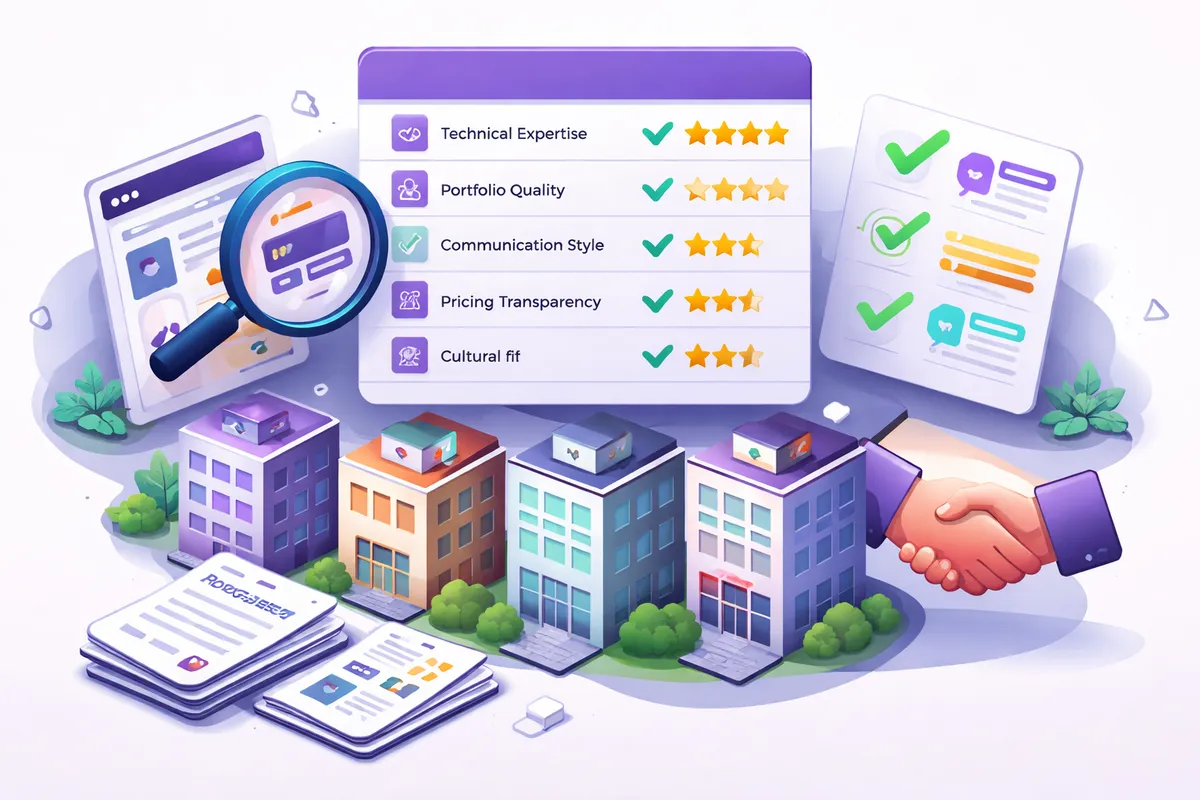
Step 2: Find Candidates
Where to look. Start with referrals from your professional network. A recommendation from someone who has worked with an agency is the highest-signal source. They can tell you about the experience, not just the output.
Beyond referrals, agency directories like Clutch, DesignRush, and GoodFirms provide verified reviews and portfolio examples. Google searches for your specific need ("healthcare web development agency" or "SaaS application development") surface agencies with relevant domain experience. Industry-specific forums and communities often have threads recommending agencies their members have used.
Check portfolios before reaching out. If the agency's public work does not match the quality and complexity you need, skip the discovery call.
How many to evaluate. Three to five agencies is the sweet spot. Fewer than three limits your comparison and leaves you with insufficient data to make a confident decision. More than five creates evaluation fatigue. Each agency requires one to two hours of your time for discovery calls, proposal review, and follow-up questions. Multiply that across eight or ten agencies and you have lost a full work week.
Step 3: Evaluate Their Portfolio
Portfolio review tells you more than any sales call. A polished pitch deck means nothing if the agency's actual work does not hold up under scrutiny.
Look for these signals of quality. Work similar to what you need in terms of industry, complexity, and technology. Consistent quality across multiple projects, not just one standout example. Live examples you can test yourself, not just screenshots or Figma mockups. Results described alongside the work such as traffic growth percentages, conversion rate improvements, or revenue impact.
A strong portfolio entry tells a story. It describes the client's challenge, the agency's approach, the technology choices and their rationale, and the measurable outcome. Agencies that only show visual designs without context are telling you they do not measure their impact.
Red flags in portfolios. Only design mockups with no live sites to visit. Every project looks like the same template with different colors and logos. No recent work added in the past year. They cannot share URLs of projects they have built, citing NDA restrictions for every single project. While some clients do require confidentiality, an agency that cannot show a single live project should raise concerns.
Test the live examples. Load them on your phone. Check page speed with Google PageSpeed Insights. Click through the navigation. Fill out a form. The quality of the finished product tells you what your project will look like.
Step 4: Evaluate Their Process
A good agency has a defined process for discovery, design, development, testing, and launch. Ask them to walk you through their process step by step.
Questions to ask. How do you handle requirements gathering and discovery? How do you communicate during the project, and how frequently? What project management tools do you use? How do you handle scope changes and change requests? What does your testing and quality assurance process look like? How do you handle the handoff after launch?
What strong answers sound like. A structured discovery phase of one to two weeks with defined deliverables. Weekly status updates plus async communication through a project management tool like Linear, Jira, or Asana. A formal change request process with documented impact on timeline and budget. A dedicated QA phase with documented test cases, device testing, and performance benchmarks.
Red flags. Cannot articulate their process clearly or gives vague answers. No project management tool or structured communication plan. "We are flexible" as the answer to every process question. No QA or testing phase mentioned in their process. No defined handoff process after launch.
An agency without a defined process is not flexible. They are disorganized. Flexibility within a framework is good. No framework at all leads to missed deadlines, forgotten requirements, and finger-pointing when things go wrong.
Step 5: Evaluate Their Team
You are hiring people, not a logo. Understanding who will actually work on your project is critical because the quality of your project depends on the skills and experience of the individuals assigned to it.
Questions to ask. Who will be my primary point of contact? Who are the developers and designers assigned to my project? What are their backgrounds and experience levels? Are they full-time employees or contractors? Where is the team located? Will the same team stay on my project from start to finish?
Why team composition matters. A junior developer working on a complex application produces different results than a senior developer, regardless of the agency's reputation. Agencies that staff projects with a mix of senior leadership and junior execution often deliver strong results at reasonable rates. Agencies that assign your project entirely to junior staff or unfamiliar contractors introduce risk.
Red flags. Cannot tell you who will work on your project before you sign. Heavy reliance on offshore contractors they have not worked with before. An account manager with no technical background as your sole point of contact. High team turnover mentioned casually during conversations.
Ask if you can meet the team members who will work on your project before signing the contract. Any agency confident in their team will welcome this request.
Step 6: Evaluate Their Proposals
Request detailed proposals from your shortlist of two to three agencies. A strong proposal demonstrates understanding, not just capability.
What a good proposal includes. A summary of your requirements written in their own words, proving they understood your business and not just your feature list. A proposed technical approach with rationale for technology choices. A detailed scope broken into phases or milestones with dependencies identified. A timeline with key dates and buffers for review cycles. Pricing with a clear breakdown showing where the money goes. Explicit statements of what is included and what is excluded. Assumptions and identified risks with proposed mitigation strategies. Ongoing support and maintenance options with pricing.
How to compare proposals. Score each proposal on four dimensions. Completeness: did they address everything you asked for? Understanding: do they demonstrate comprehension of your business goals, not just your feature list? Pricing transparency: can you see exactly where your budget is allocated? Risk management: do they identify potential issues and propose solutions proactively?
The cheapest proposal is rarely the best value. The most expensive proposal is not automatically the best either. Look for the proposal that demonstrates the deepest understanding of your project and the most realistic plan for delivering it. An agency that prices your six-month project at half the cost of competitors is either cutting corners, underestimating scope, or planning to negotiate change orders later.
Step 7: Check References
Talk to two to three past clients. Do not rely solely on the references the agency hand-picks. Ask specifically for clients from projects similar to yours in scope, complexity, and industry.
Questions for references. Did the project finish on time and on budget? If not, what caused the delays or overages? How did the agency handle problems, bugs, or scope changes during the project? How responsive were they during development and after launch? What surprised you about working with them? Would you hire them again for a similar project? What would you do differently in hindsight?
Reading between the lines. Pay attention to hesitation. A client who pauses before answering "would you hire them again?" is telling you something. Look for patterns across references. If two out of three mention communication issues, that is a systemic problem, not a one-time occurrence. Ask about the post-launch experience specifically, because many agencies are attentive during the sale and development but disappear after the check clears.
Red Flags That Should Stop the Conversation
These warning signs indicate problems serious enough to disqualify an agency from consideration.
Guaranteed results. No honest agency can guarantee specific business outcomes like revenue targets or traffic numbers. They can guarantee deliverables and timelines. Results depend on factors outside any agency's control.
No contract or vague contract. Scope, deliverables, payment terms, intellectual property ownership, and termination clauses must be documented in writing. An agency that resists putting terms on paper is protecting themselves, not you.
Pressure to sign quickly. Artificial urgency, limited-time discounts, and "we can only hold this team for two more days" tactics signal an agency more focused on closing deals than delivering quality work. Good agencies let you make informed decisions.
Cannot explain their technology choices. If an agency cannot articulate why they chose React over Vue, PostgreSQL over MongoDB, or Next.js over a WordPress build, they did not choose thoughtfully. Technology decisions should be driven by your project requirements, not by what the agency already knows.
Significantly cheaper than every competitor. Below-market pricing usually means below-market quality, hidden costs through change orders, or an agency that underestimated your scope and will struggle to deliver. When three agencies quote $40,000 to $60,000 and one quotes $15,000, investigate why before celebrating your savings.
What to Look for in a Long-Term Partner
Beyond the initial project, evaluate whether this agency could serve your business for years. The best development relationships deepen over time. An agency that understands your codebase, your users, and your business goals delivers faster and better with each subsequent project.
Look for agencies that offer transparent website design and development processes, invest in understanding your industry, and propose solutions that align with your long-term technology strategy. The initial project is an investment. The ongoing relationship is where compounding returns happen.
If your project involves marketing technology, ask whether the agency can support CRM and marketing technology consulting alongside development. Agencies that understand both the technical build and the marketing systems that connect to it reduce integration friction and deliver more cohesive solutions.
FAQ
How much should I budget for a development agency?
Simple marketing websites typically cost $5,000 to $15,000. Complex websites with custom functionality, integrations, and content management run $15,000 to $50,000. Full web applications with user authentication, dashboards, and business logic range from $25,000 to $150,000 or more. E-commerce platforms fall between $10,000 and $100,000 depending on catalog size, payment complexity, and custom features. These ranges reflect mid-market agency pricing in 2026 for US-based or comparable-quality teams.
Should I choose a local agency or a remote one?
Remote agencies give you access to a larger talent pool and often provide better value because they are not constrained by a single market's salary expectations. Local agencies offer in-person meetings and may better understand your regional market dynamics. Both models work well when communication practices are strong. Choose based on quality, process maturity, and cultural fit rather than geography alone.
How long should I expect the evaluation process to take?
Two to four weeks from initial outreach to agency selection is typical when evaluating three to five candidates. This includes portfolio review, discovery calls, proposal review, internal deliberation, and reference checks. Rushing the evaluation to save a week often costs months later when you discover the wrong fit. Build the evaluation timeline into your overall project schedule.
What if the agency I choose is not working out mid-project?
Address concerns early and directly with specific examples and clear expectations for improvement. Most issues stem from communication breakdowns that can be resolved when surfaced promptly. If problems persist after direct conversation and a defined improvement period, review your contract for termination terms and transition provisions. Switching agencies mid-project is costly and typically adds 30 to 50 percent to total project cost. But finishing a failed project with the wrong partner costs more.
Should I sign a long-term contract with an agency?
For project work, sign a contract scoped to the specific project with clear deliverables, milestones, and payment terms. For ongoing retainer work, start with a three-month commitment to evaluate the relationship before extending. Avoid multi-year contracts until you have a proven working relationship with demonstrated results. Even then, annual contracts with reasonable termination clauses protect both parties better than multi-year lock-ins.
What questions should I ask about post-launch support?
Ask about response time guarantees for critical bugs versus non-urgent requests. Clarify whether post-launch support is included in the project price or billed separately. Understand who handles support tickets and whether it is the same team that built the project. Ask about their process for security updates, performance monitoring, and proactive maintenance. A clear post-launch support plan protects your investment long after the initial build is complete.