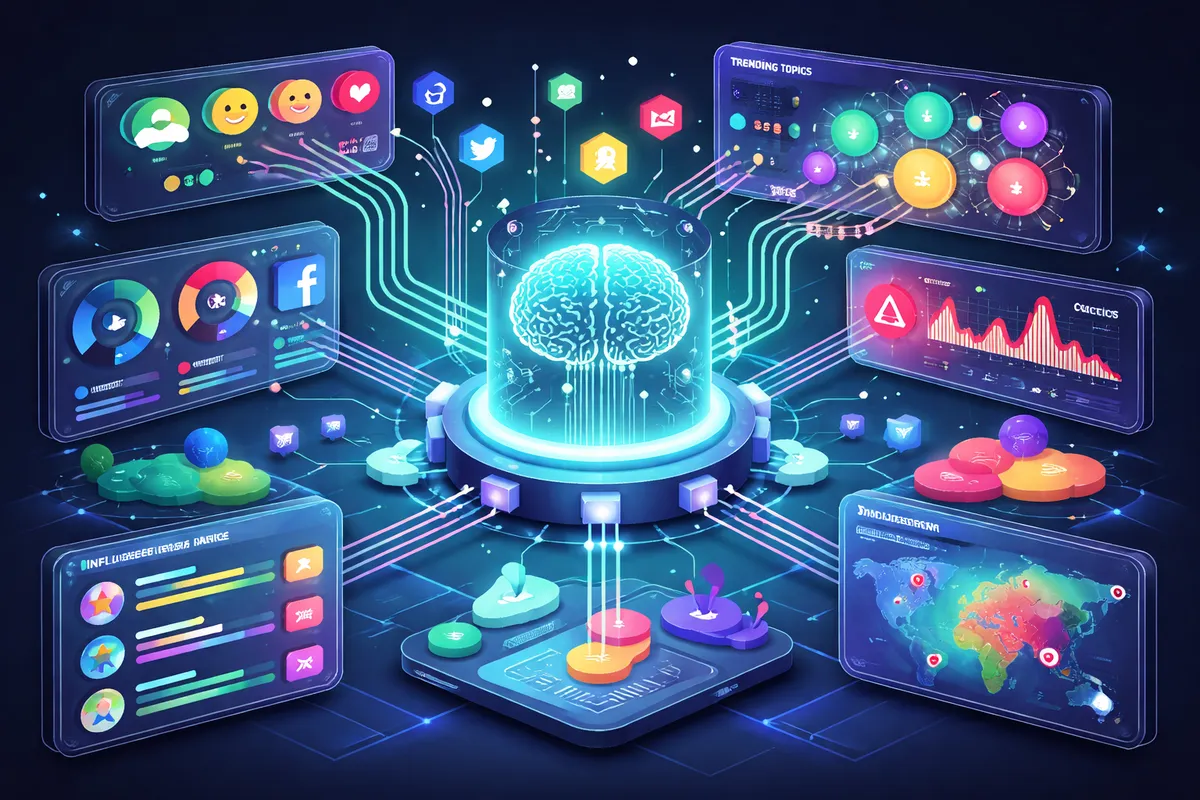
How AI Solves Social Listening
AI social listening uses natural language processing, sentiment analysis, and trend detection algorithms to process millions of online conversations simultaneously, producing signal instead of archive.
NLP models understand context, sarcasm, and intent. They distinguish between "I love this product" and "I love how this product broke on day one," between a genuine recommendation and a sponsored promotion, between a support request and a feature suggestion. Sentiment analysis scores every mention on a spectrum from highly negative to highly positive, often with sub-scores for emotions like frustration, excitement, confusion, or anger. Topic modeling identifies emerging themes and clusters related conversations, so that 40 posts mentioning a new shipping issue get surfaced as a single trend instead of 40 unrelated complaints. Anomaly detection flags unusual spikes in volume or sentiment that signal a trend or crisis, typically within 15 to 60 minutes of the first signals appearing. See our digital marketing capabilities.
The AI processes data from social media, news outlets, forums, review sites, blogs, podcasts (via transcription), and even closed communities where API access permits. Leading platforms in this space include Brandwatch, Sprinklr, Talkwalker, Meltwater, and custom stacks built on APIs like the X firehose, Reddit API, and review-site scrapers where terms allow. Choosing between them depends on breadth of source coverage, NLP quality for your industry vocabulary, and how well alerts integrate with the tools your team actually uses.
What AI-Powered Social Listening Looks Like
The shift from manual to AI-driven listening transforms market intelligence from reactive to proactive.
### Before AI - Team manually searches brand mentions on 2 to 3 social platforms daily - Competitor monitoring limited to occasional manual reviews, often quarterly - Sentiment assessed subjectively by whoever reads the mentions - Trend detection happens after trends have already peaked - Crisis response begins when an executive sees the post, not when it was written - Review-site feedback aggregated manually once a quarter for leadership decks
### After AI - AI monitors all major platforms, forums, review sites, and news outlets continuously - Competitor mentions tracked and benchmarked alongside your own brand automatically - Sentiment scored consistently across millions of mentions with accuracy and nuance - Emerging trends and anomalies flagged within hours, not days or weeks - Crisis alerts reach the team in 15 to 60 minutes with context and suggested response paths - Review-site and product feedback streamed into product and CX workflows in real time
A concrete example: a DTC beverage brand noticed a TikTok post critiquing their packaging pick up 40,000 views in 6 hours. Their AI listening platform flagged the anomaly at 4,000 views, the community team responded thoughtfully in-thread at 12,000 views, and the creator posted a follow-up acknowledging the response. Total negative sentiment spike resolved within 48 hours. Without the alert, they would have caught it two days later in a weekly digest, well after the damage.
Key Benefits
- Time savings: Replace 10 to 20 hours per week of manual monitoring with automated, comprehensive coverage, freeing social and PR teams for actual engagement work
- Accuracy: Consistent sentiment analysis across thousands of mentions, eliminating subjective bias and the "squeaky wheel" effect where loud posts dominate attention
- Scale: Monitor your brand, competitors, industry keywords, and trends across 50+ sources simultaneously, including private communities and niche forums where purchase decisions get made
- Speed: Detect brand crises and competitive moves early, when response costs are lowest. A crisis handled at 5,000 impressions rarely becomes a crisis at 500,000
- Insights: Discover unmet customer needs, product feedback, and market opportunities from organic conversations, feeding product, support, and marketing with data from people who are not in your CRM
- Competitive intelligence: Understand share of voice, sentiment gaps, and messaging effectiveness against named competitors, with enough precision to inform positioning and pricing decisions
Implementation Approach
We start with a listening scope definition. What brands, products, competitors, and topics do you need to track? Which platforms and sources matter most for your industry? A consumer brand lives on Instagram, TikTok, and Reddit. A B2B SaaS platform lives on LinkedIn, Twitter/X, G2, and niche Slack and Discord communities. Getting the source mix right up front prevents a platform that looks great in demo from going dark in practice.
Our team configures AI models to understand your specific brand context, industry terminology, and competitive landscape. We set up sentiment baselines so the system knows what "normal" looks like and can flag meaningful deviations. A fintech brand's sentiment baseline differs from a gaming brand's, and feeding the model 4 to 8 weeks of historical data anchors the anomaly detection to your reality, not a generic internet average.
Integration delivers insights where your team works: Slack or Teams alerts for urgent mentions, weekly digest reports for leadership, real-time dashboards for deep analysis, and CRM enrichment with social signals (a sales rep sees that a target account just praised a competitor on LinkedIn). We also set up escalation rules so that crisis-level events page the on-call person, while routine negative sentiment goes into a daily triage queue. Review our timeline and custom solutions.
How to Evaluate Your Options
Four questions matter when evaluating AI social listening platforms. First, source coverage. The best NLP in the world cannot analyze conversations it never sees. Verify coverage of the specific platforms and review sites where your customers actually talk, including closed communities via API partnerships. Second, NLP quality for your vertical. Generic sentiment models struggle with healthcare, legal, and financial vocabulary. Ask for an accuracy benchmark on 500 of your own historical mentions, not vendor-provided test data. Third, alert design. A platform that emails you 200 alerts a day trains your team to ignore alerts. Prioritization, deduplication, and clear severity tiers matter more than raw alert volume. Fourth, integration with your existing stack. If alerts do not land in Slack or your ticketing system, they will not drive action.
Be skeptical of mention-volume dashboards that impress in demos but do not produce decisions. The goal is faster, better actions by the humans in your business, not prettier charts.
Frequently Asked Questions
### How accurate is AI at analyzing social media sentiment? AI sentiment analysis achieves 80 to 90% accuracy on straightforward mentions. Sarcasm, irony, and heavily context-dependent posts reduce accuracy, which is why the system flags uncertain cases for human review. Accuracy improves as the model learns your brand's specific conversation patterns, often reaching 92 to 95% after 60 to 90 days of feedback from your team correcting edge cases.
### What data do I need to start? Your brand names, product names, competitor names, and relevant industry keywords. Access to your social media accounts for direct message monitoring if desired. No historical data is required, though providing 4 to 8 weeks of past mentions lets us calibrate sentiment baselines faster. The AI begins building your listening baseline immediately upon launch.
### How long does it take to implement AI social listening? Basic monitoring (brand mentions, sentiment, volume tracking) launches in 2 to 3 weeks. Advanced features like competitive benchmarking, trend prediction, and CRM integration take 4 to 6 weeks. The system reaches full accuracy after 4 to 6 weeks of baseline learning, and alerts reach their highest signal-to-noise ratio after the first crisis or campaign cycle when escalation rules get tuned to reality.
### Will AI social listening replace my social media team? No. AI handles monitoring, classification, and alerting at a scale humans cannot match. Your social media team focuses on crafting responses, developing strategy, creating content, and building community. The AI tells them where to focus their attention. The best outcomes happen when the social team trusts the alerts enough to respond fast and ignores the noise the model has filtered out.
### What does AI social listening cost? Implementation ranges from $8,000 to $25,000 depending on the number of brands, keywords, and integrations. Ongoing monitoring costs scale with mention volume, typically $1,000 to $5,000 monthly for mid-market brands and $5,000 to $20,000 for enterprises with global coverage. Most brands see immediate value through faster crisis detection and competitive intelligence, often within the first major news cycle or competitive launch.
### Can AI social listening track conversations in multiple languages? Yes. Modern NLP models handle 30+ languages with reasonable sentiment accuracy, with top-tier performance in English, Spanish, Portuguese, French, German, Japanese, and Chinese. Accuracy varies by language and vertical, so for global brands we validate each language on a sample of historical mentions and retrain as needed. Regional slang and emoji usage matter more than most teams expect and are worth a dedicated calibration pass per market.