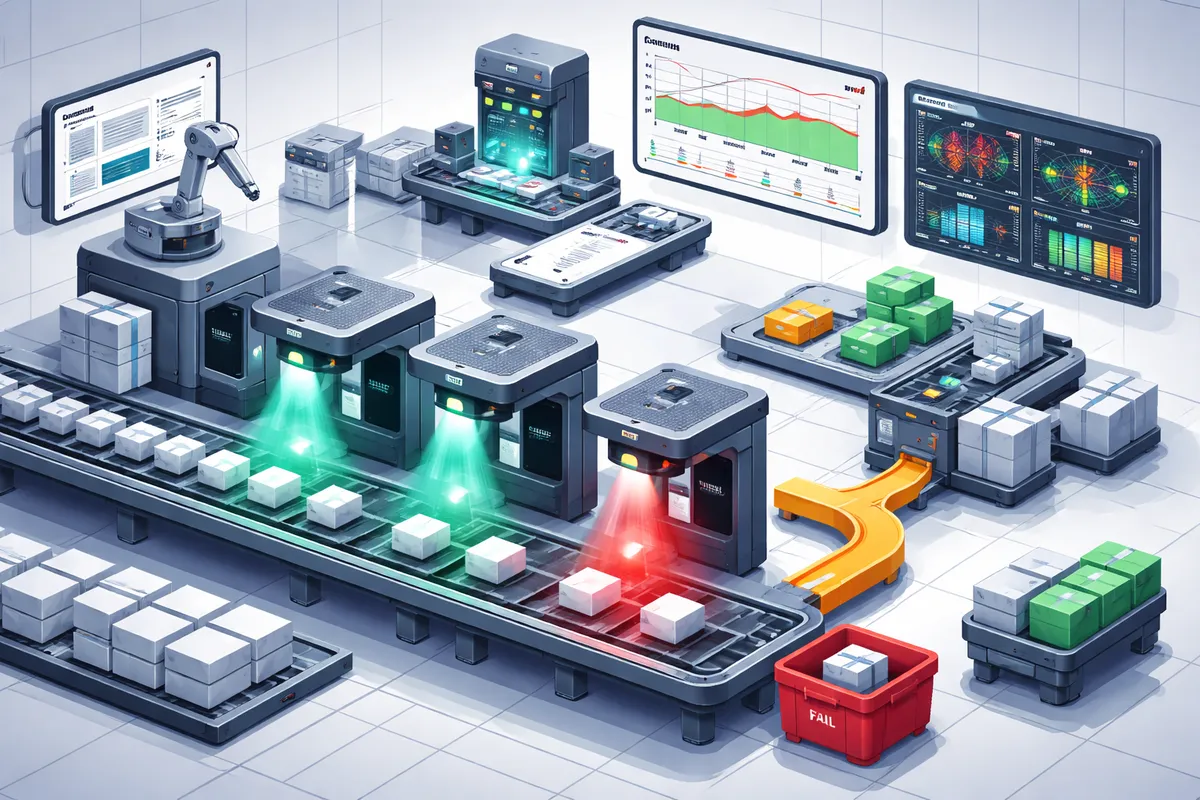
How AI Solves Quality Control
AI quality control combines computer vision, deep learning, and real-time analytics to transform inspection from sampling to 100% coverage.
High-resolution cameras capture images of every unit on the production line, typically at 5 to 20 megapixels with specialized lighting to reveal surface defects. Convolutional neural networks trained on thousands of defect examples classify each image in 20 to 100 milliseconds. The AI detects scratches, dents, color variations, dimensional errors, assembly mistakes, missing components, and surface defects invisible to the naked eye. For tasks requiring sub-millimeter precision, structured-light or 3D imaging adds depth data that flat 2D vision cannot capture. See our custom AI development approach.
The system improves continuously. Every confirmed defect becomes training data that sharpens future detection. And because the AI records every inspection with timestamped images, measurements, and confidence scores, you get complete traceability for compliance and root cause analysis. When a customer complaint arrives, the quality engineer pulls the exact image captured at inspection, confirms whether the defect was present and missed or introduced downstream, and fixes the right problem.
The software side typically runs on industrial edge compute (NVIDIA Jetson, Intel OpenVINO appliances) so that latency stays under 100 ms and decisions happen at line speed. A central training platform (often AWS, Azure, or a specialized MLOps stack) retrains models weekly or monthly as new defect examples accumulate.
What AI-Powered Quality Control Looks Like
The upgrade from manual to AI inspection changes both coverage and consistency.
### Before AI - Inspectors visually check 5 to 10% of production units by sampling - Defect criteria vary between inspectors and shifts, especially for borderline cases - Inspection data recorded manually on paper or basic spreadsheets - Root cause analysis happens days or weeks after defects are discovered - First-pass yield measured weekly, obscuring shift-level and hour-level variation - Customer complaints often drive the first detection of systematic defects
### After AI - Every unit inspected automatically at production line speed - Consistent defect criteria applied identically 24/7 with no fatigue or drift - Every inspection logged with images, measurements, classification, and confidence - Real-time alerts and trend analysis enable immediate root cause response - First-pass yield visible in real time, broken down by line, shift, and SKU - Systematic defects caught within minutes of appearing, not weeks later
A concrete example: a Tier 2 automotive supplier running 3 stamping lines deployed AI vision to detect edge burrs, dimensional deviations, and surface scratches. Within 90 days, escape rate to customer dropped from 880 PPM to 140 PPM, scrap cost fell 38% because defects were caught before downstream operations added value, and one recurring issue traced to a worn die was identified in an afternoon instead of the 3 weeks it had taken in the past.
Key Benefits
- Coverage: Inspect 100% of production without slowing the line or adding inspectors, replacing sampling with certainty
- Accuracy: Detect defects with 95 to 99% accuracy, catching micro-defects invisible to human inspectors and eliminating inspector-to-inspector variation
- Scale: Handle production increases without proportionally increasing QC headcount, and add new SKUs by training the model rather than retraining people
- Cost: Reduce scrap and rework costs by 30 to 50% by catching defects earlier in production, before upstream value gets wasted on units that will be scrapped
- Insights: Trend analysis identifies which machines, materials, and conditions produce the most defects, feeding continuous improvement with data instead of anecdote
- Compliance: Full visual and measurement records for every unit provide audit-ready traceability for ISO 9001, IATF 16949, FDA, and customer-specific quality standards
Implementation Approach
We begin with a defect catalog. Your team identifies the defect types that matter most: the ones causing returns, safety issues, or production stops. We photograph and classify examples to build the initial training dataset. For a typical deployment, we target 5 to 12 defect classes initially. Chasing every theoretical defect in month 1 dilutes model performance and delays value. Start with the top-cost defects, then expand.
Camera placement and lighting design come next. AI vision systems need consistent imaging conditions. We work with your production team to install cameras at optimal inspection points without disrupting line flow. Lighting matters more than most teams expect. Coaxial, diffuse, dark-field, or structured light each reveal different defect types, and a well-lit setup often turns a 92% accurate model into a 99% accurate one without any software change. Expect $5,000 to $25,000 per station for camera, lighting, and compute hardware depending on resolution, speed, and environmental protection requirements.
Model training uses your defect examples plus synthetic data generation to build robust classifiers. We validate accuracy against your existing inspection results in a parallel-run phase, where the AI inspects alongside human inspectors for 2 to 4 weeks. This phase builds operator confidence, surfaces edge cases, and calibrates confidence thresholds. Once the model proves itself, it takes over primary detection responsibility with humans shifting to reviewing flagged exceptions. Review our timeline approach and integration capabilities.
How to Evaluate Your Options
Three questions matter when evaluating AI quality control. First, how does the vendor handle your hardest defects? Most platforms ace surface scratches on flat metal. Fewer handle transparent packaging, reflective surfaces, or subtle color shifts. Ask for a pilot that includes your worst 3 defect types, not your easiest. Second, what is the total cost of ownership over 5 years? Hardware plus software plus integration plus retraining labor adds up, and a platform that requires expensive vendor labor for every new SKU can double your run rate. Third, how does the system handle product changes? Lines that introduce new SKUs quarterly need a model retraining workflow your own team can run, not a 6-week vendor engagement per change.
Watch out for vendors who quote accuracy only on the easy cases. A 99% accuracy claim that falls to 85% on borderline defects is not deployment-ready. Insist on per-defect-class metrics and confusion matrices, not top-line averages.
Frequently Asked Questions
### How accurate is AI at detecting quality defects? Accuracy depends on defect type and image quality. Surface defects like scratches and dents typically achieve 97 to 99% detection rates. Subtle defects like color variations reach 90 to 95%. The system flags uncertain cases for human review rather than making a wrong call, and the balance between false accepts (defects that slip through) and false rejects (good parts flagged as bad) is tunable based on your cost structure.
### What data do I need to start? You need 200 to 500 images of each defect type you want to detect, plus images of acceptable products. If you do not have a defect image library, we help build one during a 2 to 4 week data collection phase on your production line. Synthetic data augmentation can fill gaps for rare defects, which matters because many of the most costly defects also happen the least often.
### How long does it take to implement AI quality control? Pilot deployment covering one inspection point takes 6 to 8 weeks. Full production line coverage takes 12 to 16 weeks depending on the number of inspection stations and defect types. We recommend starting with your highest-impact defect and expanding from there. Lines with harsh environments (heat, dust, washdown) add 2 to 4 weeks for hardware hardening.
### Will AI completely replace human quality inspectors? AI handles primary visual inspection. Human inspectors focus on complex judgment calls, final verification of AI-flagged items, and quality assurance tasks that require physical manipulation or functional testing. Most facilities reassign inspectors to higher-value quality engineering roles, including root cause investigation, supplier quality work, and continuous improvement projects that were previously understaffed.
### What does AI quality control cost? Hardware (cameras, compute) plus software implementation ranges from $30,000 to $100,000 per inspection station. Ongoing costs include model updates and system maintenance, typically $1,500 to $5,000 monthly per line. Most manufacturing clients see ROI within 6 to 12 months through reduced scrap, fewer returns, and lower warranty costs. High-value products (medical devices, aerospace components) often pay back within the first quarter.
### How do we handle new products or SKU changes? New SKUs typically need a targeted retraining pass using 50 to 200 labeled examples. We provide tools so your quality team can label images and trigger retraining without vendor involvement, usually turning a new SKU around in 2 to 5 days. For product families with shared features, transfer learning cuts that further.