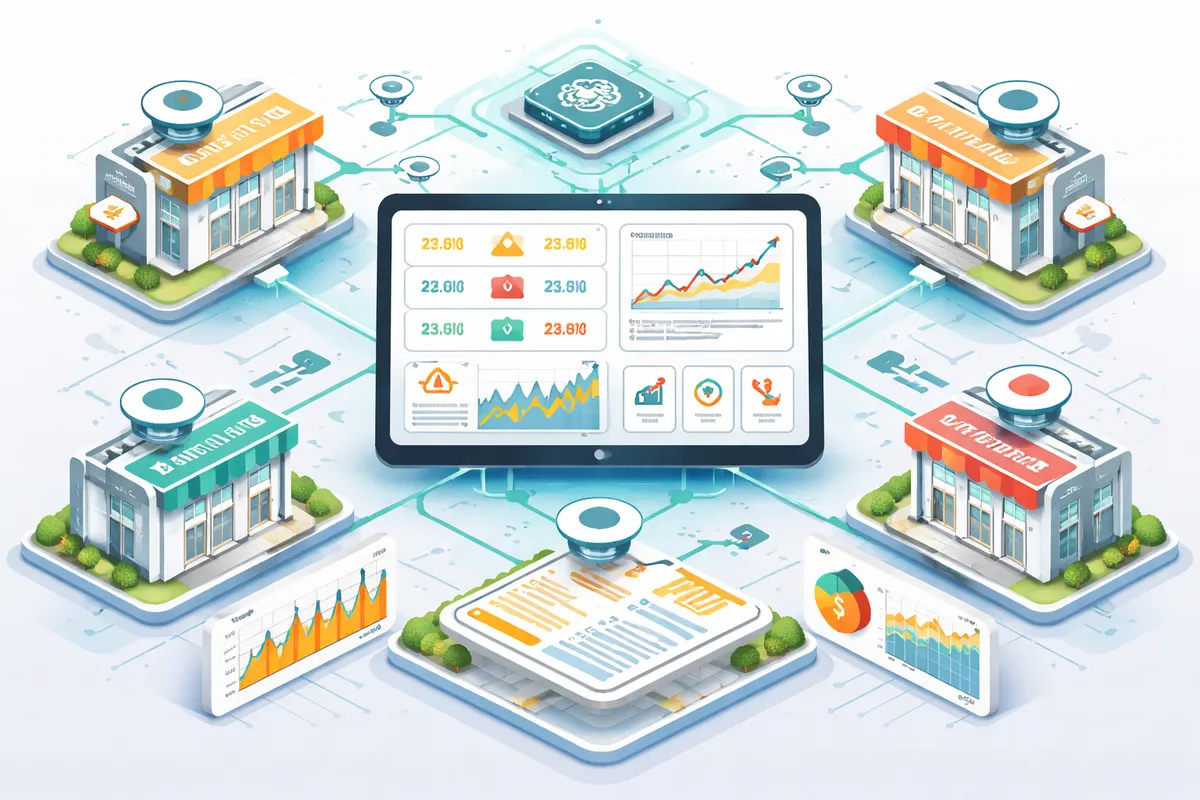
How AI Solves Price Monitoring
AI-powered price monitoring uses web scraping, machine learning, and optimization algorithms to track, analyze, and act on pricing data automatically. The typical architecture runs scheduled crawlers against a target list of competitor URLs and marketplace APIs, stores the raw price history in a time-series database, and runs matching, normalization, and recommendation models on top of that data.
Automated crawlers monitor competitor websites, marketplaces, and comparison shopping engines continuously. A well-built system can track 10,000 SKUs across 50 competitors with a refresh interval of 1 to 4 hours, depending on category volatility. Machine learning models identify matching products across competitors even when names and descriptions differ, using a combination of text embeddings, image similarity, and attribute matching. Price optimization algorithms calculate the price point that maximizes your chosen objective: revenue, margin, market share, or a weighted combination. See our custom automation services for building this stack to fit your catalog.
The AI does not just report prices. It understands pricing context: promotional periods, stock levels, shipping costs, and seller ratings that affect the true competitive position. A competitor showing a $199 price with a 2-week shipping delay is not actually beating your $209 price with next-day delivery, and the model needs to reflect that. A competitor showing $179 with "only 2 left" on Amazon is often within hours of a stockout, which changes the right response entirely.
What AI-Powered Price Monitoring Looks Like
The transformation from manual to AI-driven pricing changes both speed and sophistication. Most teams underestimate how much the speed alone matters, because so many pricing problems are really latency problems in disguise.
### Before AI - Team manually checks 5 to 10 competitor websites weekly for key products - Price changes recorded in spreadsheets with inconsistent update frequency - Pricing decisions based on cost-plus margins with manual competitive adjustments - Promotional and MAP compliance checked occasionally through manual spot checks - No visibility into how your own price changes affect conversion or traffic
### After AI - AI monitors hundreds of competitors across thousands of SKUs in real time - Price change history tracked automatically with timestamps and trend analysis - Optimal prices calculated based on competitive position, demand elasticity, and margin goals - Automatic alerts for MAP violations, competitor stockouts, and unusual pricing patterns - Conversion and revenue impact of every price change measured and attributed
Key Benefits
- Time Savings: Replace 15 to 20 hours per week of manual price checking with automated, comprehensive monitoring. One pricing analyst can now oversee a catalog that previously required three.
- Accuracy: Capture every price change across all monitored competitors with exact timestamps, enabling accurate elasticity and response modeling.
- Scale: Monitor unlimited SKUs and competitors simultaneously across marketplaces and direct channels. The marginal cost of adding another 500 SKUs to the monitoring set is effectively zero.
- Cost: Improve margins by 2 to 5% through data-driven pricing that responds to market conditions in real time. On a $20M revenue business, that is $400,000 to $1,000,000 in annualized contribution.
- Insights: Understand competitor pricing strategies, seasonal patterns, and elasticity curves that inform long-term strategy. The data feeds into SEO services and merchandising decisions as well, because search position and price are tightly linked.
Realistic Failure Modes and How to Avoid Them
AI price monitoring systems fail in predictable ways. Understanding those failure modes upfront saves months of frustration.
The first is product matching drift. When a competitor relabels a SKU or launches a variant, the matching model can silently start comparing the wrong products. A well-built system flags match confidence and requires human review when confidence drops below a threshold, usually 0.85 on a 0 to 1 scale. Without that guardrail, the recommendation engine will eventually push you to match a price that does not apply.
The second is crawler breakage. Competitor sites change markup, add bot detection, or shift prices to JavaScript-rendered components. Robust systems use rotating proxies, headless browsers where needed, and automated monitoring of crawler health. A silent crawler failure that goes unnoticed for a week is functionally identical to having no system at all.
The third is over-reaction. Teams sometimes configure repricing rules that chase every competitor move, which creates thrash, confuses customers, and often ends in a margin collapse. The right pattern is usually a dampened response: update pricing once or twice per day based on a weighted signal, not instantly on every competitor change.
The fourth is MAP policy violation by your own system. If you sell through multiple channels and one of your brand partners enforces MAP, an AI repricer without MAP-aware guardrails can expose you to contractual penalties. Always encode the floor as a hard constraint, not a soft objective.
Implementation Approach
We start by defining your competitive landscape. Which competitors matter? Which products are most price-sensitive? What marketplaces and channels need monitoring? Which SKUs drive the majority of revenue, and where is margin most at risk?
Our team builds product matching algorithms that identify the same or equivalent products across competitors despite different naming conventions. We configure monitoring frequency based on market dynamics. Fast-moving categories like consumer electronics may need hourly checks, while stable markets like industrial supplies need daily monitoring. We also define the rule set that governs automatic actions: what gets auto-repriced, what requires human approval, and what triggers alerts.
Integration connects pricing intelligence to your ecommerce platform, ERP, or pricing management system. We can implement fully automated repricing or decision-support dashboards where your team approves AI recommendations before they go live. Many teams start in recommendation-only mode for the first 30 to 60 days, then graduate to automated repricing for low-risk segments once trust is established. Review our implementation approach and custom solutions.
How to Evaluate Your Options
Three categories of tools exist. Off-the-shelf repricers like Prisync, Skuuudle, and Informed (formerly Appeagle) work well for marketplace sellers with common catalogs. Pricing is typically $300 to $2,000 per month, and setup takes a few days. Enterprise platforms like PROS, Vendavo, and Pricefx handle more complex B2B scenarios with contract-aware pricing and deal-level optimization, at pricing that starts around $50,000 per year. Custom builds sit between or above those, and are the right choice when your catalog, channels, or logic do not fit an existing product.
When evaluating, score vendors on match accuracy in your category (ask for a trial run on your actual SKUs), refresh frequency, data export flexibility, rule engine expressiveness, and support for MAP and channel-specific constraints. Avoid anyone who cannot show you their matching confidence scores or who requires you to manually maintain the competitor mapping indefinitely.
Frequently Asked Questions
### How accurate is AI at matching competitor products? Product matching accuracy typically reaches 90 to 97% for exact matches and common variants. The AI uses product attributes, images, and specifications to identify matches even when product names differ. Uncertain matches (confidence below 0.85) are flagged for human confirmation during the first 30 days of deployment, which trains the model to handle your specific catalog conventions. After that ramp, manual confirmations usually drop to under 5% of new matches.
### What data do I need to start? Your product catalog with SKUs, current prices, and cost data. A list of competitors and their websites or marketplace storefronts. Target margin floors and any MAP pricing requirements. Historical sales data by SKU helps the demand elasticity models calibrate faster, but is not strictly required. We handle the crawling setup and product matching from there.
### How long does it take to implement AI price monitoring? Basic monitoring (price tracking and alerts) launches in 2 to 3 weeks. Advanced features like dynamic pricing recommendations and automated repricing take 4 to 8 weeks. Product matching refinement continues during the first month as edge cases are resolved. Integration with an ERP or enterprise pricing system adds 2 to 4 weeks on top, depending on the API surface.
### Will AI completely replace my pricing team? No. AI handles data collection, analysis, and routine price adjustments. Your pricing team sets strategy, defines rules and guardrails, manages vendor relationships, and makes judgment calls on promotions and new product launches. The AI executes strategy faster and more consistently, but strategy itself remains a human responsibility. Most teams find that their pricing analysts shift from data collection to higher-value analysis and cross-functional work.
### What does AI price monitoring cost? Implementation ranges from $10,000 to $30,000 depending on catalog size, competitor count, and integration complexity. Ongoing costs scale with monitoring volume, typically $1,000 to $5,000 monthly for crawler infrastructure, data storage, and model hosting. Most businesses see ROI within 1 to 2 months through margin improvements alone, and the payback accelerates as the model learns your specific market.
### How do I avoid starting a price war with competitors? Configure your rule engine with constraints that reflect your strategy, not raw competitor matching. For example, set a rule that says "price within 3% of the cheapest in-stock competitor, but never below the margin floor of 22%, and never reduce more than twice per week." Those guardrails keep your pricing responsive without chasing competitors into unprofitable territory. The best systems are ones where the AI is bounded by strategy, not the other way around.