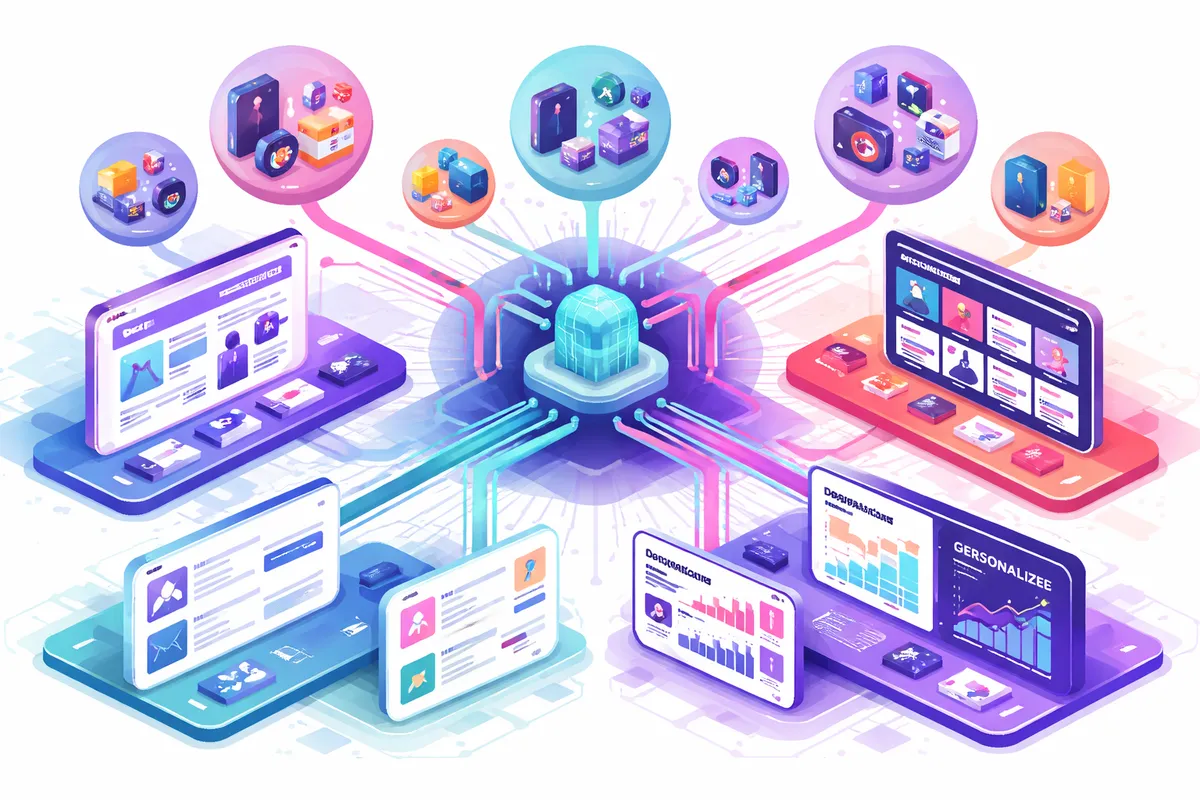
How AI Solves Personalization
AI-powered personalization uses machine learning to understand each customer individually and adapt experiences in real time. No segments. No rules. Each visitor gets a unique experience based on their specific behavior patterns, predicted intent, and observed response to previous variations.
Behavioral models track how each user navigates your site, what they click, what they ignore, how they scroll, and how they compare to high-converting users. Real-time decision engines select the best content, offer, or product for each person at each moment, typically within 50 to 150 milliseconds so the page still feels instant. NLP models generate or select messaging that matches individual preferences and communication styles, including tone, length, and the balance of rational versus emotional appeals. Explore our personalization solutions.
The AI operates across channels: website, email, paid ads, SMS, and mobile app. A consistent understanding of each customer creates coherent personalization everywhere they interact with your brand. If a customer responded to a video asset on Instagram, the homepage hero can echo the same visual when she lands. If she ignored three emails in a row, the system quiets that channel and shifts budget to a channel where she is active. This is the difference between talking at customers and responding to them.
Modern stacks often combine a customer data platform like Segment or Rudderstack, a decisioning layer like Dynamic Yield or a custom model, and a headless CMS to deliver variants. A solid website foundation matters because personalization can only adapt what the underlying page can render.
What AI-Powered Personalization Looks Like
The shift from segment-based to individual-level personalization transforms customer experience in concrete, measurable ways.
### Before AI - 5 to 10 customer segments receiving pre-built content variations - Website shows the same layout and messaging to all visitors in a segment - Email personalization limited to first name, company name, and basic merge fields - Personalization rules maintained manually and updated quarterly at best - Product recommendations rely on "customers also bought" lists updated weekly - A/B tests run one at a time and take weeks to reach significance
### After AI - Every visitor sees a uniquely optimized experience based on individual behavior - Website content, layout, hero images, and CTAs adapt in real time as the visitor browses - Email content, send time, subject lines, and even preview text optimized per recipient - Personalization models learn and improve continuously without manual rule updates - Product recommendations reflect the session's intent, not a rolling 30-day average - Multi-armed bandits run dozens of variations simultaneously and converge faster
A practical example: a DTC skincare brand using segment-based personalization might lift conversion from 2.1% to 2.4% with three years of careful work. After migrating to AI personalization on product pages and email, the same brand commonly sees conversion move to 3.2% or higher within a quarter, with average order value rising another 8 to 12% from smarter cross-sell suggestions.
Key Benefits
- Time savings: Eliminate manual segment creation and content variation management, freeing marketing teams for strategy and creative work
- Accuracy: Deliver experiences that match individual intent, not broad segment assumptions that were probably wrong for half the people in the segment
- Scale: Personalize for millions of users simultaneously across every channel without hiring a matching army of campaign managers
- Revenue: Increase conversion rates by 15 to 40% from the same traffic and same budget, with average order value typically rising 5 to 15%
- Insights: Understand which personalization elements drive conversions for different customer types, then feed those insights back into product and creative decisions
- Retention: Better in-session relevance translates to higher repeat-visit and repeat-purchase rates, often lifting customer lifetime value 10 to 25%
Implementation Approach
We start with a personalization audit. Where do your customers interact with your brand? What data do you capture at each touchpoint? Which moments in the customer journey have the highest impact potential? A mid-sized ecommerce site might have 40 candidate touchpoints. We prioritize the 6 to 8 that move revenue the most, starting with the homepage, product detail page, cart, and post-purchase email.
Our team integrates your data sources: website analytics, CRM, purchase history, email engagement, ad platform data, and support ticket history. This unified customer profile powers AI decision-making across channels. If your data is fragmented across Shopify, Klaviyo, HubSpot, and a Google Analytics property that has not been audited in a year, we handle the plumbing and the governance. Clean inputs make or break personalization quality.
We implement personalization in phases, starting with highest-impact touchpoints like homepage hero, product pages, and welcome email. A/B tests validate that AI personalization outperforms your current approach at every step, with statistical significance thresholds set before the test starts. Once proven, we expand to additional channels and touchpoints. Typical first-90-day wins look like homepage conversion up 12 to 20%, email click-through up 25 to 40%, and post-purchase repeat rate up 5 to 10%. See our implementation timeline and digital marketing services.
How to Evaluate Your Options
Three questions matter when choosing a personalization approach. First, what is the minimum traffic threshold? Most AI personalization engines need 10,000 monthly visitors per surface to learn effectively. Below that, rules-based tools may outperform for the first 6 months while you grow. Second, how transparent is the decisioning? You should be able to ask "why did the AI show this variant to this user" and get a readable answer. Black-box systems create debugging nightmares and compliance risk. Third, how does the vendor price? Flat-fee SaaS works for predictable traffic. Revenue-share pricing aligns incentives but can cost more at scale. Custom-built systems cost more upfront and less over time.
Be skeptical of vendors who promise lift without demanding data quality first. Personalization is only as good as the signals feeding it, and a vendor who does not ask hard questions about your CDP, your tagging, and your identity resolution is selling you a lottery ticket.
Frequently Asked Questions
### How accurate is AI at personalizing customer experiences? AI personalization typically improves conversion rates by 15 to 40% over segment-based approaches. The accuracy depends on data quality and volume. Sites with 10,000+ monthly visitors see meaningful personalization within 2 to 3 weeks. Performance improves continuously as the model learns, often plateauing at peak lift around the 90-day mark.
### What data do I need to start? Website behavioral data (page views, clicks, scroll depth, time on page), customer transaction history, and email engagement data provide the foundation. More data sources improve personalization quality. We can start with as little as website analytics and a CRM database, then layer in support history, loyalty data, and ad platform signals over the first quarter.
### How long does it take to implement AI personalization? Initial deployment covering website personalization takes 4 to 6 weeks. Adding email and ad personalization takes another 2 to 4 weeks. Full omnichannel personalization matures over 2 to 3 months as models learn from cross-channel interactions and the decision engine accumulates enough observations per variant.
### Will AI personalization feel intrusive to customers? Done well, personalization feels helpful, not creepy. The AI adapts content relevance without exposing what it knows about the user. We follow privacy-by-design principles and comply with GDPR, CCPA, and other privacy regulations. Customers experience better relevance, not surveillance. The line is crossed when personalization references information the customer never knowingly shared, and we design around that line.
### What does AI personalization cost? Implementation ranges from $15,000 to $50,000 depending on channels and integration complexity. Ongoing platform and inference costs typically run $2,000 to $8,000 monthly for mid-market brands, scaling with traffic and data volume. Most clients see positive ROI within 2 to 3 months through increased conversion rates and average order value.
### Can AI personalization work for B2B with long sales cycles? Yes. B2B personalization looks different. Instead of optimizing impulse purchases, it optimizes account progression, surfacing relevant case studies, ROI calculators, and decision-stage content based on firmographics and engagement signals. Expect slower lift curves (6 to 9 months to full value) but stronger effects on pipeline velocity and deal size, often shortening enterprise sales cycles by 10 to 20% and lifting win rates on active pipeline by 5 to 12%.
### How do we handle privacy regulations like GDPR and CCPA? Consent-aware personalization is built into every implementation. Visitors who decline tracking get a sensible default experience with no behavioral profiling. Consented visitors get full personalization, and all data flows are documented for DPIA and audit purposes. We work with your legal team on retention policies, data subject access request workflows, and cross-border transfer considerations so that personalization never becomes a compliance liability.
### What happens if our catalog or content changes frequently? Fast-moving catalogs are where AI personalization shines. The model adapts to new products, retired SKUs, and changing content libraries without manual rule updates. For retailers who add 50 to 200 new SKUs per week, AI recommendations reach useful accuracy on new items within 48 to 72 hours by using content-based signals (category, attributes, copy) before behavioral data has accumulated. Publishers and media brands get similar benefits on freshly released articles and episodes.