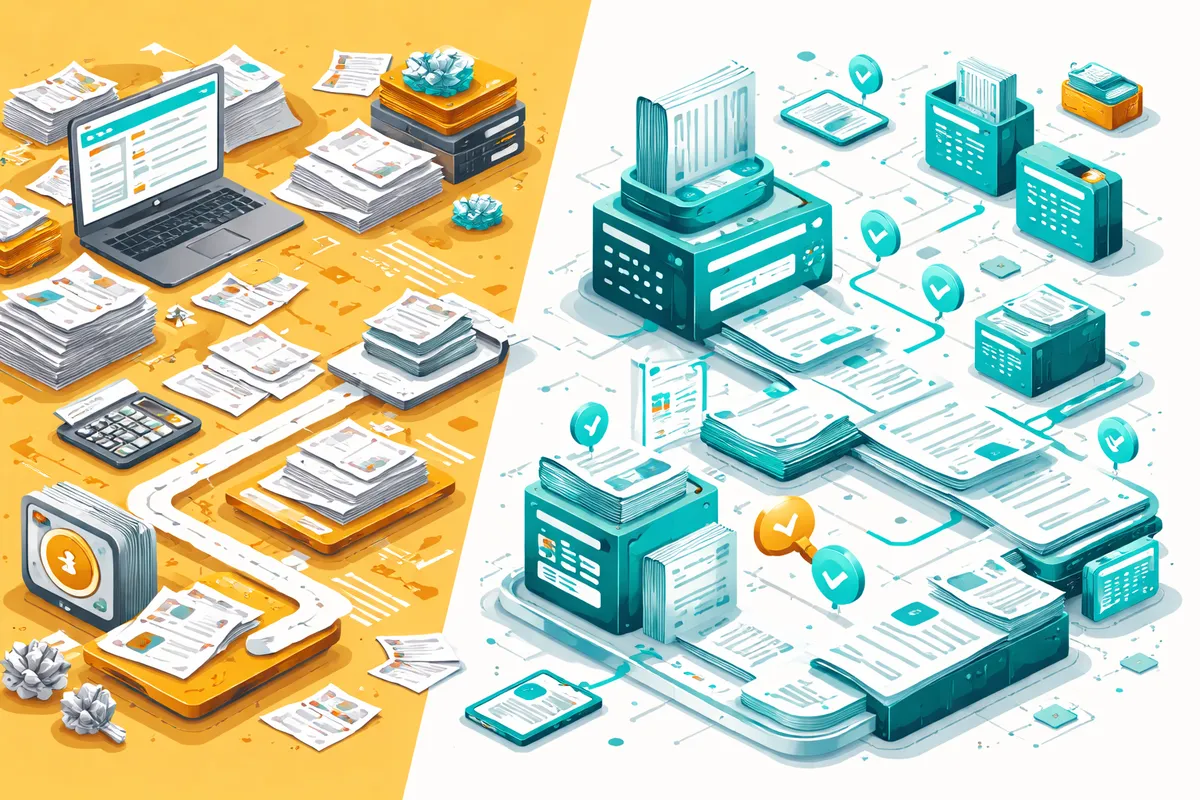
How AI Solves Invoice Processing
AI-powered invoice processing combines optical character recognition (OCR), natural language processing, and machine learning to automate every step from inbox to ledger.
Computer vision and OCR extract text from scanned documents, PDFs, and even photos of paper invoices taken on a phone. Modern models handle rotated, skewed, and low-resolution scans with 95%+ character accuracy. NLP models understand invoice structure regardless of format, identifying vendor names, invoice numbers, line items, quantities, unit prices, tax amounts, total due, dates, and payment terms, even when each vendor uses a different template. Machine learning matches invoices to purchase orders, flags anomalies (unit price drift, quantity mismatches, new vendors, unusual totals), and learns your specific business rules over time. See how we build custom automation.
A typical stack pairs a document extraction layer (Rossum, Docsumo, AWS Textract, Azure Form Recognizer, or a custom trained model) with a rules and orchestration layer that sits between extraction and your ERP. When the AI is 98% confident in a field, it writes straight to your accounting system. When it falls below a configurable threshold (often 90%), the invoice is queued for human review with the uncertain fields highlighted. The AI learns your specific vendors, formats, and business rules over time, improving accuracy with every invoice processed and every correction a reviewer makes.
What AI-Powered Invoice Processing Looks Like
The transformation eliminates manual touchpoints while improving accuracy, speed, and visibility across the entire AP workflow.
### Before AI - Staff manually enters invoice data into accounting software, retyping vendor names, amounts, and GL codes - Purchase order matching requires pulling up POs and comparing line by line in separate tabs - Approval routing happens via email chains with no visibility into status or bottlenecks - Exception handling takes hours of back-and-forth with vendors to resolve simple mismatches - Month-end close drags because the AP queue still has a backlog of unentered invoices
### After AI - AI extracts all invoice data automatically regardless of format, with confidence scores per field - Purchase orders matched instantly with flagging for unit-price, quantity, or line-item discrepancies - Approvals route automatically based on amount thresholds, vendor category, cost center, and department rules - Exceptions are categorized (PO mismatch, missing PO, new vendor, duplicate, tax discrepancy) and prioritized with suggested resolutions - Close happens on schedule because the AP backlog is measured in hours, not days
Key Benefits
- Time Savings: Reduce invoice processing time by 80% to 90%, from 12 to 15 minutes per invoice to under 2 minutes on exception cases and zero touch on straight-through cases
- Accuracy: Lower error rates from 1% to 3% down to under 0.1% with AI validation and cross-referencing against PO and master-vendor data
- Scale: Process thousands of invoices daily without adding headcount to your finance team
- Cost: Cut per-invoice processing cost from $15 to $40 down to $2 to $5, and recover 0.1% to 0.5% of AP spend previously lost to duplicate payments
- Insights: Real-time dashboards show cash flow obligations, vendor spending patterns, early-pay discount opportunities, and top sources of AP exceptions
How to Evaluate Your Options
Not every AP team needs a bespoke AI build. Your evaluation should weigh four factors: volume, complexity, integration, and control.
Volume sets the baseline. Below 500 invoices per month, a packaged SaaS like Bill.com, Ramp Bill Pay, or Stampli covers most needs at $5 to $15 per invoice with limited setup. Between 500 and 5,000 invoices per month, mid-market platforms like Tipalti, Airbase, or a configured Rossum deployment become the sweet spot. Above 5,000 per month or with complex three-way matching across ERP modules, a custom integration on top of an extraction engine like AWS Textract or Azure Form Recognizer usually wins on total cost of ownership within 18 months.
Complexity matters more than raw volume. A company with 30 vendors and consistent formats can hit 90% straight-through processing with a light-touch setup. A company with 500 vendors, multi-entity consolidation, freight invoices that need line-item allocation, and international VAT handling needs a more sophisticated model, vendor-specific templates, and stronger exception workflows. Be honest about where your edge cases live before scoping the project.
Integration is where most implementations slow down. If you run NetSuite, Sage Intacct, SAP, Oracle, Microsoft Dynamics, or QuickBooks Enterprise, native connectors exist but still require careful field mapping, GL coding logic, and approval hierarchy replication. Budget 30% to 50% of the project for integration work. Finally, consider control: packaged tools move fast but lock you into their approval logic and reporting, while custom builds take longer but let you model your exact business rules and data ownership.
Implementation Approach
We begin with a process audit of your current accounts payable workflow. This maps every step from invoice receipt through payment, identifies bottlenecks and error-prone stages, and establishes a baseline for cost per invoice, touch time per invoice, error rate, and days payable outstanding. Without these numbers, you cannot prove ROI later.
Next, we assess your invoice formats and data quality. AI needs training data to learn your specific vendors and document types. We typically start with your top 20 vendors by volume, which usually covers 70% to 80% of invoices, and expand from there. For each vendor we build a template or a trained region-of-interest map so extraction confidence stays high even when the vendor changes their layout.
Integration connects the AI system to your accounting software, ERP, and approval workflows. We run a parallel processing period (usually 2 to 4 weeks) where AI handles invoices alongside your existing team, so you can validate accuracy before full automation. During parallel run, we tune the confidence thresholds, rebuild the approval hierarchy, and confirm that GL coding matches your chart of accounts. Only after two consecutive weeks of 95%+ match rates do we recommend cutting over. Review our implementation approach and custom integration services.
Frequently Asked Questions
### How accurate is AI at extracting invoice data? Modern AI invoice processing achieves 95% to 99% extraction accuracy on the primary fields (vendor, amount, date, invoice number, PO) depending on document quality. Handwritten invoices and poor scans reduce accuracy, but the AI flags low-confidence extractions for human review rather than silently writing bad data. Accuracy improves as the system learns your specific vendor formats, often reaching 99%+ on your top 50 vendors within the first 90 days.
### What data do I need to start? You need a sample set of 200 to 500 invoices representing your typical vendor mix and formats. Access to your accounting system or ERP for integration. Your purchase order data if you want automated three-way PO matching. Master vendor data to catch new vendors and potential fraud. We handle the data preparation and model training.
### How long does it take to implement AI invoice processing? Basic extraction and routing takes 4 to 6 weeks. Full automation including PO matching, exception handling, approval routing, and accounting system integration takes 8 to 12 weeks. We run parallel processing for 2 to 4 weeks before full cutover to validate accuracy against your existing AP team's output.
### Will AI completely replace my accounts payable team? AI handles 70% to 85% of invoices without any human intervention. Your team focuses on exceptions, vendor relationships, fraud review, and strategic financial decisions like early-pay discount optimization and working capital management. Most companies redeploy AP staff to higher-value work rather than eliminating positions, because the same people who knew the exceptions are now the ones teaching the AI how to handle them.
### What does AI invoice processing cost? Implementation ranges from $20,000 to $60,000 depending on invoice volume, format complexity, and integration requirements. Ongoing costs scale with volume, typically $0.50 to $2.00 per invoice for processing plus a monthly platform fee. Companies processing 1,000+ invoices monthly usually see ROI within 4 to 6 months.
### How does AI handle fraud and duplicate invoices? The model cross-references each incoming invoice against your 90-day history using vendor name, invoice number, amount, and date, flagging likely duplicates before they enter the approval queue. Anomaly detection catches new vendors, unusual amounts for a given vendor, unit-price drift, and invoices that arrive outside normal patterns. Studies suggest companies recover 0.1% to 0.5% of AP spend previously lost to duplicates within the first year of automation.