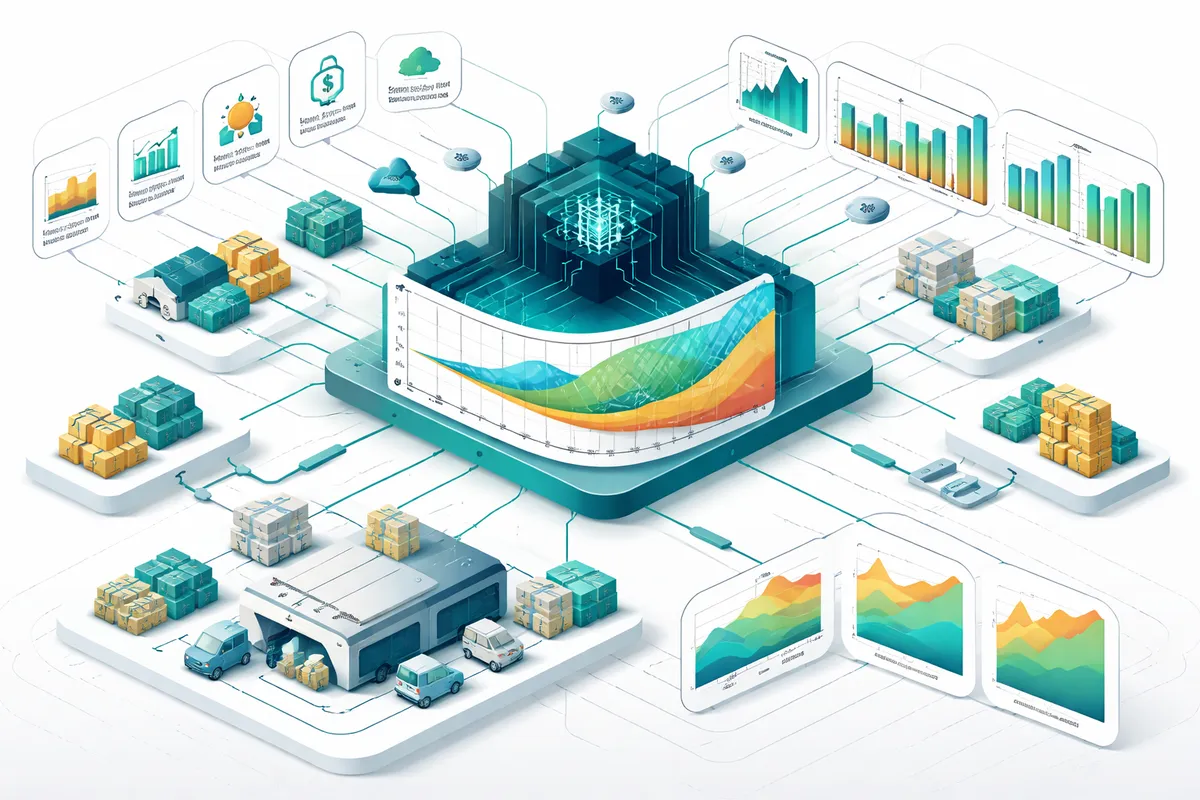
How AI Solves Demand Forecasting
AI-powered forecasting uses machine learning models trained on your sales data combined with external signals. Time series models like Prophet and ARIMA capture cyclical patterns. Gradient boosting models like XGBoost and LightGBM identify complex relationships between demand drivers. Neural networks, particularly transformer-based architectures that recently replaced LSTMs for most production use cases, handle long-horizon forecasts with multiple interacting drivers.
The AI incorporates variables that manual methods cannot: weather forecasts, local events, economic indicators like consumer confidence and gas prices, social media trends, competitor pricing, and marketing campaign schedules. Models update daily or weekly instead of monthly. A production deployment for a national retailer we built ingests 47 external signals alongside internal sales, inventory, and promotion data. See our custom AI development process and AI integration services for how this connects to ERP and POS systems.
Crucially, AI quantifies uncertainty. Instead of a single number, you get probability ranges that inform smarter inventory decisions. A forecast of "1,200 units next week, with 90% confidence between 950 and 1,480" is operationally different from "1,200 units." The first lets your team right-size safety stock. The second is just a guess dressed up as a number.
What AI-Powered Forecasting Looks Like
The upgrade from manual to AI forecasting changes both accuracy and agility.
### Before AI - Planners build forecasts in spreadsheets using 12 months of historical data - Forecasts updated monthly with manual adjustments for known events - New products forecasted by comparison to similar past launches - Safety stock set at fixed percentages regardless of demand volatility - Promotion lift estimated by "what worked last time," often wrong by 30 to 50%
### After AI - AI models process years of data plus external signals to generate daily forecasts - Forecasts update automatically as new sales data and market signals arrive - New product demand estimated using attribute-based models and early sales velocity - Safety stock optimized dynamically based on forecast confidence and lead times - Promotion lift modeled per SKU with price elasticity and cannibalization accounted for
A specialty food brand we worked with reduced overstock by 31% and cut stockouts by 58% within two seasons. The unlock was not the model itself. It was integrating the forecast output into their replenishment workflow so buyers saw AI-recommended quantities inside the same ERP screen where they placed POs. Without that last mile of UX, even great forecasts get ignored.
Key Benefits
- Time Savings: Reduce forecasting cycle time by 75%, from weeks to hours
- Accuracy: Improve forecast accuracy by 20 to 50% compared to manual and simple statistical methods
- Scale: Forecast at the SKU level across thousands of products and locations simultaneously
- Cost: Reduce overstock costs by 20 to 30% while cutting stockout rates by 50 to 65%
- Insights: Understand demand drivers at a granular level. Know why demand shifts, not just that it shifted
- Alignment: One forecast across planning, merchandising, marketing, and finance
Implementation Approach
We start with a data assessment. Good forecasting requires clean historical sales data, and we evaluate what you have and what gaps need filling. Most businesses have 2+ years of transaction data, which provides a strong foundation. The common gaps we find: incomplete stockout logging (so lost sales look like zero demand), missing promotional calendars, and no systematic price history, which makes elasticity modeling impossible.
Our team builds and tests multiple forecasting models against your actual historical demand. We measure accuracy using holdout periods so you see real performance before deployment. Typical production deployments combine a base time-series model with a gradient-boosted ensemble that handles promotions and external signals, plus a separate cold-start model for new SKUs. The winning model integrates with your inventory management or ERP system, whether that is NetSuite, SAP, Microsoft Dynamics, or a specialty system like Cin7 or Fishbowl.
We configure alert thresholds for demand anomalies and build dashboards that give your planning team visibility into forecast drivers. Training ensures your team knows how to interpret and act on AI-generated forecasts, including when to override the model. Good AI forecasting systems are collaborative, not automated away from human judgment. Review our implementation timeline and solutions approach.
How to Evaluate Your Options
The market has three tiers. Enterprise platforms like Blue Yonder, Oracle Demantra, and o9 Solutions. These are powerful but expensive, usually $500,000 to $3 million per year for mid-market implementations, with 9 to 18 month deployments. Specialized SaaS like Inventoro, Streamline, and RELEX. These target mid-market with $30,000 to $200,000 annual pricing and faster deployments. Custom builds on cloud ML platforms like Databricks, SageMaker, or Vertex AI, which give you full control at the cost of ongoing engineering ownership.
Five questions to ask every vendor. What is your MAPE or WAPE benchmark at the SKU-week level for customers in our category? How do you handle new product forecasting without historical data? Can we override the model for strategic SKUs and retain those overrides through retraining? How long does it take to add a new external signal, like a new promotion type or a new competitor price feed? What happens to forecast quality when we hit Black Friday or a supply shock? If the vendor cannot cite specific customer outcomes and methodologies, the sales demo is hiding something.
Pilot scope matters. A good pilot covers one category, 500 to 2,000 SKUs, one location or one region, and runs for 12 weeks against the existing forecasting process in parallel. If AI does not beat your current process by at least 15% on WAPE in that window, either the data is not ready or the vendor is not a fit.
Frequently Asked Questions
### How accurate is AI at demand forecasting? AI models typically achieve 80 to 95% accuracy at the SKU-week level, compared to 50 to 70% for manual methods. Accuracy varies by product type: stable products forecast better than fashion or trending items. For highly volatile items, the value of AI is less about a tighter point forecast and more about quantifying the uncertainty so you can set safety stock intelligently. The model improves continuously as new data accumulates.
### What data do I need to start? At minimum, 18 to 24 months of historical sales data at the SKU level. Additional data that improves accuracy: pricing history, promotional calendars, weather data, and economic indicators. We handle data preparation and enrichment with external data sources. If stockouts were not logged, we reconstruct censored demand using inventory snapshots before starting training.
### How long does it take to implement AI demand forecasting? Data assessment and preparation takes 2 to 3 weeks. Model development and testing takes 3 to 4 weeks. Integration and deployment takes 2 to 3 weeks. Total timeline is typically 8 to 10 weeks from kickoff to production forecasts. Enterprise deployments with complex ERP integration can run 16 to 24 weeks, but the core model is usually producing usable output within the first 10 weeks.
### Will AI completely replace my planning team? No. AI generates forecasts and flags anomalies. Your planning team applies business judgment: upcoming promotions, strategic inventory decisions, supplier negotiations, and new market entries. The AI handles the math so your team can focus on strategy. Planners who embrace the shift become 3x more productive and end up doing the higher-value work they were always hired for.
### How do you handle new product introductions with no history? Attribute-based models borrow signal from similar existing SKUs, matched on category, price point, seasonality profile, and marketing treatment. Once the new SKU has 4 to 8 weeks of sales data, the model switches to a hybrid that blends the cold-start prediction with observed demand. By week 12, the SKU is typically forecast with the full production model at near-normal accuracy.
### What does AI demand forecasting cost? Implementation ranges from $25,000 to $75,000 depending on SKU count, data complexity, and integration requirements. Ongoing costs include model hosting and updates, typically $2,000 to $8,000 per month for mid-market deployments. Most businesses see ROI within 3 to 6 months through reduced carrying costs, fewer stockouts, and improved cash conversion cycle.
### How does AI forecasting handle supply chain disruptions? Post-2020, every forecasting system has to handle shocks, not just noise. Modern models use regime-detection techniques that flag when current demand patterns diverge from historical baselines, triggering a switch to a shorter-window model that weights recent data more heavily. During the 2021 shipping crisis, clients running this architecture adjusted buy quantities within two weeks, while peers on legacy systems took 8 to 12 weeks to recognize the shift. Similar logic applies to local shocks like regional supplier outages or weather events.