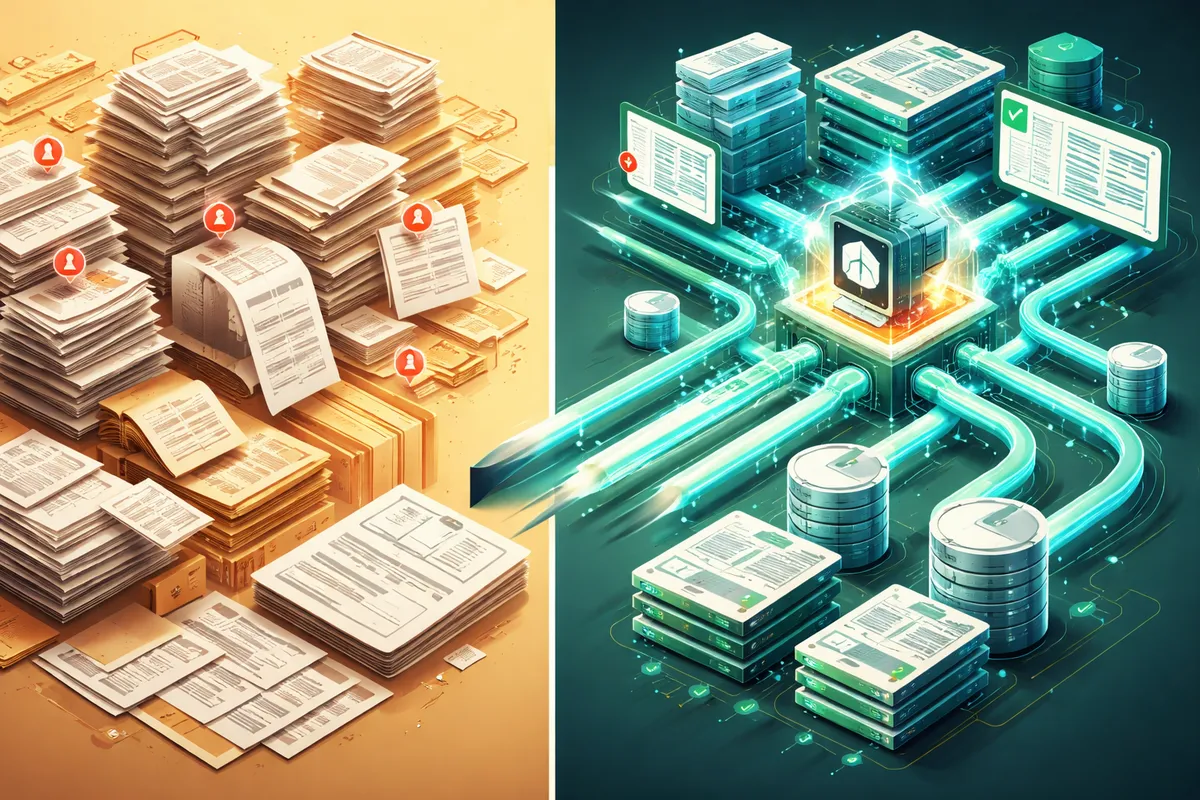
How AI Solves Data Entry
AI-powered data entry combines optical character recognition (OCR), natural language processing (NLP), and intelligent document processing (IDP) to automate extraction and input end to end.
OCR converts printed and handwritten text into machine-readable data, with modern engines handling skewed scans, varying fonts, and even degraded faxes that stumped earlier systems. NLP understands document context to extract the right fields regardless of format variation. A vendor invoice from Acme Corp with "Total Due: $4,812.50" in the top right and one from Globex with "Amount Owed" tucked into a table in the middle both get mapped to the same field in your ERP. Machine learning models validate extracted data against business rules and flag anomalies, such as an invoice total that does not match line items or a date outside a reasonable range. Robotic process automation (RPA) handles the actual system input, navigating your existing software interfaces the same way a human would, which matters when the target system is a legacy app with no modern API. Learn about our automation solutions.
The AI handles structured documents such as forms and invoices, semi-structured documents like emails and contracts, and unstructured data like handwritten notes and photographed receipts with equal capability once trained on your examples. Common platforms include AWS Textract, Google Document AI, Azure Form Recognizer, and specialized vendors like Rossum, Hypatos, and Nanonets. Choosing between them depends on volume, document complexity, and how much custom training your document types require.
What AI-Powered Data Entry Looks Like
The transformation eliminates the most tedious work while dramatically improving data quality.
### Before AI - Staff manually read documents and type data into CRM, ERP, or spreadsheets - Forms and applications processed one at a time in the order received - Error checking depends on a second person reviewing the first person's work - Peak volume creates backlogs that take days to clear - Documents arrive by email, fax, portal, and paper mail with no unified intake - Data trapped in PDFs never makes it into analytics or reporting
### After AI - Documents scanned or uploaded, with data extracted and entered automatically - Batch processing handles hundreds of documents simultaneously, 24 hours a day - AI validates every entry against business rules and flags only genuine exceptions - Volume spikes handled instantly without additional staffing - Unified intake queue accepts email, portal upload, API, and scanned paper - Every extracted field is structured, auditable, and immediately reportable
A concrete before-and-after: a regional property management firm processing 8,000 tenant applications per year shifted from 4 FTEs doing manual entry to 1 FTE handling exceptions plus an AI pipeline. Processing time per application dropped from 22 minutes to under 90 seconds, error rates fell from 3.1% to 0.4%, and the firm now onboards new properties in a week instead of a quarter.
Key Benefits
- Time savings: Reduce data entry time by 85 to 95%, reclaiming hours of productive capacity daily and eliminating weekend catch-up shifts
- Accuracy: Achieve 97 to 99.5% accuracy with AI extraction and validation, reducing correction work and downstream disputes
- Scale: Process 10 to 100 times more documents per day without adding staff, and handle volume spikes without hiring seasonal contractors
- Cost: Cut data entry costs by 70 to 80% per document processed, with typical payback periods of 3 to 9 months
- Insights: Structured data captured consistently enables analytics and reporting that messy manual data never could, including real-time dashboards and trend alerts
- Compliance: Every extraction logged with source image, confidence score, and operator approval, giving auditors a clean trail instead of a filing cabinet
Implementation Approach
We begin by cataloging your data entry workflows. What documents come in? What systems do they go into? Where are the highest volumes and most common errors? A typical discovery surfaces 8 to 15 document types, with 3 or 4 driving 80% of the volume. Those become the priority targets.
Our team builds extraction models for your specific document types. We train the AI on your actual documents, not generic templates. This ensures high accuracy for your specific formats, layouts, and terminology, including the quirks that matter (your top vendor's invoice template changed in Q3, one customer still sends faxes, a regulator requires dates in a specific ISO format). Training typically needs 100 to 300 labeled examples per document type, and we can use synthetic data augmentation to fill gaps for rare layouts.
Integration connects extraction output directly to your target systems: CRM, ERP, databases, spreadsheets, and legacy apps. We set confidence thresholds so low-confidence extractions route to human review while high-confidence data flows straight through. A common production pattern: 70 to 85% of documents auto-post with no human touch, 10 to 20% route to a reviewer for a one-click approval, and 2 to 5% need manual correction. That residual human work is what trains the next model iteration. See our implementation timeline and custom solutions.
How to Evaluate Your Options
Three criteria separate useful AI data entry from expensive disappointments. First, document diversity: a vendor that excels at standard invoices may fall apart on handwritten delivery slips or multi-page contracts. Ask for accuracy on your worst documents, not your cleanest. Second, integration depth: data extraction is only half the job. The pipeline has to post cleanly to your ERP, CRM, or claims system, handle retries, and respect validation rules. A vendor that stops at extraction leaves you building the expensive half yourself. Third, total cost of ownership at your volume: per-page pricing looks cheap at 500 documents a month and eye-watering at 50,000. Model per-document costs, platform fees, and integration maintenance over 3 years before signing.
Be cautious of demos that use the vendor's own sample documents. Insist on a paid pilot with 500 of your real documents, and measure both straight-through processing rate and end-to-end processing time, not just raw OCR accuracy.
Frequently Asked Questions
### How accurate is AI at data entry? AI extraction accuracy ranges from 95 to 99.5% depending on document quality and complexity. Clean, typed documents achieve the highest rates. Handwritten or low-quality scans are lower but still far exceed manual entry accuracy, which typically runs 96 to 99%. The system flags uncertain extractions for human verification, so errors that do slip through are caught before they hit your system of record.
### What data do I need to start? A sample set of 100 to 300 documents representing your typical document types and formats. Access to the target systems where data needs to be entered. Your business rules for data validation (acceptable date ranges, required fields, cross-field checks). We handle model training and integration from there, and we can augment small training sets with synthetic data when a document type is rare.
### How long does it take to implement AI data entry? A single document type like invoices or applications takes 3 to 4 weeks from training data to production. Each additional document type adds 1 to 2 weeks. Full deployment across all document types typically takes 6 to 10 weeks, with continuous accuracy improvements in the following quarter as the model sees more edge cases.
### Will AI completely replace data entry staff? AI handles 80 to 95% of data entry without human intervention. Staff shift to handling exceptions, verifying flagged entries, and managing the system. Most companies redeploy data entry staff to analysis, customer-facing roles, or quality assurance. The transition is gradual and supervised, and the best implementations involve the data entry team in training the model, which preserves institutional knowledge.
### What does AI data entry cost? Implementation ranges from $10,000 to $35,000 depending on document types, volume, and system integrations. Ongoing costs run $0.05 to $0.50 per document processed, with volume discounts at scale. Companies processing 500+ documents daily typically see ROI within 2 to 3 months, and higher-volume operations often pay back implementation costs within the first 60 days.
### What about sensitive data and compliance? For HIPAA, PCI, GDPR, or SOC 2 workloads, we deploy into your own cloud account or on-prem, use encrypted storage, and maintain full audit logs. PII can be redacted before reaching any external model. Compliance requirements often shape vendor selection, and we walk through the tradeoffs before a platform is chosen.