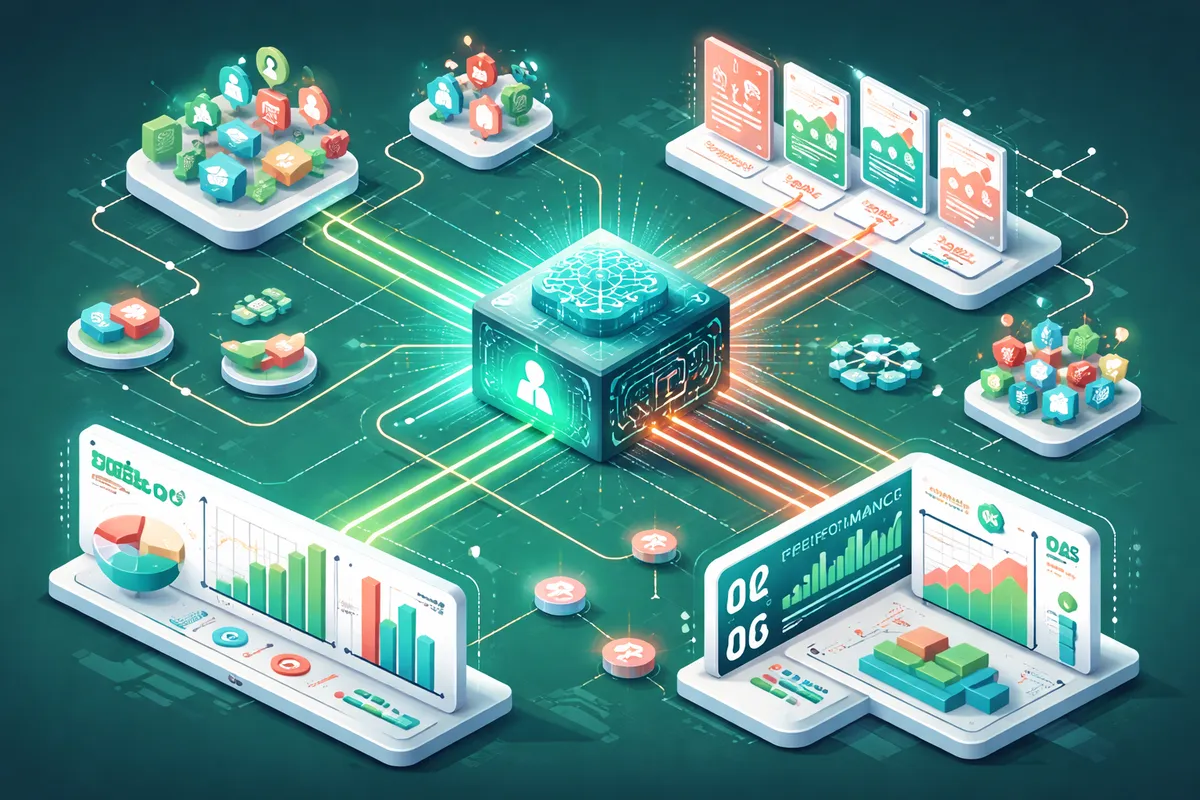
How AI Solves Ad Targeting
AI-powered ad targeting uses machine learning to process signals that manual targeting cannot. Predictive models analyze thousands of conversion data points to identify which audience attributes, behaviors, and contexts drive real business outcomes. A typical production model scores prospects on 200 to 800 features, ranging from on-site behavior to firmographic enrichment to historical engagement recency.
The AI evaluates creative performance across audience segments in real time. It reallocates budget toward high-performing combinations within hours, not days. Machine learning models discover non-obvious audience segments that outperform manual selections. One retail client discovered that their highest-LTV cohort was not the demographic their brand team had built personas around, it was a segment of users who visited the site on Sunday evenings and engaged with comparison content. That insight reshaped both targeting and landing page strategy. See our digital marketing services for the full picture.
Advanced AI targeting goes beyond platform-native tools by incorporating your first-party data: CRM records, purchase history, and website behavior that platforms cannot access. This is where server-side conversion APIs like Meta CAPI, Google Enhanced Conversions, and LinkedIn CAPI become non-negotiable. Without them, you are handing Meta and Google incomplete data and then blaming the algorithm for underperformance.
What AI-Powered Ad Targeting Looks Like
The shift from manual to AI-driven targeting fundamentally changes how your ad budget works.
### Before AI - Audience creation based on demographics and broad interest categories - Manual bid adjustments reviewed weekly or biweekly - Creative testing limited to 3 to 5 variations due to management overhead - Performance optimization based on platform-reported metrics only - Attribution ends at the lead form, with no feedback on revenue quality
### After AI - Audiences built from conversion patterns, behavioral signals, and first-party data - Bids adjusted continuously based on real-time conversion probability - Hundreds of creative and audience combinations tested simultaneously - Optimization tied to actual business outcomes like revenue and LTV - Server-side events feed back CRM outcomes so platforms learn from closed-won deals, not just clicks
A B2B services client we worked with moved from a blended CPL of $380 to $165 within 90 days by pushing SQL and closed-won events back into Meta and Google via server-side pixels, then letting the AI optimize toward sales-qualified leads instead of form fills. The platform was already capable. It just needed the right signal to optimize against.
Key Benefits
- Time Savings: Reduce campaign management time by 60% while improving performance
- Accuracy: Target users with 2 to 3x higher conversion probability than manual audience selection
- Scale: Test hundreds of audience and creative combinations simultaneously across platforms
- Cost: Improve ROAS by 30 to 80% by eliminating wasted spend on low-intent audiences
- Insights: Discover which customer attributes and behaviors predict purchases, not just clicks
- Resilience: Performance holds up as platform signal quality decays, because your first-party data is the backbone
Implementation Approach
We start by auditing your current ad accounts, conversion tracking, and first-party data sources. Clean conversion data is the foundation. Without it, AI optimizes for the wrong outcomes. A common finding in our audits: 15 to 25% of conversions are double-counted or miscategorized, which silently trains algorithms on bad labels for months.
Our team integrates your CRM and analytics data with ad platforms to enrich targeting signals. We build custom audience models trained on your actual customers, not generic platform data. The AI system connects to your ad accounts via API for real-time optimization. Stacks we commonly deploy include Segment or RudderStack for the CDP layer, BigQuery or Snowflake for the data warehouse, dbt for transformations, and custom Python services for the scoring models. See our implementation timeline and supporting website design work when landing pages need to match the new targeting strategy.
We run a 2 to 4 week calibration period where the AI learns alongside your existing campaigns. Once baseline performance is established, the AI takes over targeting and bidding with human oversight on strategy and creative direction. Explore our custom solutions.
How to Evaluate Your Options
Three categories of tooling show up in most evaluations. Platform-native smart bidding, like Google Performance Max and Meta Advantage+. These are free with your spend but optimize toward the platform's incentives, not yours. Third-party ad optimization platforms, like Smartly, Marin, and Skai. These add a management layer but still rely on platform data. Custom in-house ML, where you build the scoring and attribution yourself and use platforms purely as delivery channels.
For most companies under $500,000 per month in spend, a hybrid approach works best: strong server-side conversion tracking, a clean CDP, and platform-native bidding with custom audiences fed from your warehouse. For enterprise spend above $1 million per month, custom ML usually pays for itself within two quarters.
Three questions to ask every vendor. What is the minimum conversion volume needed per campaign for your models to outperform native bidding? How do you handle privacy-safe audience building under ATT and GDPR? What does the signal pipeline look like when a platform deprecates a data source, as inevitably happens? If a vendor cannot answer all three clearly, keep shopping.
Frequently Asked Questions
### How accurate is AI at selecting the right audiences? AI audience models typically outperform manual targeting by 40 to 100% on conversion rate. Accuracy depends on data quality and volume. Accounts with 100+ monthly conversions see the strongest results. The model improves continuously as new conversion data flows in, and we retrain weekly to avoid drift as seasonality, creative fatigue, and platform changes shift the landscape.
### What data do I need to start? You need active ad accounts with conversion tracking, at least 3 months of campaign history, and ideally CRM or purchase data. The minimum viable starting point is 50+ monthly conversions. Less data means longer calibration, but we can supplement with industry benchmarks and synthetic seed audiences. If your conversion pixel fires on thank-you pages only, we start by adding server-side events for downstream revenue milestones.
### How long does it take to implement AI ad targeting? Account audit and data integration takes 1 to 2 weeks. The AI calibration period runs 2 to 4 weeks alongside existing campaigns. Most clients see measurable improvement within 6 weeks of launch. Full optimization typically matures over 2 to 3 months as the model accumulates enough closed-loop conversion data to stabilize.
### Will AI completely replace my media buying team? No. AI handles targeting, bidding, and audience optimization at a speed humans cannot match. Your team focuses on strategy, creative development, landing page optimization, and business context the AI cannot understand. The combination outperforms either alone. We have seen media buyers 3x their output when the machine handles the tactical layer and they focus on testing hypotheses and creative direction.
### What does AI ad targeting cost? Implementation ranges from $10,000 to $30,000 depending on the number of platforms and data integration complexity. Ongoing management fees are typically a percentage of ad spend, usually 8 to 15%. Most clients see the AI investment pay for itself within 60 to 90 days through improved ROAS.
### How does this work with iOS privacy changes and cookie deprecation? The approach we use becomes more valuable as third-party signals decay. Server-side conversion tracking via Meta CAPI, Google Enhanced Conversions, and LinkedIn CAPI sends clean first-party events directly from your backend. Custom audiences built from CRM data do not depend on third-party cookies. When Chrome finishes phasing out cookies, accounts that already run this architecture will see minimal disruption. Accounts that did not will see 20 to 40% performance drops.
### What platforms do you support? We have production deployments on Google Ads, Meta (Facebook and Instagram), LinkedIn Ads, TikTok Ads, Pinterest, Reddit, and programmatic DSPs including The Trade Desk and DV360. The scoring and audience layer is platform-agnostic. The same propensity model feeds custom audiences into each platform's API, then platform-native bidding optimizes delivery. For most B2B clients, the optimal mix is Google and LinkedIn as primary, with Meta for retargeting and brand. For DTC, Meta and TikTok dominate, with Google for intent capture.
### How do you measure incrementality versus platform-reported conversions? Platform-reported ROAS is almost always inflated because platforms claim credit for conversions they did not cause. We run geo holdout tests, ghost ad experiments, and occasional full pause tests on a subset of audiences to measure true incremental lift. For clients spending more than $100,000 per month, we recommend a quarterly geo experiment to recalibrate attribution weights. The typical finding: platform-reported ROAS overstates true incremental ROAS by 30 to 60%, and the AI model retrains on the corrected signal so future optimization targets real business impact.