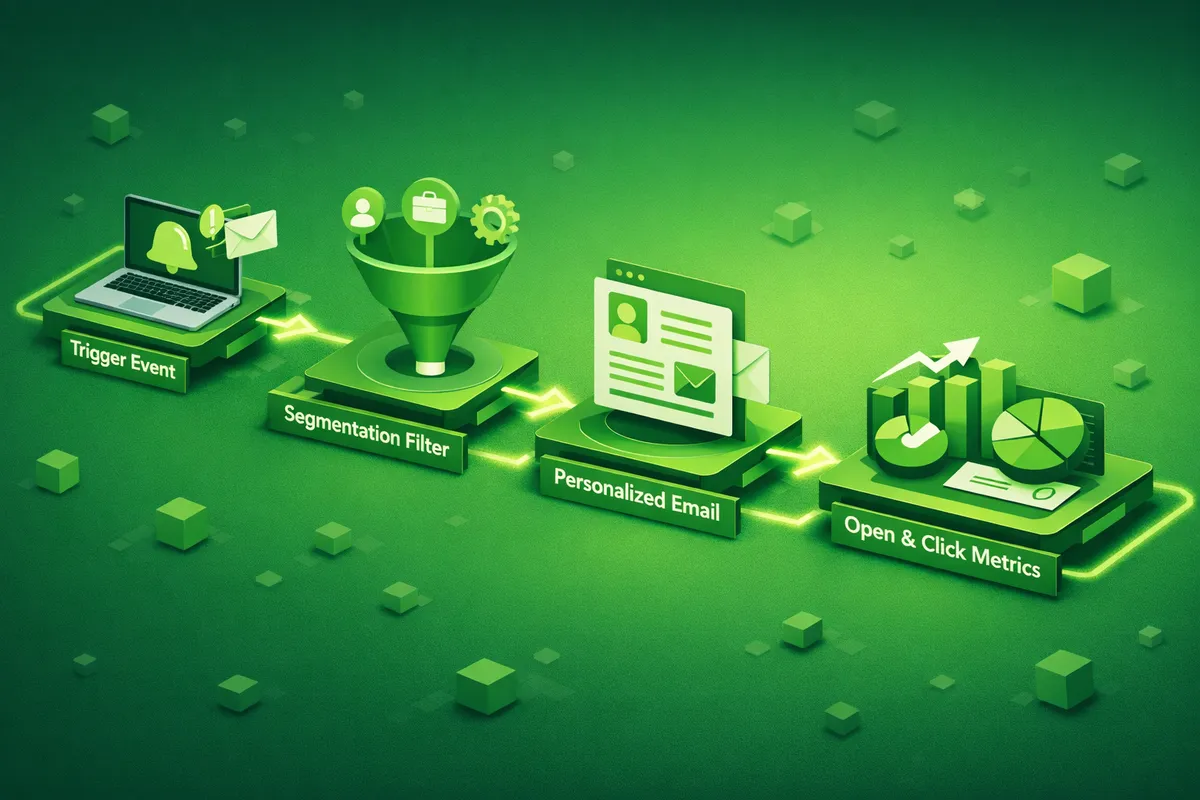
How AI Email Automation Works
AI transforms email from a broadcast channel into a personalized conversation at scale. The system operates across three layers: content generation, timing optimization, and continuous learning.
Content generation. Natural language models (typically Claude, GPT-4, or Gemini) create unique subject lines, body copy, and calls to action for each recipient based on their behavior, preferences, and stage in the customer journey. A first-time visitor gets a different welcome sequence than a repeat purchaser. A subscriber who clicks product links gets different content than one who reads blog posts. The model prompts include brand voice guidelines, product context, and prior engagement history, producing copy that feels human without a human writing every variant.
Timing optimization. Machine learning models analyze engagement patterns to determine the optimal send time for each individual. Not just "Tuesday at 10 AM" for everyone. Actual per-recipient timing based on when they historically open and click. One subscriber might consistently engage at 7:15 AM on their commute. Another opens emails at 9:30 PM. The AI sends to each at their peak window. This is what Klaviyo calls "Smart Send Time" and what HubSpot calls "Send Time Optimization," but custom implementations can go further by factoring in day-of-week patterns and response latency (how long after delivery a subscriber typically opens).
Continuous learning. Every open, click, conversion, and unsubscribe feeds back into the model. Subject line patterns that drive higher open rates get reinforced. Content approaches that generate clicks get expanded. The system gets smarter with every send, not just when your team remembers to run a test. Contextual bandits (a reinforcement learning approach) replace traditional A/B testing because they automatically shift traffic to winning variants rather than waiting for statistical significance.
We build these capabilities into custom AI solutions through our AI integration services, integrating with your existing email platform and customer data. Your AI models train on your audience's behavior, not generic benchmarks from unrelated industries.
Key Features and Capabilities
AI-generated copy. Natural language models write subject lines, preview text, and body content tailored to each recipient's interests and engagement history. Your team reviews and approves. The AI handles the volume. A company sending 50,000 emails monthly can generate hundreds of subject line variations and body copy permutations without adding headcount. Typical generation cost is $0.02 to $0.08 per personalized email at current LLM pricing, which is negligible compared to the revenue lift.
Per-recipient send time optimization. Machine learning determines when each subscriber is most likely to open and engage. Sends distribute across optimal windows automatically. Businesses using per-recipient timing typically see 15 to 25% higher open rates compared to batch sending. One DTC beverage brand moved from a 22% open rate on a Tuesday 10 AM blast to a 31% open rate with per-recipient timing, translating to $47,000 in additional monthly revenue on the same creative.
Dynamic content blocks. Email sections personalize based on recipient data. Product recommendations, content suggestions, and offers adjust for each reader without creating dozens of template variations. A single email template can render differently for every subscriber based on their purchase history, browsing behavior, and engagement patterns. Dynamic blocks typically use merge logic plus conditional content, rendered server-side at send time. Klaviyo, Iterable, and Braze all support this natively.
Predictive engagement scoring. AI identifies which subscribers are likely to open, click, convert, or churn. Use these predictions to adjust frequency, content, and re-engagement strategies before you lose subscribers. A churn-risk subscriber might receive a special offer or reduced frequency automatically, preserving the relationship. The failure mode to watch: over-emailing high-engagement subscribers because they "love the brand" is a known path to list fatigue. Predictive scoring should cap frequency even for top engagers.
Automated sequence optimization. AI monitors drip campaigns and adjusts timing, content order, and branch logic based on real performance data. Sequences improve continuously without manual A/B testing. If step three in a welcome sequence consistently loses engagement, the AI restructures the flow. A SaaS trial-to-paid nurture sequence we optimized automatically dropped its step 4 email (a testimonial roundup) after the system learned it correlated with a 12% increase in unsubscribes.
Revenue attribution. Track exactly which AI-optimized emails drive purchases, signups, or other conversions. See the revenue impact of personalization versus generic sends with clear before-and-after comparisons. Attribution should use post-click conversion tracking plus view-through windows, typically 7 days for ecommerce and 30 days for B2B.
The Personalization Spectrum
AI email automation supports multiple levels of personalization, and you do not need to start at the most advanced level. Starting at the top often fails because teams try to do everything at once and the underlying data is not clean enough.
Level 1: Optimized send times. The simplest implementation. AI determines the best send time for each subscriber and distributes your existing emails across those windows. This alone typically lifts open rates 10 to 20%. Requires 30 to 90 days of engagement history per subscriber to produce reliable predictions. Cold subscribers default to a global optimal time until enough personal data accumulates.
Level 2: Subject line generation. AI writes multiple subject line variations and selects the best match for each recipient segment. Combined with send time optimization, this addresses the two biggest factors in whether an email gets opened. Subject line generation needs brand voice guidelines in the prompt, plus constraints (character limits, no emoji if your brand avoids them, no all-caps, no clickbait patterns that Gmail penalizes).
Level 3: Dynamic content blocks. Key sections of your email body adjust per recipient. Product recommendations, article suggestions, and promotional offers change based on individual behavior. The email structure stays consistent, but the content inside adapts. Requires a product catalog feed (for ecommerce) or content taxonomy (for media and B2B) that maps to subscriber interest signals.
Level 4: Full message personalization. The entire email body generates uniquely for each recipient. Subject, preview text, body copy, images, and call to action all personalize based on the recipient's profile and behavior. This is the most resource-intensive but delivers the highest engagement lift. Cost is also highest (approximately $0.08 to $0.15 per email in LLM generation fees) so this level is typically reserved for high-value segments or transactional follow-ups, not weekly newsletters.
Most businesses start at Level 1 or 2 and progress as they see results. There is no need to implement everything at once.
Integration With Your Existing Tools
AI email automation works with your current email service provider. Mailchimp, Klaviyo, SendGrid, ActiveCampaign, HubSpot, Iterable, Braze, or a custom setup. We do not replace your sending infrastructure. We make it smarter.
We connect email data with your CRM, ecommerce platform, website analytics, and customer support tools. Purchase history, browsing behavior, support tickets, and engagement data all feed the AI models that personalize every message. This pairs naturally with ongoing SEO services work because the content ideas that rank in organic search often become your highest-performing email subject lines. A well-tuned pipeline treats content as a shared asset across email, SEO, and social rather than three isolated streams.
The integration architecture typically looks like this. Your website and ecommerce platform feed behavioral data into a central customer data layer (Segment, RudderStack, or a custom event pipeline). The AI engine reads from that layer to generate personalized content and timing. Finished emails push to your ESP for delivery. Engagement data flows back to close the loop.
If you are also running social media marketing or content marketing, the AI can coordinate messaging across channels. A subscriber who just engaged with a social post might receive a complementary email, while someone who opened an email might see a related social ad. This cross-channel coordination typically lifts multi-touch conversion rates 15 to 25%.
Why Build Custom vs. Off-the-Shelf
Mailchimp and Klaviyo offer basic AI features. Predictive send time. Subject line suggestions. Klaviyo's "Smart Send Time" and "Predicted Gender" features ship out of the box. These are starting points, not solutions. They apply generic models across millions of accounts and cannot adapt to your specific audience behavior or brand voice.
Custom AI email automation trains on your data exclusively. Your subject line model learns what your audience responds to. Your send time model reflects your subscribers' actual habits. Your content model understands your brand voice and product catalog.
The difference shows in the numbers. Generic AI features typically improve open rates by 5 to 10%. Custom models trained on your data deliver 15 to 30% improvements because they learn patterns specific to your audience that no generic model can detect. For a luxury home goods brand with $10M in annual email revenue, the gap between a 10% and 25% open rate lift represents roughly $1.5M in incremental annual revenue.
For businesses with fewer than 5,000 subscribers, off-the-shelf AI features are often sufficient. Once you pass 10,000 subscribers or need sophisticated personalization across product lines, customer segments, or lifecycle stages, custom solutions deliver meaningfully better results.
Measuring Success
Effective AI email automation should move these metrics within the first 60 days.
Open rate. Expect a 15 to 30% increase from baseline. If your open rate is 20%, target 23 to 26%. Note that Apple Mail Privacy Protection inflates open rates artificially, so evaluate alongside click rates rather than in isolation.
Click-through rate. Expect a 20 to 40% increase. Dynamic content and personalized CTAs drive clicks by matching content to recipient interests.
Revenue per email. The metric that matters most. Track revenue generated per email sent, not just per email opened. AI personalization should lift this metric 25 to 50% within the first quarter. This is the honest measure because it captures both deliverability and persuasion.
Unsubscribe rate. Should decrease as relevance improves. Subscribers stay when emails match their interests and arrive at convenient times. Target unsubscribe rates under 0.3% per send to stay within Gmail and Yahoo's sender reputation thresholds.
Team time saved. Measure hours spent on email creation, testing, and optimization before and after implementation. Most teams reclaim 10 to 15 hours per week.
What to Do Next
Start with an audit of your current email performance. Pull 90 days of data: send volume, open rate, click rate, unsubscribe rate, revenue attributed to email. Segment by campaign type (promotional, transactional, lifecycle) because each has different benchmarks.
Next, evaluate your data infrastructure. Do you have behavioral events flowing into your ESP? A unified customer profile? Purchase history tied to email addresses? If any of those are missing, the first phase of AI implementation should be data plumbing, not modeling. Building AI on top of fragmented data produces disappointing results.
Finally, choose a starting level. Businesses new to AI email should begin with send time optimization (Level 1) because it delivers clear wins with minimal data requirements. Teams with strong engagement data and a polished brand voice can jump to Level 2 or 3.
Frequently Asked Questions
How much does AI email automation cost?
Custom AI email automation projects range from $10,000 to $45,000 depending on list size, number of integrations, and the depth of personalization required. Basic send time optimization and subject line generation fall on the lower end. Full content personalization with dynamic sequences and predictive scoring costs more. Monthly optimization retainers run $1,500 to $4,000.
How long does implementation take?
Most AI email automation projects launch within 6 to 10 weeks. Initial setup and data integration take two to three weeks. Model training requires several weeks of historical data analysis. Testing and validation run for one to two weeks before full deployment. You will see initial improvements within the first month as the simplest optimizations go live first.
What data do I need to get started?
You need at least 6 months of email engagement history: opens, clicks, unsubscribes, and conversions. Subscriber profile data (purchase history, browsing behavior, demographic info) improves personalization. A list of at least 5,000 active subscribers provides enough data for meaningful AI model training. If your list is smaller, we can start with send time optimization and subject line generation, which require less data.
Will this replace my existing email platform?
No. Your email service provider handles deliverability, compliance, and sending infrastructure. AI automation layers intelligence on top. We integrate with your current platform so your team keeps using the tools they know. The AI makes those tools perform better by optimizing content, timing, and targeting.
How do I measure ROI from AI email automation?
Track open rate improvement (typically 15 to 30% increase), click-through rate improvement (20 to 40% increase), revenue per email sent, and unsubscribe rate reduction. Also measure time saved by your marketing team on email creation and testing. Most businesses see measurable improvement within 30 to 60 days of deployment.
Does AI email automation comply with email regulations?
Yes. AI automation works within your existing compliance framework. CAN-SPAM, GDPR, CASL, and the Google/Yahoo 2024 sender requirements still apply, and the system respects unsubscribe requests, consent records, and data handling policies configured in your ESP. AI improves what you send and when you send it. It does not change who you can send to or how consent is managed.