Legacy System Integration
Old Systems. Modern Connections.

What We Do
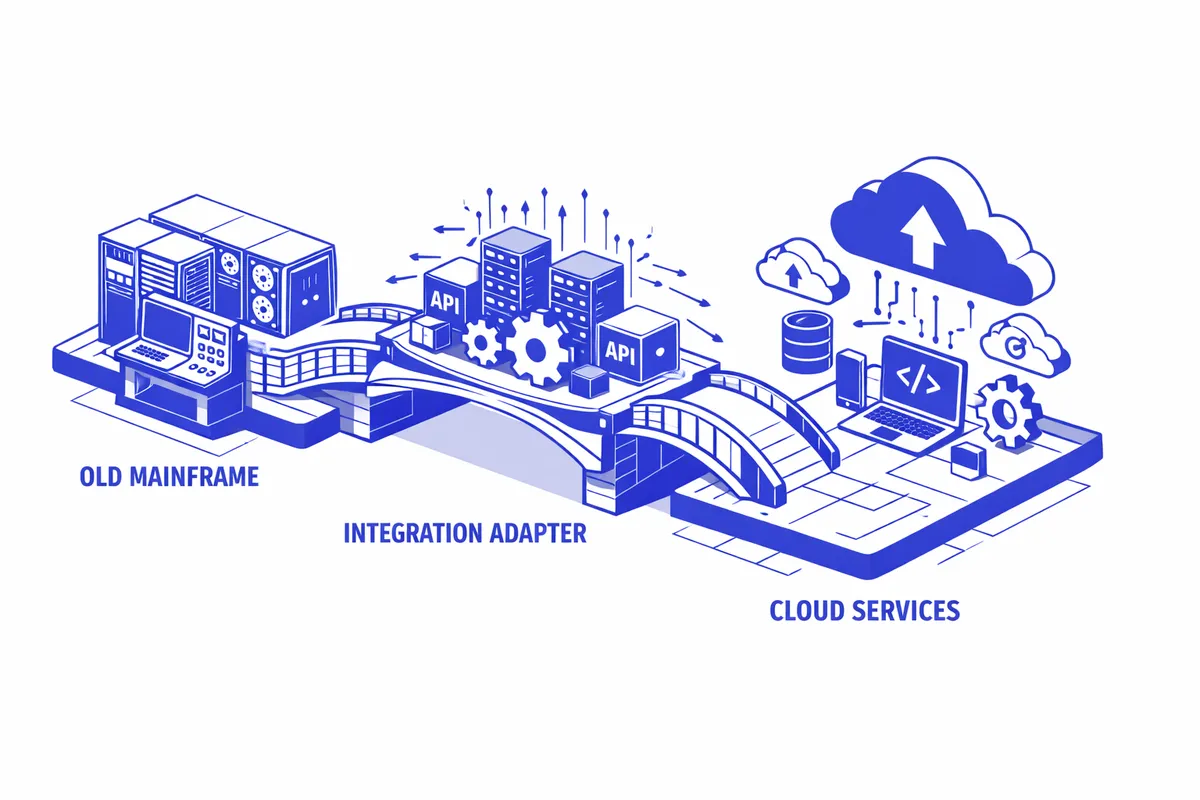
Replacing a legacy system that has been running your business for 15 years is not a weekend project. It is a multi-year migration with significant risk, cost, and operational disruption. For many businesses, the better path is integration: connecting the legacy system to modern platforms through adapter layers that translate between old and new data formats, giving your team modern interfaces without touching the system that still reliably runs the core business.
We have built integrations for systems that predate modern APIs, that communicate through flat file exchanges, that require database-level access, and that use protocols that engineers who graduated after 2010 have never encountered. Old systems. Connected to the present.
How We Work
Legacy integration begins with deep discovery: understanding the legacy system's data model, its communication interfaces, and the specific business transactions that need to flow between old and new systems. That discovery often requires reverse-engineering documentation that does not exist, which we approach methodically with read-only access and incremental testing. We build adapter layers that translate the legacy system's data formats and protocols into the interfaces modern systems expect.
Synchronization logic handles the bidirectional flow of data during any transition period when both systems need to stay accurate. We implement in phases with rollback capability at every step so operational risk stays contained. Your team continues operating normally throughout the integration process.
Why Running Start Digital
Pricing
From $10,000
Typical turnaround: 8-16 weeks
Includes
Frequently Asked Questions
Yes. COBOL mainframes, AS/400 systems, legacy databases (FoxPro, Access), SOAP services, and file-based integrations. We have experience connecting to systems from every era of enterprise computing.
Not necessarily. Many businesses get years of additional value from legacy systems by integrating them with modern interfaces. We help you decide when to integrate, when to wrap, and when to replace.
We build transformation layers that convert between legacy data formats and modern standards. Date formats, character encodings, field mappings, and business logic translation are all handled in the integration layer.
The primary risks are undocumented business logic and fragile interfaces. We mitigate both through thorough discovery, read-only testing phases, and gradual rollout with rollback capability.
A single integration between a legacy system and one modern platform takes 6 to 12 weeks depending on the legacy system's documentation quality and interface complexity. Multi-system programs take proportionally longer.
We work with unsupported systems regularly. The approach relies on empirical discovery rather than vendor documentation. We reverse-engineer what we need to know through careful testing and database inspection.
Integrate when the legacy system runs reliably, the business cannot tolerate replacement risk, or the cost of replacement exceeds the integration cost by a significant margin. Replace when the system is a genuine barrier to growth and no amount of integration solves the underlying limitation.
Ready to get started?
Start with a $5,000 deposit. Balance due on delivery.