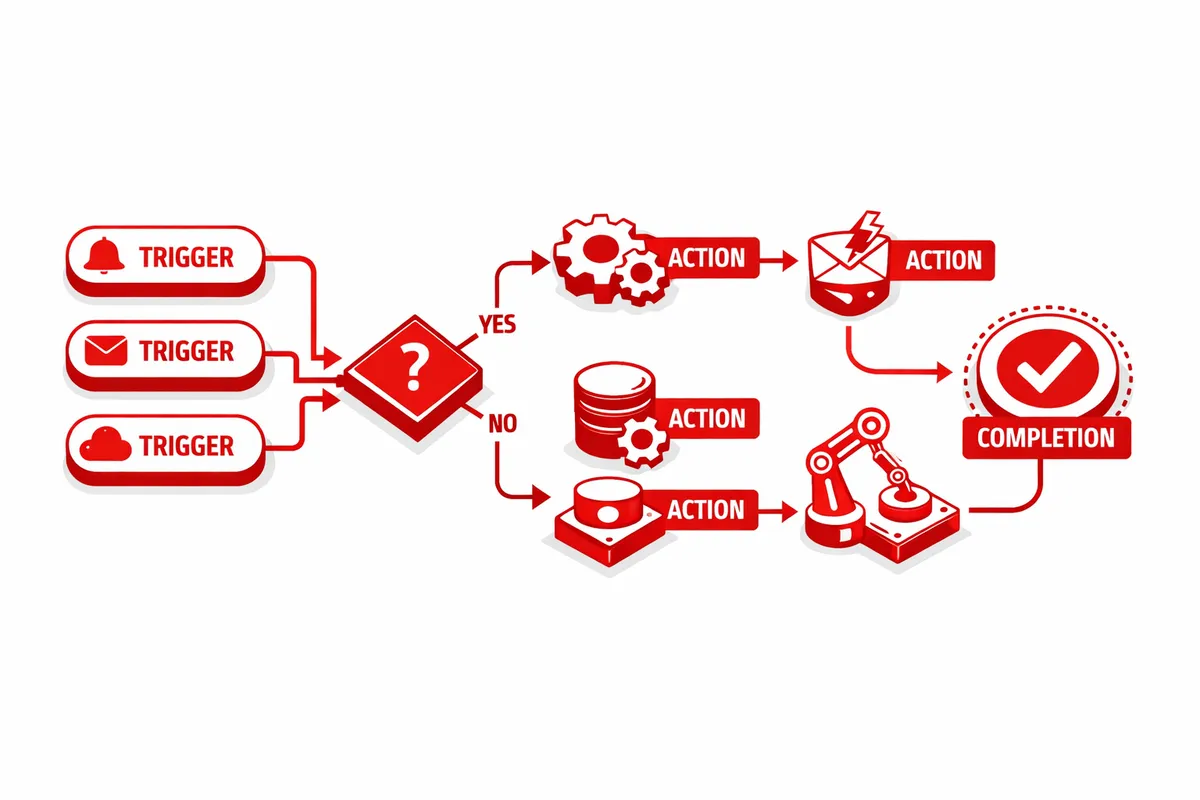
Our Workflow Automation Work in Detroit
- EDI transaction processing automation: planning releases, purchase orders, ASNs, and supplier acknowledgments for automotive suppliers serving Ford, GM, and Stellantis
- IATF 16949 and APQP quality documentation workflow automation with approval routing, version control, and complete audit trail
- Engineering change notice (ECN) processing: routing, review assignment, disposition capture, and ERP update automation
- Invoice processing and accounts payable automation with SAP, Oracle, Infor, and Microsoft Dynamics integration
- Healthcare authorization and eligibility verification automation with Epic, Cerner, and Athenahealth integration for Detroit-area health systems
- Approval workflow design for purchase orders, capital expenditure requests, engineering changes, and quality holds with configurable routing logic
- Customer and client onboarding automation integrating CRM, billing, provisioning, and communication workflows
- HR workflow automation: new hire onboarding, offboarding, certification and safety training tracking, and performance review cycles
- Supplier qualification and audit documentation management for Tier 1 and Tier 2 automotive suppliers
- System integration connecting ERP, WMS, CRM, EHR, and operational platforms that do not share data natively
- Report generation and scheduled distribution for production, quality, financial, and compliance metrics
- Exception handling and escalation routing for high-volume processes with intelligent monitoring and alerting
Industries We Serve in Detroit
Automotive Suppliers and Manufacturers: The supply chains connecting Tier 1 and Tier 2 suppliers to Ford's River Rouge and Dearborn facilities, GM's Warren Technical Center, and Stellantis's Auburn Hills headquarters run on precision data exchange that manual processes cannot sustain. We build EDI transaction processing, PPAP document routing, engineering change workflows, and supplier communication automation that matches the operational discipline OEM procurement teams expect. For Automation Alley corridor companies building industry 4.0 capabilities, we connect shop floor data systems to ERP and quality management platforms.
Healthcare Systems and Medical Practices: Henry Ford Health System's extensive network of hospitals and specialty practices, the Detroit Medical Center, Beaumont Health, and the growing Ascension Michigan footprint across the metro all manage administrative workflow volumes that grow faster than clinical staffing budgets allow. HIPAA-aware automation for insurance eligibility verification, prior authorization submission and follow-up, patient intake data processing, and claims management typically delivers positive ROI within the first year for Detroit healthcare organizations.
Technology Companies and Startups: TechTown Detroit's portfolio companies, Detroit Mobility Lab participants, and the growing software and services businesses throughout Downtown and Midtown compete in national markets where operational efficiency is evaluated by enterprise clients and investors. Workflow automation for TechTown-adjacent businesses addresses customer onboarding sequences, SLA-based support routing, billing and subscription management, and the internal operational processes that determine whether a startup can scale without proportional headcount growth.
Legal and Professional Services: Detroit's Downtown and Midtown legal community, the accounting and consulting firms serving Metro Detroit's industrial base, and the professional services organizations throughout Wayne, Oakland, and Macomb counties spend significant staff time on administrative workflows. Client intake and onboarding automation, matter billing entry, document review routing, deadline tracking, and compliance documentation management are all automation opportunities that reduce administrative overhead so attorneys and consultants focus on billable client work.
Logistics and Distribution: Detroit's position at the center of the Great Lakes logistics network, with direct connections to Canadian manufacturing through the Ambassador Bridge and tunnel crossings, I-75 and I-94 truck corridors, and intermodal rail access, supports a significant logistics and distribution sector. Shipment tracking, carrier communication, customs documentation, freight exception handling, and EDI transaction processing for logistics companies are all automation targets we have built for Metro Detroit operations.
Financial Services and Insurance: Financial services firms in Southfield, Bloomfield Hills, and Downtown Detroit, along with the insurance companies serving the automotive sector's complex risk environment, process documentation volumes under regulatory scrutiny that demand systematic audit trail construction. Compliance report automation, client onboarding documentation, reconciliation workflows, and exception routing are common automation targets for Detroit's financial services sector.
What to Expect
Process Discovery and Mapping: We begin by systematically mapping your current process landscape. For automotive clients, this means walking the EDI and ERP workflows end to end, interviewing the people who manage supplier communications and quality documentation, and quantifying both the volume and the error rate. For healthcare and professional services clients, we conduct structured interviews with the staff doing administrative work, observe actual process execution, and document every rule and exception that governs each workflow. The mapping produces the evidence base for the automation ROI calculation.
Automation Opportunity Assessment: With processes mapped, we assess automation feasibility and expected ROI for each candidate. In Detroit's manufacturing sector, the cost-avoidance value of automated processes often exceeds the labor cost saving because errors in automotive supply chain workflows carry penalty and production-stoppage consequences that dwarf the hourly cost of the employee who made the mistake. We prioritize by total ROI impact and produce a phased automation roadmap.
Build and Integration: We design the automation logic and build using the appropriate approach for each process: native API integration for systems that support it, RPA for legacy systems and older ERP modules that lack API access, custom application development for complex orchestration, or configurable workflow platforms for approval-routing use cases. ERP integration is often the most technically complex element for Detroit's manufacturing clients, and we design for reliability and maintainability from the start rather than treating integration as secondary to the automation logic.
Testing, Deployment, and Monitoring: Automation is tested against historical process data before production deployment. For automotive supply chain workflows, testing against real EDI transaction samples is mandatory before go-live. We deploy monitoring and alerting so failures surface immediately. For mission-critical production workflows, we design manual failover procedures that keep operations running if automation is unavailable, eliminating single points of failure that an automotive client cannot accept.
Ready to Automate Your Detroit Business Processes?
Detroit's businesses understand that operational discipline creates competitive advantage. The same precision that defines the best manufacturing operations in this region belongs in every administrative and operational workflow that supports your business. Running Start Digital builds workflow automation that eliminates manual labor from rule-based processes, improves accuracy, and creates the scalability your Detroit operation needs to grow without proportional administrative cost. Schedule a consultation to map your current process landscape and identify where automation delivers the highest return.