How We Build Business Intelligence for Wicker Park
Wicker Park BI projects start with a direct conversation about operating reality. We do not begin with a data inventory. We begin with the question: what do you not know right now that is hurting your business? For a boutique retailer on Milwaukee Avenue, the answer is often some version of "I do not know which inventory is profitable and which is taking up floor space that better products could occupy." For a design studio on Damen Avenue, it is often "I cannot tell which clients are actually profitable until the project is over."
Those questions define the scope. We work with Wicker Park operators to document the specific decisions they make weekly, the data they currently use, and the gaps that slow or distort those decisions. Then we map every source system: Shopify or Square for retail, QuickBooks for accounting, project management tools like Harvest or Basecamp for agencies, Eventbrite or Dice for venues. We design extraction pipelines from each and build the transformation logic that turns raw transactions into analytical models.
Wicker Park businesses tend to run lean technology stacks. Most source systems are modern SaaS platforms with API access, which makes pipeline construction faster and less expensive than for businesses on legacy software. The challenge is often data volume: a boutique retailer on North Avenue may have three years of transaction history that has never been systematically analyzed. We include historical data in the pipeline so initial dashboards show trends over time, not just current snapshots.
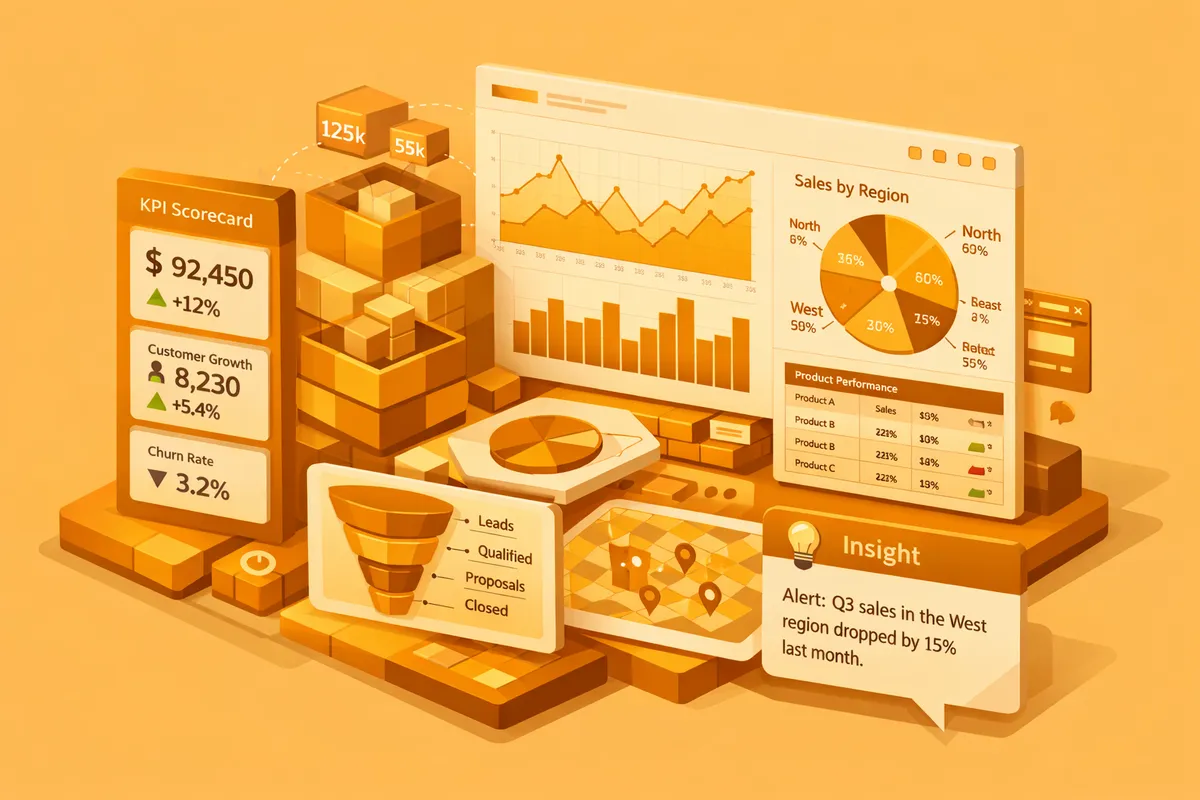
Dashboard design for Wicker Park operators follows the same principle as every engagement: every element on the screen serves a specific decision. We build for the person who will use the dashboard, not for the person who requested it.
Industries We Serve in Wicker Park
Independent retailers on Milwaukee Avenue and North Avenue use BI to track inventory turnover by category, margin by product line, returning customer rate, and revenue by day of week and hour. The difference between a Wicker Park boutique that knows its top-performing product categories and one that makes buying decisions based on last season's feel is measurable in inventory efficiency and gross margin.
Creative agencies and design studios around the Blue Line Damen station use BI to monitor billable utilization, project profitability at the engagement level, client lifetime value, and pipeline stage distribution. A design studio principal who can see mid-project that a client relationship is running over budget has the information to have a productive conversation before the project closes in the red.
Music venues and bars operating in the Wicker Park corridor near the Flat Iron Arts Building use BI to track advance ticket sales by event type, bar revenue per attendee, merchandise conversion at events, and booking pace against prior periods. Venue operators who understand their revenue drivers by event category make better booking decisions and more accurate staffing calls.
Tattoo shops and specialty service studios on Damen Avenue and Division Street use BI to track appointment volume by artist, revenue per hour by service type, rebooking rates, and customer acquisition source. For a multi-artist studio, understanding which artists are driving the most rebooking and which service categories produce the best margin per appointment shapes how the owner manages the roster.
Bars and restaurants along Hoyne Avenue and the surrounding blocks use BI to track covers, ticket average, labor cost as a percentage of revenue, and event-driven revenue spikes. A Wicker Park bar running regular events needs to understand the incremental revenue and cost of each event format to know which ones to book more of.
Real estate offices serving Wicker Park's active residential market use BI to track listing volume, days on market, and transaction close rates by agent and by property type. Wicker Park's housing market has evolved substantially in the past decade; real estate firms that track their own performance with precision make better decisions about where to invest agent development resources.
What to Expect Working With Us
1. Operating question discovery. We begin by spending time with the owners and operators who will use the dashboards. For a Milwaukee Avenue retailer, that means understanding how buying decisions are currently made, what data is currently used, and what the owner does not know that they wish they did. For an agency on Division Street, it means mapping the project lifecycle and identifying where profitability visibility breaks down. The discovery output is a prioritized list of the decisions that BI will improve and the metrics required to improve them.
2. Source system mapping and pipeline construction. We identify every system holding relevant data and build the extraction pipelines. Wicker Park businesses typically run modern SaaS stacks, which speeds pipeline work. We validate data quality at each source before building dashboards on top of it. Historical data, where it exists, is included so initial dashboards show trends rather than point-in-time snapshots.
3. Dashboard delivery in two-week sprints. We build and review working dashboards every two weeks with the operators who will use them. Wicker Park business owners are hands-on practitioners. If a dashboard does not immediately reflect operational reality as they understand it, we dig into why. Sometimes that surfaces data quality issues. Sometimes it surfaces that the metric design does not match how the operator actually thinks about the business. Both are fixable.
4. Documentation and training for long-term use. We document the data models we build and train your team to extend dashboards without calling us. An independent business owner should be able to add a new product category filter or create a view for a new location without needing developer support. We build for sustainability, not ongoing dependency.