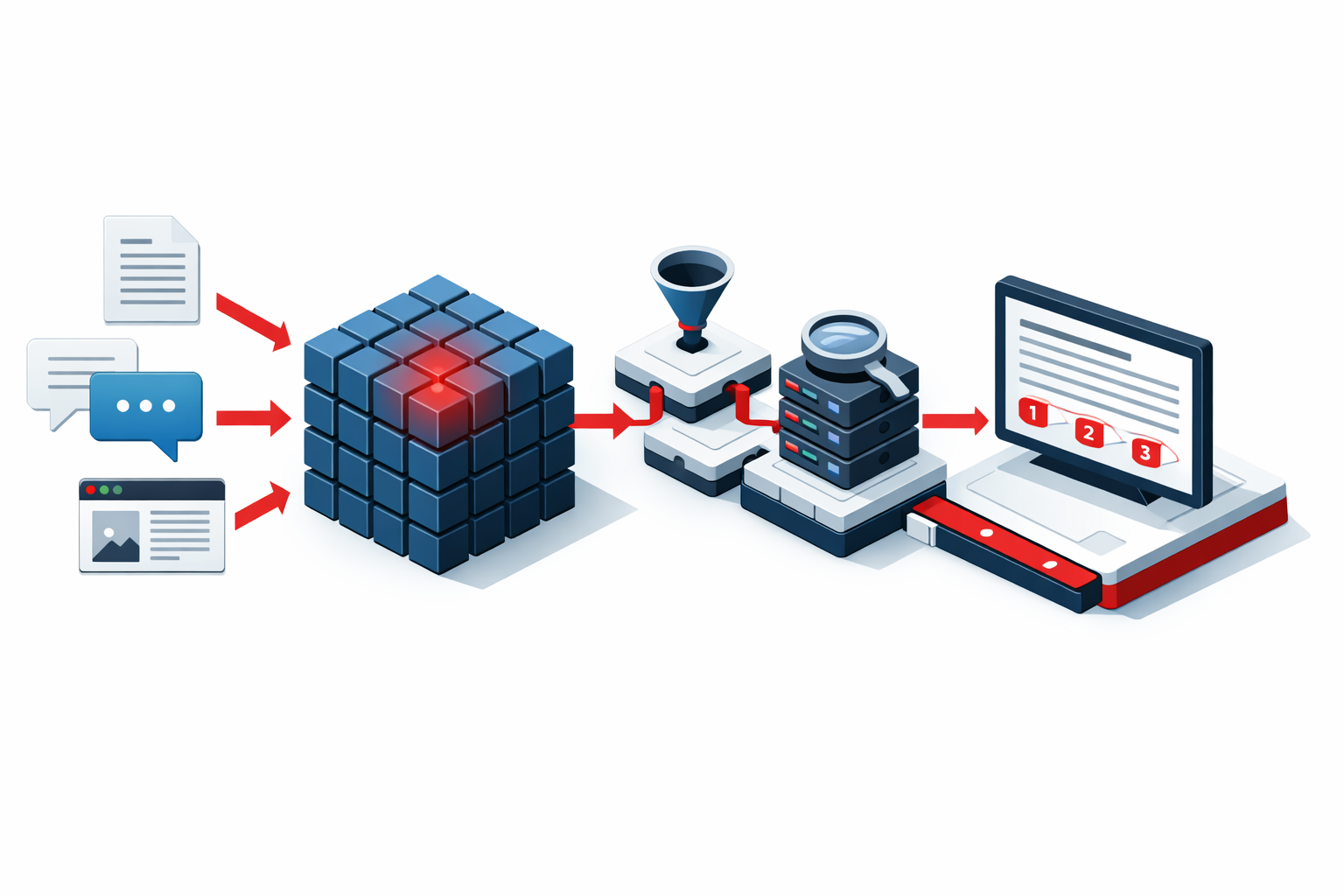
How We Build RAG for West Town
We begin with a knowledge audit. What documents, files, and records does your business have? We catalog your knowledge sources: project deliverables, case studies, research reports, proposals, client briefs, creative briefs, post-mortems, guidelines, and any other documentation that contains expertise your team has built. We assess what is worth indexing and what is outdated or irrelevant. We identify gaps where knowledge exists in people's heads but not in documents.
We then design the knowledge architecture. A RAG system is only as useful as the structure of what it can search. We decide how to chunk and index your content so queries return relevant results rather than lengthy documents where the answer is buried on page four. For a West Town design firm with a large project archive, we might index each project's brief, approach summary, and outcome separately so searches can surface relevant precedent efficiently.
We build the ingestion pipeline that pulls your existing content into the RAG system. We handle common formats: PDFs, Word documents, slide decks, project management exports, and structured data from your existing tools. We clean and process the content, generate embeddings, and load everything into the vector database that powers semantic search.
We then build the query interface. How will your team interact with the system? For some West Town businesses, a simple chat interface works well: ask a question, get an answer with source citations. For others, integration into an existing tool makes more sense: a search panel inside your project management platform, or a question interface inside your CMS. We match the interface to how your team actually works.
We test with real queries from your team and refine retrieval quality based on whether results are relevant and useful.
Industries We Serve in West Town
Design and branding studios along Chicago Avenue and Damen Avenue use RAG to search project archives for relevant precedent, surface past brand systems for reference, and help new designers understand the studio's visual history and client work. Studios stop recreating solutions they have already developed.
Advertising and marketing agencies use RAG to search campaign histories, audience research, competitive analyses, and creative decks. Account teams find relevant past work for new business pitches in minutes rather than hours. Creative teams access research and strategy context without waiting for briefings from senior staff.
Architecture and interior design firms in West Town use RAG to search specification libraries, material research, building code documentation, and past project drawings. Technical staff access precedent and specification detail quickly, reducing research time on new projects.
Consulting and professional service firms on Division Street use RAG to search engagement deliverables, methodology documentation, research reports, and client case studies. Consultants access the firm's accumulated knowledge on any topic without relying on senior staff as the sole knowledge holders.
Real estate and development businesses use RAG to search market research, property analysis, regulatory documentation, and past transaction records. Teams access institutional knowledge about specific submarkets, building types, and regulatory contexts quickly.
Content and media production companies use RAG to search script archives, research notes, interview transcripts, editorial guidelines, and past production documentation. Writers and producers access relevant material from existing work rather than starting every project from scratch.
What to Expect Working With Us
1. Knowledge audit and system design. We catalog your knowledge sources, assess content quality and structure, and design the knowledge architecture for the RAG system. We identify the top three to five use cases that will deliver the most immediate value to your team. The audit and design phase takes two to three weeks.
2. Content ingestion and indexing. We process your existing documents, build the ingestion pipeline, generate embeddings, and load content into the vector database. We address data quality issues and validate that content is indexed correctly. Ingestion typically takes two to four weeks depending on the volume and variety of your content.
3. Query interface development and testing. We build the interface your team will use to query the system, integrate it with your existing tools where appropriate, and test retrieval quality against real queries from your team. We refine indexing and retrieval logic until results are consistently relevant and useful. Interface development and testing takes two to three weeks.
4. Training, deployment, and ongoing improvement. We train your team on using the RAG system, monitor query quality after launch, and refine the system based on how your team actually uses it. We establish a process for keeping the knowledge base current as new work gets produced. Ongoing maintenance ensures the system improves over time rather than becoming stale.