How We Build No Code Platforms for West Town
The first conversation with a new client is a platform fit assessment. We ask what problem you are solving, who the users are, what data needs to live in the system, what integrations matter, and what the growth trajectory looks like. From these answers, we recommend a platform or we tell you honestly that no-code is not the right approach for your use case. We have sent West Town clients to custom developers when the requirements justified it, because recommending the wrong path wastes everyone's time.
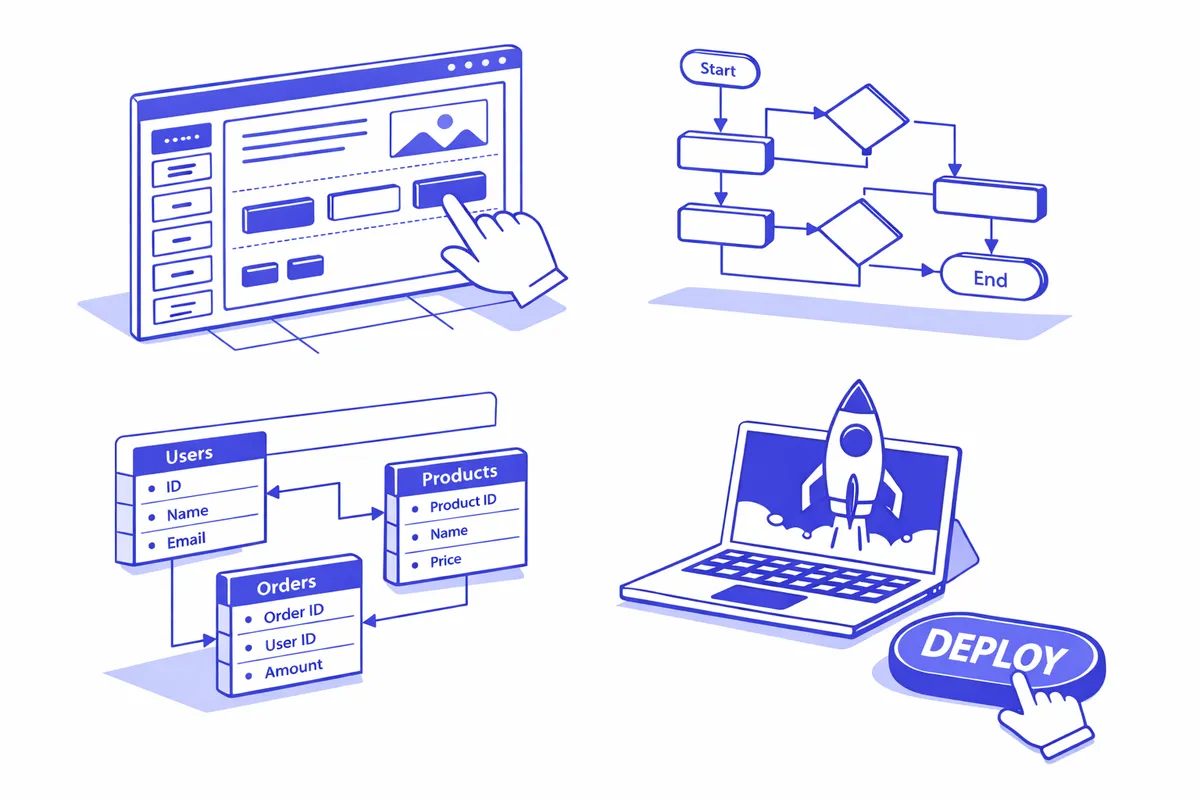
Once the platform is chosen, we start with data modeling. This is the step that most amateur no-code projects skip and then regret six months later when the structure collapses under complexity. We model the entities, the relationships, the access patterns, and the constraints before building any user interface. For an Airtable project, this means designing the base structure with linked tables, proper roll-ups, and views that match actual user workflows. For a Bubble project, this means designing the database schema, the role-based permissions, and the workflow architecture before drawing a single screen.
Interface design runs in parallel with the data work. We wireframe the key user flows and review them with you before building. For client-facing tools, we design the experience with the actual user in mind, which in West Town often means non-technical users who need the interface to be genuinely intuitive rather than feature-rich. A boutique owner who will use the inventory tool daily needs an interface designed for speed and clarity, not one that tries to expose every possible capability.
Build runs in observable increments. You have access to a preview environment from day one and watch the application come together in real time. Feedback cycles happen during the build rather than as a big reveal at the end, which means the finished product matches your expectations because you have been shaping them throughout. This collaborative build approach works especially well for West Town's creative clients who have strong visual and experience instincts.
Integration with your existing stack is part of most no-code projects. We connect the new tool to your CRM, your accounting system, your email platform, your POS, or whatever other tools are part of your operation. The goal is that the no-code application feels like a native part of your stack rather than a disconnected tool.
Training is the handoff step that determines whether the project succeeds long-term. We train your team on the platform with documentation specific to your application. A West Town retailer whose operations manager will handle day-to-day maintenance gets hands-on training on adding fields, creating views, and adjusting automations. The goal is that you own and operate the application independently, with us available for larger changes or expansions if and when you want them.
Industries We Serve in West Town
Creative agencies and design studios use no-code to build client portals on Bubble or Softr, project management dashboards layered on Airtable, internal time tracking and profitability tools, and marketing sites on Webflow. The combination of Bubble for client-facing applications and Airtable for internal operations covers most agency needs in West Town.
Boutique retailers along Division Street and Chicago Avenue use no-code for custom inventory systems, vendor and consignment management, wholesale account portals, and customer loyalty tools that extend beyond what POS platforms provide natively. Airtable with Softr interfaces handles most of these use cases for retail teams that want speed and flexibility over heavy custom development.
Craft producers and small manufacturers in the converted industrial buildings of West Town use no-code for batch tracking, wholesale order management, compliance documentation, and distribution coordination. The operational spine for a growing producer often lives in a well-designed Airtable base connected to their accounting and sales tools.
B2B consultancies and professional services firms in East Village and Noble Square use no-code for client intake tools, engagement management, proposal pipelines, and internal knowledge bases. Bubble handles the client-facing portal needs. Airtable or Notion handle the internal operational layer.
Startups at the idea or MVP stage operating from West Town's coffee shops, co-working spaces, and founder apartments use no-code to validate product concepts before custom development. We have built MVPs on Bubble that subsequently raised funding, served real customers for a year or longer, and produced the data foundation for a later custom rebuild once the market was proven.
Community and cultural organizations rooted in West Town's Latino heritage and newer nonprofit arrivals use no-code for program participant tracking, donor management, event coordination, and volunteer scheduling. Nonprofit budgets do not support custom development, but they do support well-designed no-code operations.
What to Expect Working With Us
1. Platform fit assessment. We meet for one to two hours to understand your problem, your users, your data, and your growth plans. We recommend a platform or we tell you honestly if no-code is not the right fit. No commitment on either side.
2. Data model and wireframes. We design the foundation before building. You review and approve the data model and the key user flow wireframes before any configuration work starts. This step separates successful no-code projects from ones that have to be rebuilt.
3. Build with live previews. Build runs in observable increments over four to eight weeks for typical West Town projects. You have access to a preview environment throughout and provide feedback as the application takes shape.
4. Launch, training, and documentation. We launch with your team trained on the platform. Documentation specific to your application lives with you. You own the application outright and can maintain or extend it without us.