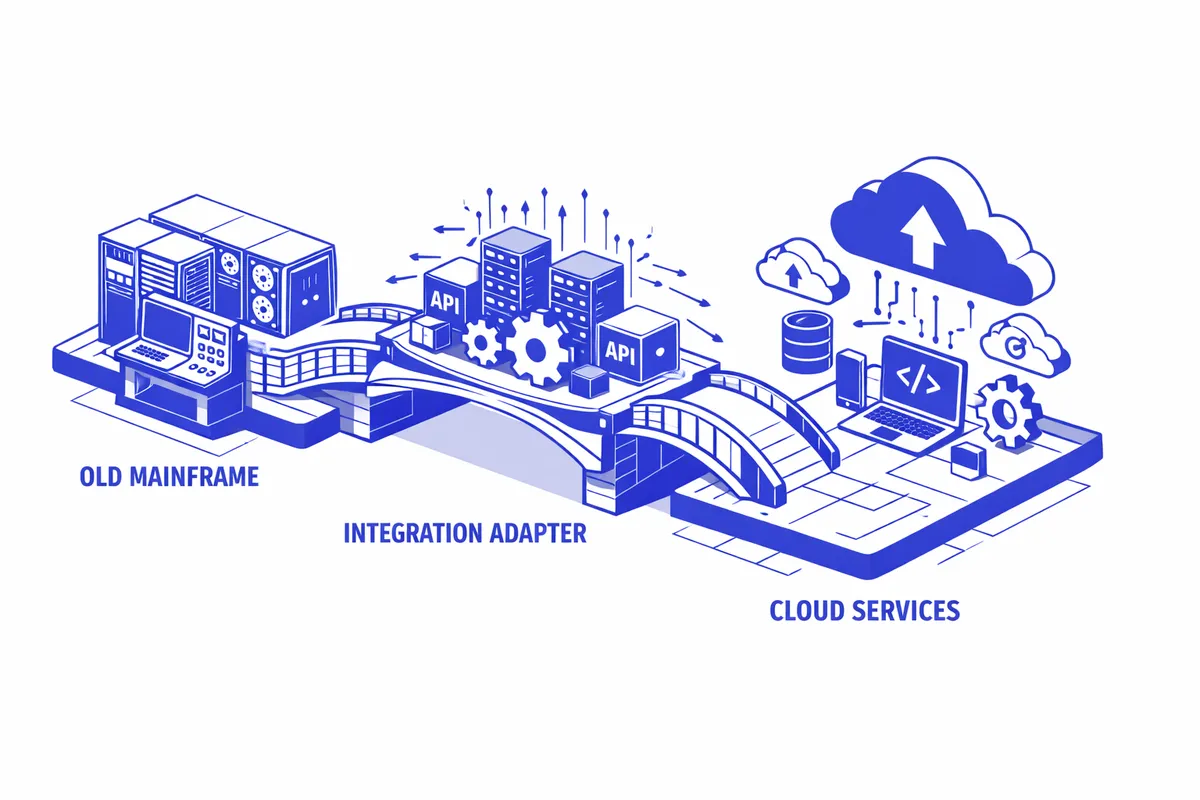
How We Build Legacy System Integration for West Town
The first work is system archaeology. We need to understand what the legacy system actually does, what data it holds, how it currently sends or receives information, and what its technical boundaries are. Some legacy systems have undocumented APIs. Some have data exports that can be automated. Some require middleware that watches for file changes and routes data between systems. Some require a custom-built connector that translates between an old data format and a current API. We do not recommend a solution until we understand what we are actually connecting.
For West Town's manufacturing and workshop businesses near Western Avenue, that audit often reveals that the legacy system is a custom database built by a contractor who is no longer reachable. We document the schema, understand the data relationships, and then design an integration approach that does not require modifying the legacy system itself, because modifying an undocumented custom system that the business depends on is too risky.
We build integrations with error handling from the start. The failure mode for any data integration is not just that it stops working but that it silently passes bad data. We build monitoring that alerts when an integration produces unexpected results or stops functioning, so the business learns about a problem through our monitoring rather than through a customer complaint or a financial discrepancy.
For data migration work, which sometimes accompanies integration projects when legacy data needs to be moved into a new system while the old one remains active for historical reference, we build the migration with reconciliation checks so the transfer is verifiable rather than assumed.
Industries We Serve in West Town
Small manufacturers and workshops near Western Avenue operate production management, quoting, and customer relationship software that predates modern API infrastructure. Integration work for these businesses typically connects their job management or ERP system to a modern customer portal, a current accounting platform, or a materials ordering system with an accessible API. The goal is automating the data re-entry that currently happens manually between disconnected systems.
Real estate offices serving the West Town, Ukrainian Village, and Humboldt Park corridors use legacy CRM and lead management systems that were built before cloud platforms became standard. Integration connects those contact databases to current marketing automation tools, Google Business profiles, and listing platforms so lead data flows in both directions without manual export and import cycles.
Long-established retailers on Chicago Avenue and Division Street have POS systems, loyalty programs, and accounting software that have been in operation long enough to contain irreplaceable historical data. Integration work here focuses on connecting those systems to modern ecommerce platforms, inventory management tools, and customer communication platforms without displacing the legacy POS that processes daily transactions.
Service businesses near Pulaski Park and Emmett Till Academy including healthcare offices, legal services, and financial service providers often carry scheduling and client management systems from prior decades that contain years of client records and workflow configurations that staff depend on. Integration connects those systems to current communication platforms, billing tools, and referral tracking systems.
Cafes and food businesses operating with older kitchen management or franchise-mandated POS systems that lack modern integration capabilities need custom middleware that routes data to current analytics platforms and ordering systems. A restaurant on Division Street whose corporate POS cannot connect to a delivery platform directly benefits from an integration layer that bridges that gap without replacing the core system.
Design and creative firms on Ashland Avenue and the Grand Avenue corridor sometimes carry project management systems or billing software from early in their history that contain client records and project archives that are not easily migrated. Integration work for these firms connects historical project data to current workflow and CRM platforms, making it accessible without requiring the old system to remain the primary interface.
What to Expect Working With Us
1. Legacy system audit and documentation. We spend the first phase understanding your existing systems in detail. For systems with poor or no documentation, this means working with the staff who use them daily, examining the data structures, and testing what export or API capabilities exist. This audit produces a technical document that defines exactly what integration is possible and what approach makes the most sense.
2. Integration architecture and approach. Based on the audit, we present integration options with honest tradeoffs. Sometimes the best approach is an off-the-shelf middleware platform. Sometimes it requires a custom connector. Sometimes the right answer is a data migration that moves historical records to a new system with the legacy system archived for reference access only. We explain each option in terms of cost, risk, and long-term maintenance burden before any work begins.
3. Build with staged testing. We build integrations in a staging environment that mirrors your production setup, then validate with real data samples before any live system is affected. For West Town businesses whose operations cannot tolerate downtime on a busy Division Street Friday or a Eckhart Park event weekend, we schedule production deployments for low-traffic windows and maintain rollback capability throughout.
4. Monitoring setup and documentation. Every integration we deliver includes monitoring dashboards and alert configurations so you know when something stops working before it affects operations. We also document every integration we build, including the connection logic, error handling procedures, and what to do if a system on either end of the integration changes. That documentation belongs to you.