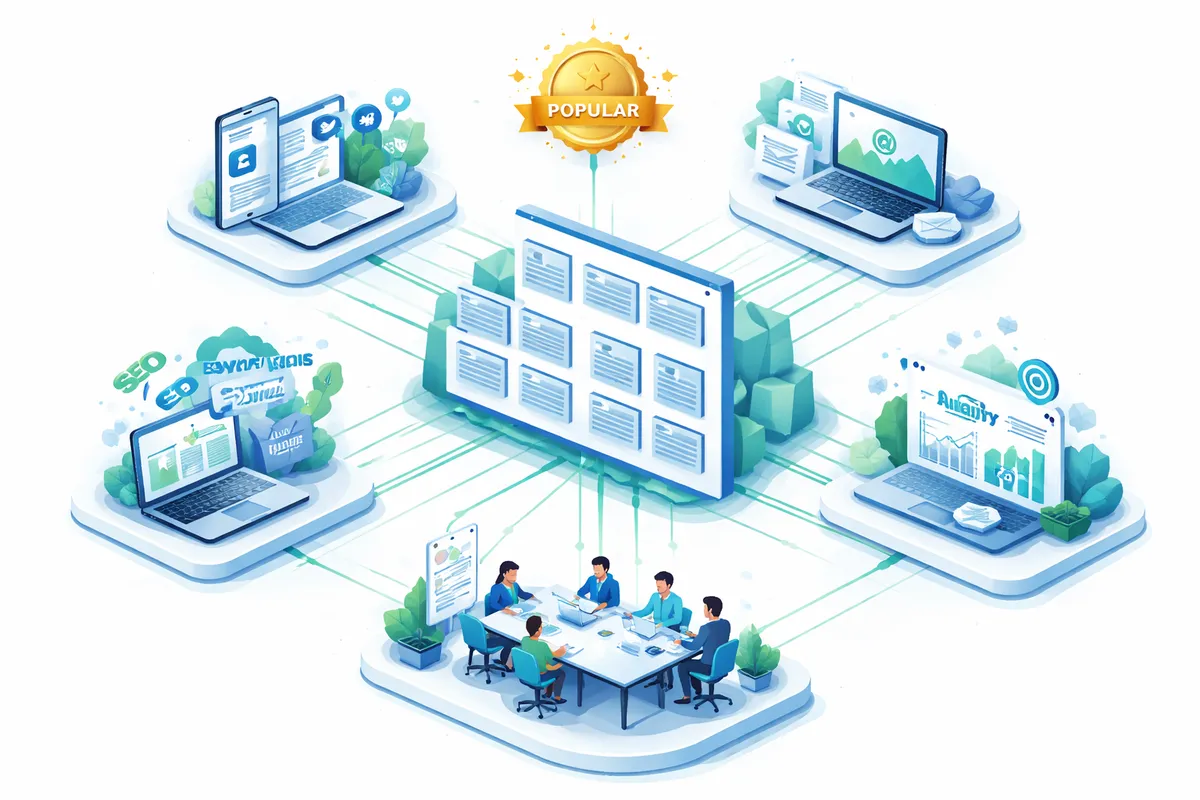
How We Build Growth Marketing for West Town
The first step is identifying which growth lever is most constrained. Some West Town businesses have strong acquisition but terrible retention: new customers come once and never return. Others have loyal regulars but no mechanism to acquire new customers beyond passive foot traffic. Others have both, but neither is measured, so growth looks random rather than driven. We diagnose the constraint before we start spending budget.
We sit with business owners at their actual operation, whether that is a counter conversation at a cafe on Division Street or a walkthrough of a studio near Western Avenue, before we write a single brief. Understanding how customers currently find you, what makes your regulars come back, and what friction exists between a first visit and a second one is the strategic foundation everything else builds on.
From that foundation we build a growth stack calibrated to the business. For a restaurant or retailer, that typically means an email and SMS program, a structured loyalty mechanic, and a paid acquisition program targeting the specific zip codes and interest profiles that match your existing best customers. For creative firms, it means content and referral structures that generate inbound inquiries from the right client types.
We measure everything. Every campaign connects to a measurable outcome: not impressions, but new customers acquired, existing customers retained, and revenue per customer over time. Monthly reporting makes the growth mechanics visible so decisions about where to invest next are driven by evidence, not intuition.
Industries We Serve in West Town
Restaurants along Division Street and Chicago Avenue use growth marketing to build email and SMS lists from existing customer relationships, run targeted reactivation campaigns for customers who have lapsed, and run structured referral programs that make their regulars active ambassadors. A neighborhood restaurant with three hundred loyalty members who receive a personalized offer on a slow Tuesday can move a meaningful amount of revenue with that single touchpoint.
Design and creative firms operating near Ashland Avenue and Grand Avenue grow through a combination of content marketing, referral system design, and strategic positioning in the communities where their best clients come from. Growth for a studio is less about ads and more about reputation architecture: being the obvious choice in the right conversations.
Independent retail on Chicago Avenue grows by converting walk-in customers to repeat buyers through loyalty programs, email capture at checkout, and event-driven reactivation campaigns timed to the neighborhood's seasonal calendar, including the arts walk, summer programming at Eckhart Park, and back-to-school and holiday shopping cycles.
Near Pulaski Park, neighborhood service businesses including financial services, insurance, and healthcare providers grow primarily through trust-based referral systems. Growth marketing for these businesses centers on structured referral programs, Google review generation, and community event sponsorship that builds credibility with the families who live within walking distance.
Cafes and independent coffee shops scattered across West Town's residential pockets grow through loyalty programs, local content marketing that reinforces neighborhood identity, and partnership promotions with adjacent businesses. A coffee shop near Emmett Till Academy that runs a back-to-school promotion with a neighboring bookshop or school supply store creates a growth moment that neither business could generate alone.
Workshops and small manufacturers near Western Avenue grow through B2B content marketing, LinkedIn and trade directory presence, and referral programs within the design and construction communities that generate their best project leads. Growth marketing for these operations is relationship-driven and often takes longer to build but produces higher-value customer relationships.
What to Expect Working With Us
1. Growth diagnostic. We map your current acquisition sources, retention rates, and customer lifetime value before recommending any specific tactics. Most West Town businesses discover during this process that their growth constraint is in one specific area, and the diagnostic prevents spending budget on the wrong lever.
2. 90-day growth plan. Based on the diagnostic, we build a sequenced 90-day plan with specific channels, campaigns, and targets. For West Town businesses with seasonal patterns tied to neighborhood events, the plan accounts for those windows explicitly. We do not build evergreen marketing plans that ignore the fact that June in West Town is different from January.
3. Campaign execution and infrastructure build. We build the technical infrastructure, email platform, CRM, loyalty program, ad accounts, and analytics, and run the first campaign cycle. We run the first cycle alongside you rather than handing it off, because the first ninety days of data are the most valuable learning you will get.
4. Handoff and growth rhythm. After the initial build and campaign cycle, we establish the monthly growth rhythm: what gets reviewed, what gets optimized, and what decisions get made when. Some West Town businesses engage us ongoing as a growth partner. Others take over execution themselves after the infrastructure is built. Both paths end with a business that has systems rather than guesswork driving its growth.