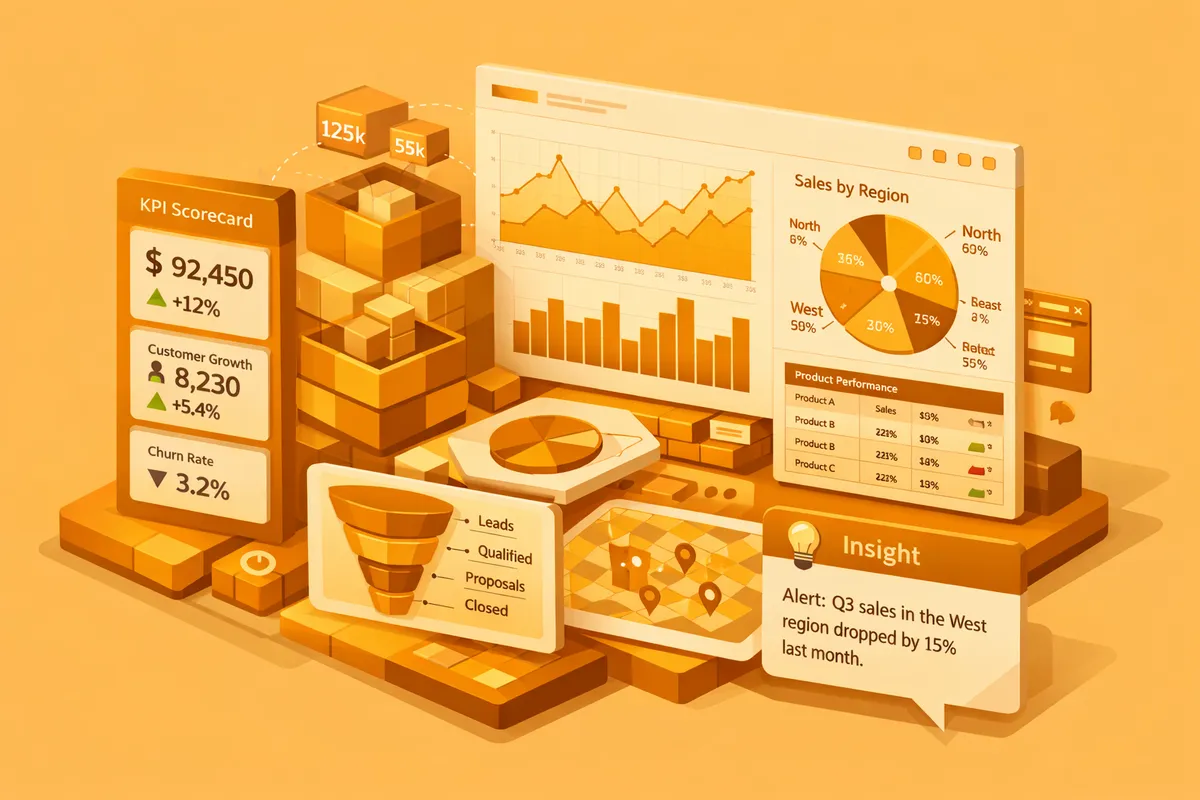
How We Build Business Intelligence for West Town
Building BI for West Town starts with understanding the specific business type and the decisions that matter most. A restaurant on Division Street needs different metrics than a design studio on Chicago Avenue or a small manufacturer doing custom work near Damen Avenue. We begin every engagement by working with the owner or operator to identify the five to eight decisions they make repeatedly, the data they currently use to make them, and the questions they cannot currently answer.
For restaurants and bars in West Town, the core data questions tend to be: which items produce the most margin, which shifts drive the most covers, how is weekend versus weekday volume trending, and when do food costs drift outside target ranges. These questions require connecting the point-of-sale system, the reservation platform, and the purchasing records in a single view. We build those connections and deliver dashboards that update daily, giving operators the visibility to adjust staffing, cut low-margin items, and respond to volume trends before they become problems.
For design and creative firms along the Chicago Avenue corridor, the core questions are about project profitability and pipeline health. Which clients generate the most margin? Which project types take longer than estimated and erode margin in execution? What does the pipeline look like thirty, sixty, and ninety days out? These questions require connecting time-tracking software, project management tools, and billing platforms in a way that makes profitability visible by client, project type, and team member.
For retail and independent shops in West Town, the core analytics questions are inventory performance, customer return rates, and channel attribution. Which products move fastest, which sit on shelves and tie up cash, and which marketing channels are actually bringing customers through the door. Dashboard design follows function: every element we build exists because it supports a specific decision, not because the data exists.
Industries We Serve in West Town
Design studios and creative agencies along Chicago Avenue use BI to track project margin by client, proposal win rates, team utilization, and revenue concentration risk. When a studio principal can see that forty percent of revenue is concentrated in two clients, the business development conversation becomes urgent and data-supported rather than a vague worry.
Restaurants and bars on Division Street deploy BI to manage margin by menu item, cover volume by shift, food and beverage cost ratios, and server performance. West Town's competitive dining environment means the difference between a thriving independent and a struggling one is often a question of operational precision, not concept alone.
Small manufacturers and workshop operations near Damen Avenue use BI to track production throughput, material cost variance, order fulfillment timing, and capacity utilization. For a custom fabrication shop or artisan production business, margin lives in the details of how efficiently raw materials convert to finished orders.
Real estate offices serving the Near Northwest Side need BI that connects listing activity, closing volume, agent performance, and lead source attribution. The West Town market moves fast; operators who can see their pipeline and conversion data in real time make better decisions about where to spend marketing dollars and which agents need support.
Independent retail and boutique shops along Chicago Avenue and Division Street use BI to manage inventory turnover, customer lifetime value, channel performance, and seasonal buying decisions. Knowing which product categories drive repeat visits and which are one-time purchases shapes both buying and marketing investments.
Community organizations and nonprofits near Eckhart Park and the Pulaski Park fieldhouse use BI to track program participation, grant utilization, donor retention cohorts, and service delivery metrics. For organizations serving West Town's long-time residents, data visibility supports both program quality and funding conversations.
What to Expect Working With Us
1. Business decision audit. We begin by cataloging the decisions your leadership makes regularly and the information gaps that make those decisions harder than they should be. For a restaurant on Division Street, this audit typically surfaces four to six operational questions that current reports cannot answer. That gap is the BI scope.
2. Data source inventory and pipeline design. We map every system that holds relevant data and design the extraction and transformation logic that brings it into the analytics layer. West Town businesses run a wide range of tools: older point-of-sale systems, modern SaaS platforms, spreadsheets that have become unofficial databases. We address data quality issues during pipeline design, not after dashboards are live.
3. Iterative dashboard builds with user review. We build in two-week sprints and review working dashboards with the people who will use them at the end of each sprint. This prevents the failure mode of delivering technically correct dashboards that nobody uses because they do not match how the operator actually thinks about the business.
4. Training and self-service enablement. We train your team not just to read the dashboards we built but to build their own views and reports. The goal is analytical independence. A West Town restaurant owner should be able to pull a custom sales report for a Saturday night without submitting a request to anyone.