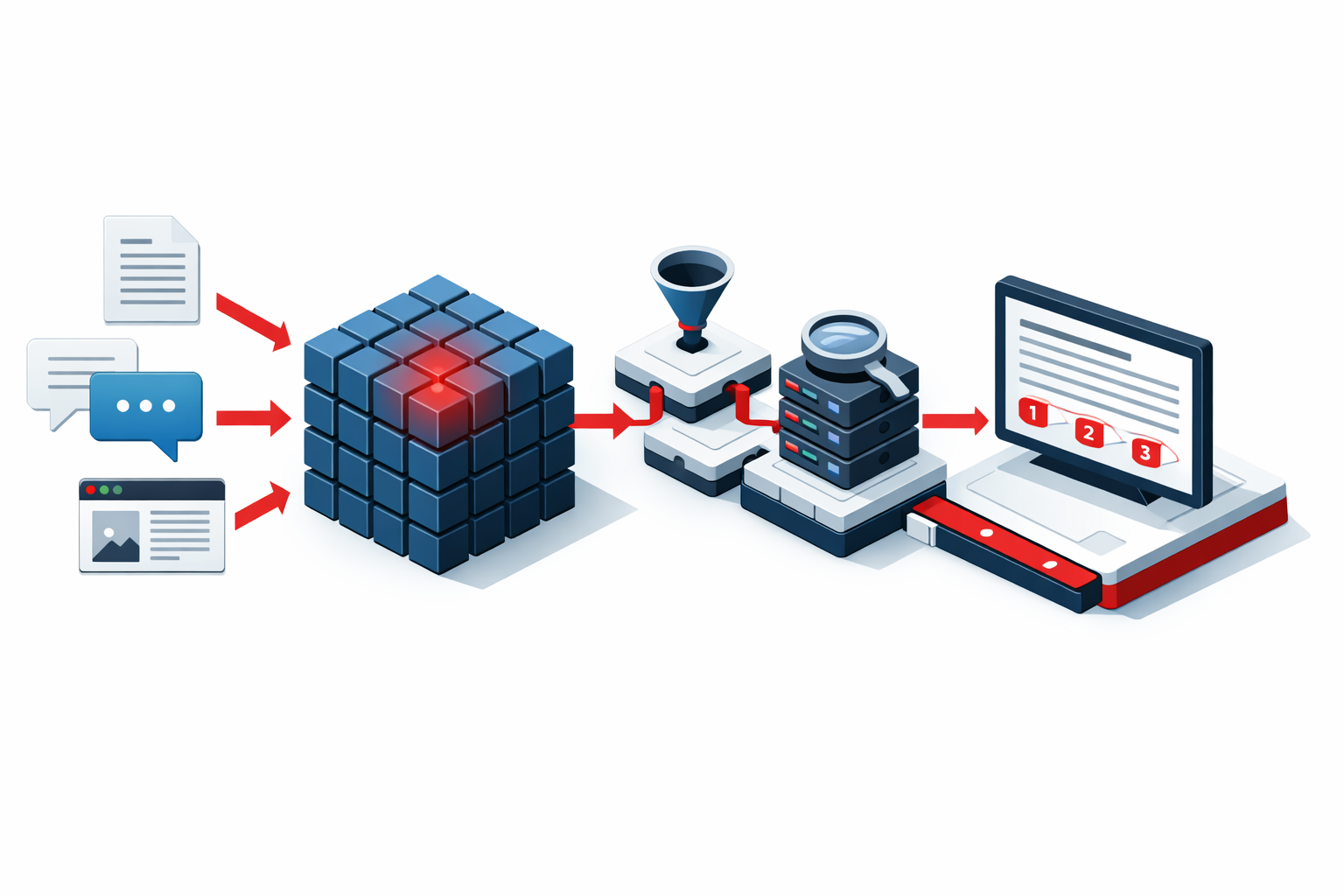
How We Build RAG Systems for West Loop
RAG development starts with knowledge base assessment. We inventory the documents and data sources that should ground your AI's answers: product documentation, research libraries, policy documents, customer communication history, regulatory filings, or whatever combination of sources your specific West Loop use case requires. The knowledge base is the foundation of RAG system accuracy, and its quality determines the quality of the answers the system can provide.
From the knowledge base assessment, we design the RAG architecture: the document processing pipeline that converts source documents into retrievable embeddings, the vector database that stores these embeddings and supports similarity search, the retrieval system that identifies the most relevant passages for each query, and the generation system that synthesizes retrieved information into coherent, grounded answers. Architecture design for West Loop businesses in regulated industries includes access control that limits retrieval to documents the querying user is authorized to access.
Document processing is the technical phase that most affects retrieval quality. Documents need to be chunked appropriately: chunks that are too small lose the context that makes passages meaningful; chunks that are too large retrieve irrelevant surrounding content alongside the relevant passage. Metadata extraction during processing enables filtered retrieval, so a query about a specific product version retrieves only from documentation for that version rather than from the entire documentation library.
Retrieval tuning is where RAG systems are often under-invested. The default retrieval that finds the most semantically similar passages does not always retrieve the most relevant passages for complex queries. We tune retrieval for your West Loop business's specific query patterns using techniques including hybrid search that combines semantic and keyword matching, reranking that reorders retrieved results before generation, and query expansion that improves retrieval on sparse or ambiguous queries.
Industries We Serve in West Loop
Legal and professional services firms on Madison Street use RAG systems to build the research and document analysis tools that are accurate about their specific practice areas, their specific jurisdiction's legal standards, and their own case history. A RAG system grounded in the firm's matter files, research library, and current regulatory documents produces legal research assistance that generic AI cannot provide.
Tech companies and startups on Lake Street and Fulton Market use RAG to build the customer support, onboarding, and self-service tools that are accurate about their specific product rather than about products in general. A startup whose support AI is grounded in current product documentation, release notes, and known issue records provides answers that reduce support escalations rather than increasing them.
Financial technology companies near Halsted Street use RAG to build AI tools that are accurate about their specific products, policies, and regulatory obligations. Customer-facing AI in financial services that retrieves from current policy documents and regulatory guidance produces accurate answers that general AI, drawing from training data that may be outdated or jurisdiction-incorrect, cannot consistently provide.
Boutique hotels and hospitality properties near Morgan Street use RAG to build the guest service AI that accurately answers questions about property-specific amenities, policies, and local recommendations. A hotel's guest service AI grounded in current property documentation provides accurate answers about shuttle schedules, dining hours, and room policies rather than generating plausible-sounding answers that do not match the actual property.
Real estate development and commercial leasing in West Loop uses RAG to build the leasing assistant tools that accurately answer prospective tenant questions about specific properties, lease terms, and available spaces. Commercial real estate AI grounded in current property documentation and lease terms produces answers that a leasing agent can stand behind.
Creative and advertising agencies near Morgan Street use RAG to build the brand and strategy knowledge systems that ground AI-assisted creative work in specific client brand documentation, campaign history, and market research rather than in general marketing knowledge.
What to Expect Working With Us
1. Knowledge base assessment and architecture design. We assess your West Loop business's document ecosystem, identify the sources that should ground the RAG system's answers, and design the retrieval architecture that makes those sources effectively searchable. Architecture design includes access control, document processing approach, and the retrieval strategy appropriate for your specific query patterns.
2. Document processing and index construction. We process your documents into retrievable embeddings, build the vector index, and validate retrieval quality against representative queries. Document processing quality directly affects retrieval quality, and we invest appropriate attention in chunking, metadata extraction, and the pre-processing steps that make your documents effective retrieval sources.
3. Retrieval tuning and generation configuration. We tune the retrieval system for your specific query patterns and configure the generation system to produce answers that are grounded, cited, and formatted appropriately for your West Loop business's use context. For legal and financial use cases, generation configuration includes the caveat language and uncertainty expression that accuracy requirements demand.
4. Integration, deployment, and ongoing maintenance. We integrate the RAG system with the interfaces and workflows your West Loop team uses, deploy with monitoring that tracks retrieval quality and answer accuracy over time, and maintain the system as new documents are added to the knowledge base and as retrieval quality requires recalibration.