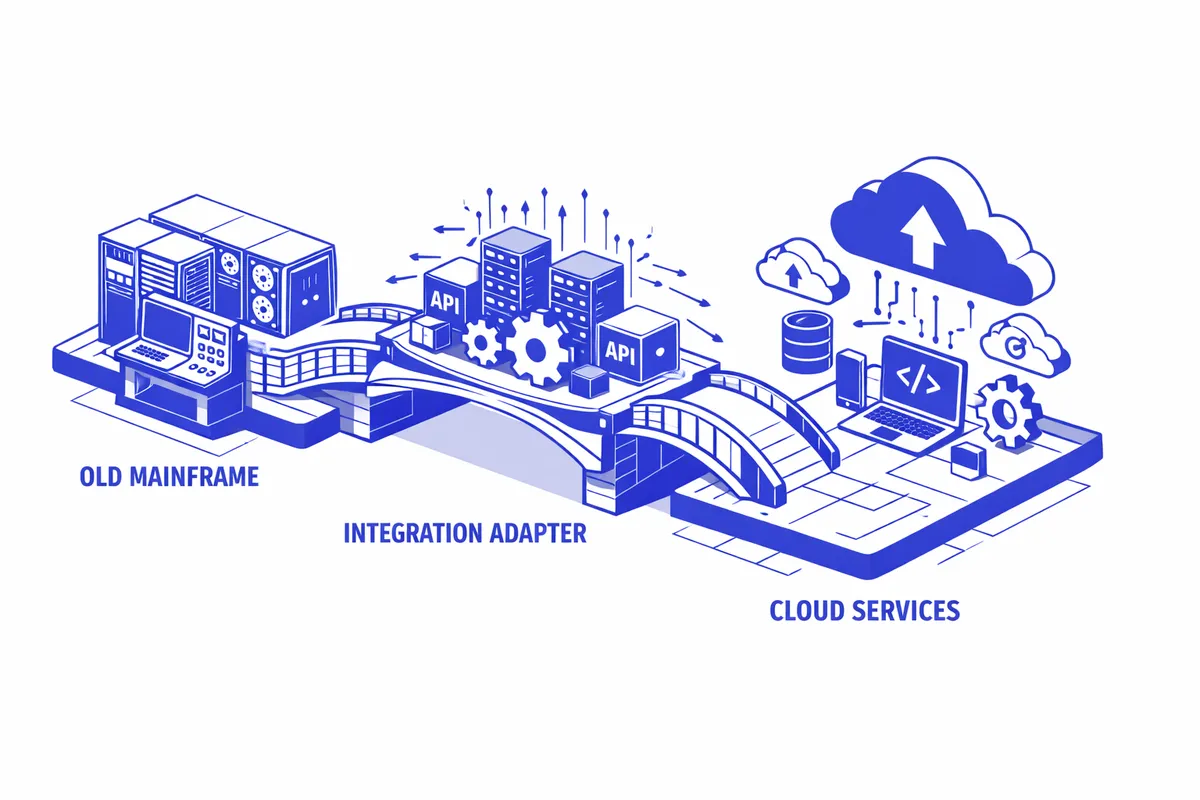
How We Build Legacy System Integration for West Loop
West Loop integration work moves faster than most Chicago neighborhoods because the businesses here are accustomed to technology and capable of participating meaningfully in the integration design process. We adapt our process to this context.
Discovery in the West Loop is typically more efficient because technical counterparts at client companies understand system architecture and can provide integration-relevant information directly. We still conduct systematic discovery, but we spend less time explaining technical concepts and more time working with internal teams to surface the edge cases and business logic exceptions that define how an integration must actually behave rather than how it appears to behave in documentation.
For restaurant clients along Randolph Street and Fulton Market, integration architecture prioritizes reliability under high-volume conditions. A POS-to-accounting integration for a busy restaurant must handle peak Friday night transaction volumes without delay or error. We build and test under load conditions that match the client's actual peak operations, not average operations.
For tech company clients, integration design often involves reconciling data models that were designed independently and have diverged. This requires transformation logic more sophisticated than simple field mapping, and sometimes requires business decisions about which system is authoritative when records conflict. We surface these decisions clearly during design rather than making assumptions that surface as data quality problems after launch.
Industries We Serve in West Loop
Technology Companies and Startups: Tech firms clustered around Morgan Street, the Morgan Pink Line station, and Fulton Market use CRM, customer database, and product analytics systems that require integration as the product portfolio grows and customer data fragments across platforms. We build the connection layers that unify customer identity and data flow across systems without requiring a full platform rebuild.
Restaurants and Hospitality: Fulton Market and Randolph Street restaurant groups with established POS, reservation, and inventory systems need integration with cloud accounting tools, delivery aggregators, marketing CRMs, and revenue analytics platforms. We build the connections that eliminate the manual reconciliation work and keep all systems current without POS replacement.
Creative Agencies: West Loop creative agencies that grew from small teams to larger operations use project management, billing, and client communication platforms that no longer integrate natively with the broader tool ecosystem the agency has adopted. We build integrations that connect these established platforms to modern tools without disrupting the workflows teams depend on.
Venture Capital and Investment Firms: VC firms operating near Bartelme Park and along Lake Street use deal management and CRM platforms with years of relationship history that require integration with modern document management, communication, and portfolio analytics tools.
Legal Services: Law firms and legal services businesses on Halsted Street and Madison Street use matter management and billing platforms that need integration with client portal technologies, document automation tools, and analytics dashboards that law firm clients now expect as standard.
Real Estate Development: Real estate development firms managing West Loop's continuing construction pipeline use project management, financial modeling, and tenant communication platforms that require integration to give deal teams real-time visibility without manual data assembly.
What to Expect Working With Us
1. Technical Discovery: We assess your legacy system's integration capabilities with the level of technical depth West Loop clients expect: API documentation review, database schema analysis where accessible, export format evaluation, and rate limit or concurrency constraints that will affect integration design. For systems where internal technical teams have existing knowledge, we incorporate that knowledge directly into discovery.
2. Integration Architecture Design: We design integration architecture appropriate to your system's capabilities, your business's data flow requirements, and the performance characteristics your operations demand. For high-volume restaurant clients, this includes load modeling for peak service periods. For tech company clients, this includes data model reconciliation design.
3. Build and Load Testing: We build the integration and test it under conditions that match production volume. West Loop businesses operate at scale, and integrations that work under average conditions but fail under peak conditions are not production-ready. Load testing is standard.
4. Deployment and Iteration: We deploy with monitoring and support a structured iteration period after launch during which the integration is tuned based on production behavior. West Loop clients frequently identify edge cases and business logic nuances during initial production operation that were not visible in testing. We build iteration time into the project timeline.