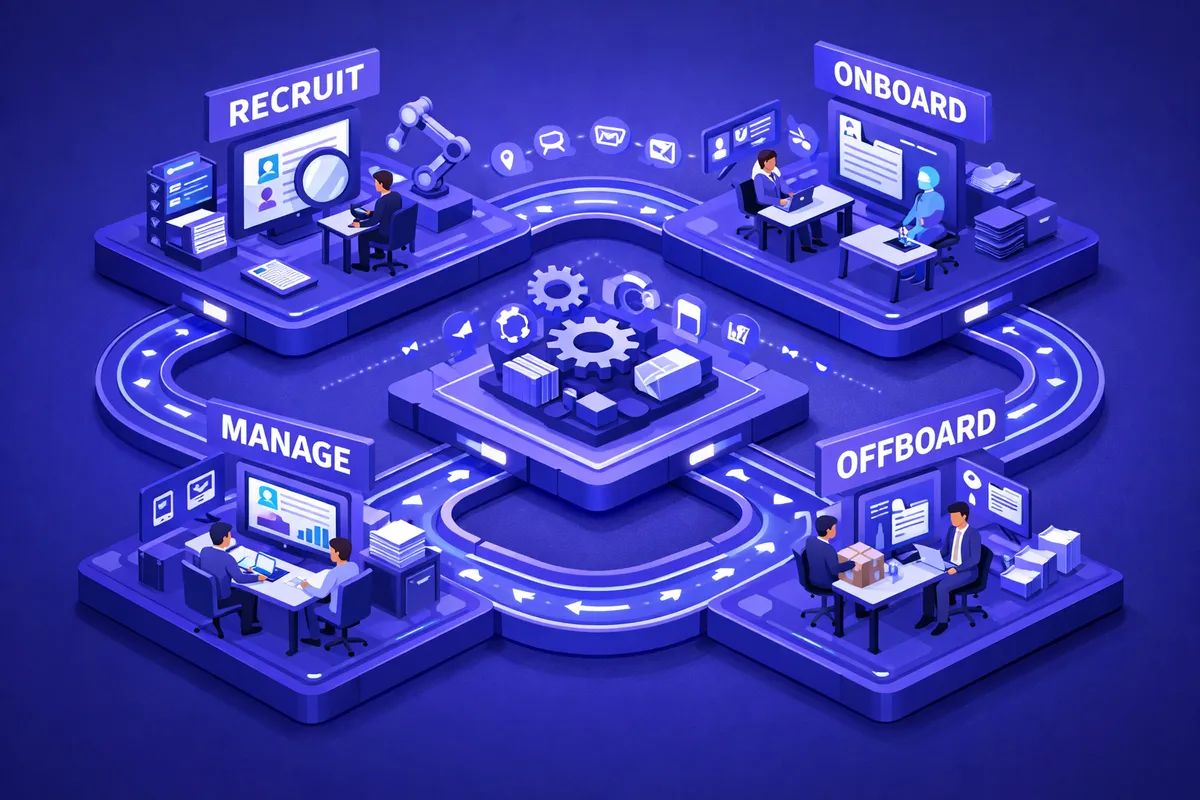
How We Build HR Automation for West Loop
We start with a process inventory rather than a platform recommendation. Most West Loop technology companies have already adopted modern HR platforms: Rippling, Gusto, Lattice, or similar tools that have significant automation capabilities that remain underused. Before we add anything, we map what your current tools can do and where the gaps are between what they can do and what they are actually doing.
For a Fulton Market tech startup, that mapping typically surfaces three high-value opportunities: new hire onboarding sequences that currently require manual HR coordinator steps between offer acceptance and day one, state-specific compliance tracking that is handled by a shared spreadsheet rather than automated monitoring, and performance review scheduling that depends on calendar reminders rather than system triggers. Each of those gaps has an automation solution that can be built within or adjacent to the existing platform.
For West Loop restaurant groups on Randolph Street, the highest-value starting point is almost always onboarding volume management. We build onboarding workflows that trigger automatically from your scheduling or HRIS system when a new employee record is created, route document collection to the employee directly, track completion status without HR coordinator intervention, and escalate incomplete items before the first scheduled shift rather than after a missed compliance deadline.
Document management is a critical component for both industry types but for different reasons. Technology companies need employment document management that supports equity agreement tracking, offer letter version control, and confidentiality agreement workflows. Restaurant operators need food handler certification tracking, tip credit documentation, and health card renewal reminders. We build each configuration based on what your business actually requires, not a generic template.
Industries We Serve in West Loop
Technology companies and startups near Fulton Market automate multi-state onboarding workflows, equity vesting schedule notifications, offer letter e-signature routing, state-specific I-9 and compliance checklist management, mandatory harassment prevention training, and annual benefits open enrollment communication sequences. Growth-stage companies moving from 30 to 150 employees in 18 months cannot scale HR manually; automation is the infrastructure that makes that growth sustainable.
Restaurants and hospitality groups along Randolph Street automate seasonal staff onboarding at volume, food handler certification tracking and renewal reminders, tip credit documentation, required harassment prevention training completion, anniversary-based performance review scheduling, and health code compliance training for kitchen staff. The Fulton Market corridor includes some of the highest-revenue restaurants in Chicago; the HR workflows running those kitchens should match the operational sophistication of the food programs.
Creative agencies and design firms in the West Loop automate contractor versus full-time employee onboarding as separate workflows, project assignment notifications, annual review scheduling tied to project completion milestones, benefits enrollment for full-time staff, and the administrative components of agency growth including offer letter management and reference check routing.
Venture capital firms and financial services offices near Union Park automate employee investment transaction preclearance, annual compliance training, fund staff onboarding including required securities disclosures, performance review cycles, and compensation change approval workflows. The regulatory requirements for registered investment advisers make compliance tracking particularly well-suited to automation.
Legal services and professional practices in West Loop office buildings automate new associate onboarding including conflicts intake and bar admission tracking, mandatory CLE credit monitoring, annual attorney review workflows, and the document management requirements for regulated legal employment files.
Real estate development firms along Lake Street automate project-team onboarding for deal-specific staffing, required OSHA and safety certification tracking, seasonal construction crew onboarding workflows, and the offboarding process when project-based staff complete assignments.
What to Expect Working With Us
1. Process inventory and gap analysis. We document every HR workflow your team runs today, identify which steps are manual, and score each manual step for automation value based on frequency, error rate, and time consumed. Most West Loop companies discover that their highest-value automation opportunity is not the most obvious one.
2. Platform maximization before new tooling. We build every automation we can within your existing HR platforms before recommending additional tools. Modern HR platforms have substantial automation capability that most companies do not use. If your team is on Rippling or Lattice, we start by exhausting what those tools can do.
3. Multi-state compliance configuration. For West Loop technology companies operating across state lines, we configure jurisdiction-specific onboarding checklists, required posting updates, and leave law compliance calendars for each state where you have employees.
4. Iteration through your first full cycle. We run every automated workflow through a complete cycle, whether that is a single onboarding cohort, a quarterly review cycle, or a full seasonal staffing peak. The first cycle reveals edge cases: an employee hired mid-project who triggers an unusual routing, a contractor reclassification that needs a different document set. We resolve those and refine before the next cycle.