How We Build Field Service Management for the West Loop
The design process begins with a day in the field. We follow a dispatcher and one or two technicians through a full service day: how service requests come in, how they get assigned, what the technician knows when they arrive at a Randolph Street restaurant or a Fulton Market office, what they need to document on site, and how that documentation makes its way back to the billing system. That day surfaces the friction points that a software requirements document never captures.
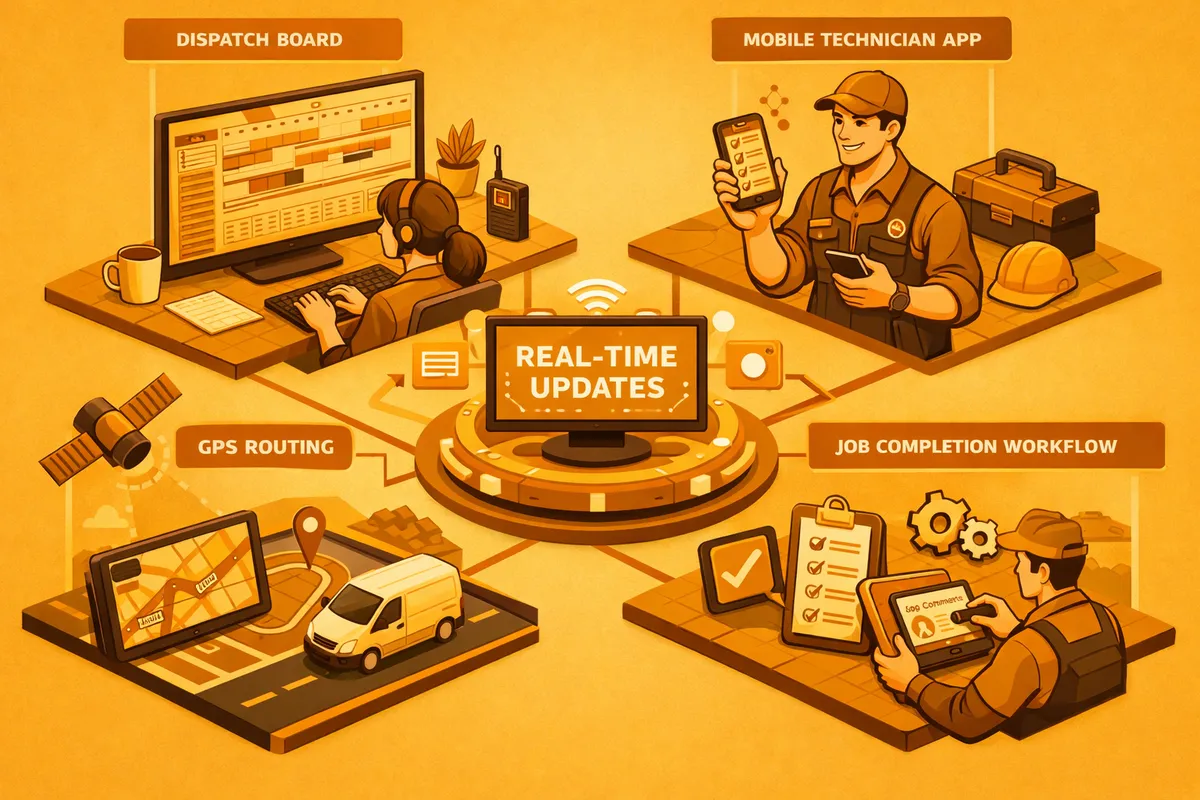
System architecture centers on three user types: dispatchers, field technicians, and account managers. The dispatcher interface shows the full service schedule on a map, lets drag-and-drop reassignment happen in seconds when a job runs long or a priority account calls in, and surfaces the technician skills and certifications required for each job so the right person is always assigned to the right work. The mobile interface for field technicians shows their daily schedule, the service history for each account, the parts and tools they need, and a streamlined documentation form that lets them complete the job record in under two minutes before driving to the next account.
Billing integration is the phase most field service businesses underinvest in. We build the connection between the completed job record and the billing system so that a job signed off by the customer in the field generates a draft invoice within minutes rather than hours. For West Loop service businesses billing time-and-materials work to commercial accounts with net-30 terms, cutting the lag between service delivery and invoice creation is a cash flow improvement that compounds monthly.
Industries We Serve in the West Loop
Commercial HVAC and building services companies maintaining the converted warehouse office buildings that define the Fulton Market aesthetic use field service management to schedule preventive maintenance routes, dispatch emergency service calls, and document work completed across a portfolio of commercial accounts. The building management teams at properties along Lake Street expect service documentation that is detailed and fast, not a handwritten note three days after the visit.
Restaurant equipment maintenance and repair services keeping the kitchens along Randolph Street operational use custom field service management to prioritize emergency calls against routine maintenance schedules. When a convection oven goes down during prep for a Friday dinner service, the service company that can dispatch in 45 minutes and document the repair immediately keeps its account. The one with a manual dispatch process and paper work orders loses it.
Managed IT services providers serving the tech companies and professional services firms between Madison Street and Morgan Street use field service management to track service tickets, schedule on-site visits, manage the parts and equipment inventory they bring to jobs, and produce the service level reports their enterprise clients require monthly.
Commercial cleaning and facilities management companies servicing the West Loop's office towers, restaurant spaces, and event venues use field service management to manage shift scheduling, route planning, quality inspection workflows, and the client communication that keeps commercial accounts satisfied and renewing.
Security systems and access control installers servicing the West Loop's growing residential and commercial base near Bartelme Park and Union Park use field service management to manage installation projects, schedule return visits for service issues, and maintain equipment inventory across multiple ongoing service contracts.
Property technology and smart building service providers active in the West Loop's new construction and adaptive reuse developments use field service management to coordinate installation, commissioning, and ongoing service for building technology systems across multiple concurrent projects.
What to Expect Working With Us
1. Field operations day and workflow documentation. We spend a full operational day with your team observing dispatch, technician workflow, and billing operations. No software requirements survey captures what we learn from watching a dispatcher handle a Monday morning when three service requests arrive simultaneously. That day's documentation becomes the design foundation.
2. System design and stakeholder review. We present wireframes of the dispatcher interface, the technician mobile app, and the account manager reporting view before building anything. Every stakeholder who uses the system should see their interface and confirm it reflects how they actually work before we write code.
3. Build and integration. We build the system and integrate it with your existing billing and accounting software. Integration with QuickBooks, ServiceTitan, Stripe, or other platforms your West Loop business uses is part of the standard scope. We do not build islands.
4. Dispatcher and technician training. New software adoption fails when training is an afterthought. We run separate training sessions for dispatchers, technicians, and account managers, calibrated to how each group uses the system. For field technicians who may have limited comfort with technology, we build mobile interfaces that are simple enough to require minimal training and run follow-up sessions in the field during the first two weeks of live use.