How We Build Employee Portals for the West Loop
We begin by auditing your current HR operations: how new employees are onboarded, what documentation they need to complete, how they access their benefits information, how they request time off, how managers handle common HR transactions, and where the friction points are in the daily workflow. This audit usually surfaces three to five manual processes that a well-designed portal can automate or self-service.
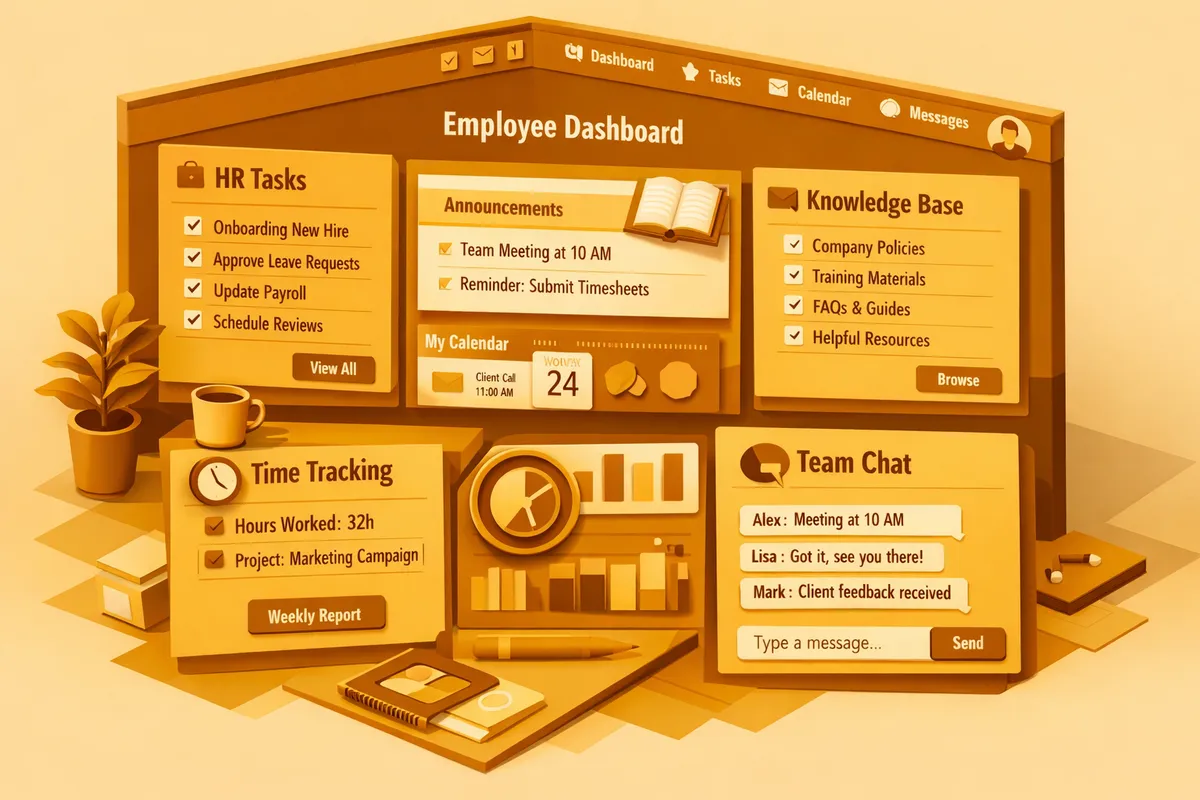
Portal architecture is designed around two sets of users: employees and administrators. The employee experience is built for low-friction self-service: fast access to the information and functions employees actually need without requiring navigation through administrative menus designed for HR managers. For a West Loop restaurant group, that means a mobile-first portal that a kitchen employee can use from their phone to check their schedule, request a shift swap, or access their most recent pay stub without visiting the back office. For a tech company on Halsted Street, it means a portal where new hires can complete their onboarding documentation, access their equipment provisioning checklist, and find their team handbook before their first day.
Administrator experience is equally important. The portal reduces the volume of routine HR requests your team handles manually, but it also needs to give managers and HR staff full visibility into employee data, task completion status, and pending approvals. We build administrator dashboards that reflect the management structure of your specific organization rather than a generic HR software admin panel.
Industries We Serve in the West Loop
Technology companies and startups scaling rapidly near Google Chicago's campus on West Fulton Market use employee portals to systematize onboarding for engineering, product, and go-to-market hires who are joining faster than the existing team can handle manually. A portal that delivers the first week's documentation, equipment checklist, system access instructions, and team introduction schedule before the new hire's first day sets the tone for the employment relationship from the start.
Restaurant groups and hospitality operators managing large hourly workforces across multiple Randolph Street concepts use employee portals to centralize scheduling access, policy acknowledgment, benefits enrollment, and time-off requests in a mobile-friendly interface that works for employees who spend their shifts away from a computer. The reduction in manager time spent on administrative HR tasks is measurable within the first quarter.
Professional services firms on Madison Street with distributed client-facing teams use portals to provide self-service access to project documentation, expense reporting, time entry, and professional development resources. For firms where billable utilization is the primary financial metric, every hour a professional spends on administrative HR tasks is an hour that cannot be billed to a client.
Creative agencies and design firms between Lake Street and Halsted Street use employee portals to manage the contractor and freelance workforce that creative businesses typically blend with their full-time staff. A portal that gives contractors access to project briefs, invoicing workflows, and the same communication tools as full-time employees reduces the friction of working with external talent at scale.
Venture capital and investment firms in the West Loop use portals to provide investors and limited partners with access to fund documents, capital call notices, distribution statements, and portfolio performance reporting in a secure, organized interface rather than a document-sharing folder.
Real estate development and property management companies active across the West Loop and Near West Side use portals to give property managers, contractors, and tenants self-service access to relevant information and workflows. A portal that handles maintenance request submission, lease documentation access, and payment history reduces the administrative load on property management staff at every property.
What to Expect Working With Us
1. HR operations audit and workflow mapping. We spend time with your HR team and a sample of your employees to understand the current onboarding process, the most common employee-facing HR requests, and the manual administrative workflows that consume management time. For a West Loop restaurant group, this often includes time during a shift change to observe how employees actually access information and interact with management about HR matters.
2. Portal design and information architecture. We design the portal interface for both employees and administrators before writing code. Employee-facing interfaces are built mobile-first for organizations with significant hourly or field-based workforces. Administrator interfaces are designed around the specific management structure and reporting requirements of your organization.
3. Build, integration, and data migration. We build the portal, integrate it with your existing HR and payroll systems, and migrate existing employee records. For companies replacing a legacy HR system or migrating from paper-based processes, data migration requires careful planning and validation to ensure accuracy.
4. Rollout and adoption support. A portal that employees do not use delivers no value. We design the rollout plan to maximize adoption: training for managers, communication templates for employees, and a phased activation that introduces the portal during a period when HR activity is manageable rather than during a hiring surge or the Randolph Street summer busy season.