How We Build Custom CRM for the West Loop
The process begins with a relationship mapping session. Before we design a single database schema or user interface, we document how relationships actually work in your business: who are the different types of contacts, what is the lifecycle from first interaction to closed relationship, what data matters at each stage, and what actions need to happen automatically when a relationship moves from one state to another. For a West Loop law firm on Madison Street, that might take two hours. For a multi-concept restaurant group with event sales, wholesale, and media relationships, it takes longer.
Data model design follows. The schema we build reflects your relationship model exactly. If your sales process has eight stages with specific required fields at each stage, those fields and validation rules are built in from the start. If your business tracks relationships at both the company and individual level with different data requirements for each, we model that correctly rather than shoehorning it into a contact/account structure that does not fit.
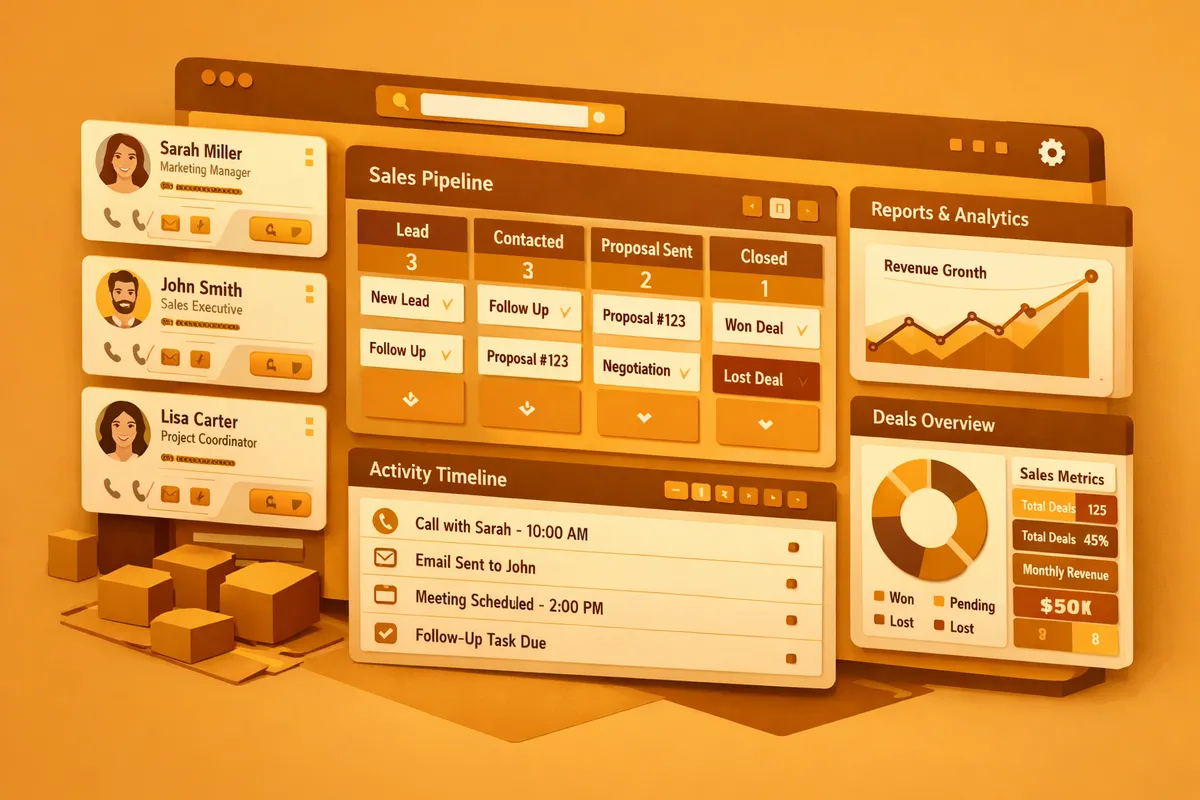
Interface design is built for the people who actually use the CRM. We have seen too many custom systems that reflected the architect's logic rather than the daily workflow of the sales rep or account manager. For West Loop companies, that means interfaces that work on mobile for people walking between meetings in Fulton Market, fast entry forms that do not require ten fields to log a five-minute call, and dashboards that answer the specific questions managers actually ask rather than displaying every field in the database.
Industries We Serve in the West Loop
Enterprise SaaS and technology companies near Google's campus on West Fulton Market use custom CRM to track complex multi-stakeholder sales processes where standard pipeline stages do not capture the actual state of a deal. When a procurement cycle involves a technical evaluation, a legal review, a security questionnaire, and executive sign-off, a custom CRM with purpose-built stages for each gives the sales team a clear picture of where every deal stands and what is blocking it.
Restaurant groups and hospitality businesses on Randolph Street use custom CRM to manage the event sales, corporate dining, and media relationship workflows that generic CRMs handle poorly. A private dining inquiry at a Fulton Market restaurant group involves a specific contact, a specific date, a specific room, a menu discussion, a contract, and a post-event follow-up. A CRM built for that workflow turns the event sales team into a coordinated operation rather than a collection of individuals managing their own spreadsheets.
Legal services firms with offices serving clients along Madison Street use custom CRM to track client relationships, matter status, referral sources, and business development activities in a single system that reflects the structure of legal work. Billable hours, relationship health, practice area expertise, and referral networks are relationship data that standard CRM tools were not built to manage coherently.
Venture capital firms and investment offices based in the West Loop use custom CRM to manage deal flow, portfolio relationships, LP communications, and the ecosystem relationships that generate deal flow. The investment relationship model is fundamentally different from a sales pipeline. A custom CRM built for that model captures the data that matters and ignores the noise.
Creative agencies and professional services firms concentrated between Lake Street and Halsted Street use custom CRM to track client relationships, project pipelines, referral networks, and renewal calendars in a unified system. When a client relationship at an agency involves an account lead, a project team, a finance contact, and a set of ongoing project deliverables, the CRM needs to model all of those dimensions without requiring the agency to pay for enterprise Salesforce seats.
Real estate developers and commercial brokers working across the West Loop and into the Near West Side use custom CRM to manage tenant relationships, broker relationships, investor relationships, and property pipelines in ways that residential or generic commercial CRM platforms do not accommodate. The lifecycle of a commercial real estate relationship from introduction through lease execution through renewal is long and complex. A custom CRM built for that lifecycle retains institutional knowledge even when team members change.
What to Expect Working With Us
1. Relationship model workshop. We run a two to four hour working session with your team to map every relationship type, every lifecycle stage, and every data point that matters to your business. We leave with enough information to design a data model that reflects your actual operations rather than our assumptions about what a CRM should look like.
2. Schema and interface design. We present the proposed data model and user interface wireframes before writing any code. You see exactly what we are building and why before we build it. This is where we catch mismatches between what we heard in the workshop and what the design implies about how the system will actually work.
3. Build, test, and migration. We build the CRM, migrate your existing data from whatever system you are coming from, and run parallel testing to validate that the new system captures everything correctly. For West Loop companies with years of client history in spreadsheets or legacy CRM exports, the migration is often the most complex part of the project.
4. Training and continuous improvement. Launch is not the end of the engagement. We train your team, monitor usage patterns for the first 90 days, and build the additional features and adjustments that only become obvious once real users are working in the system daily. Most clients request two or three significant workflow improvements in the first quarter based on actual use.