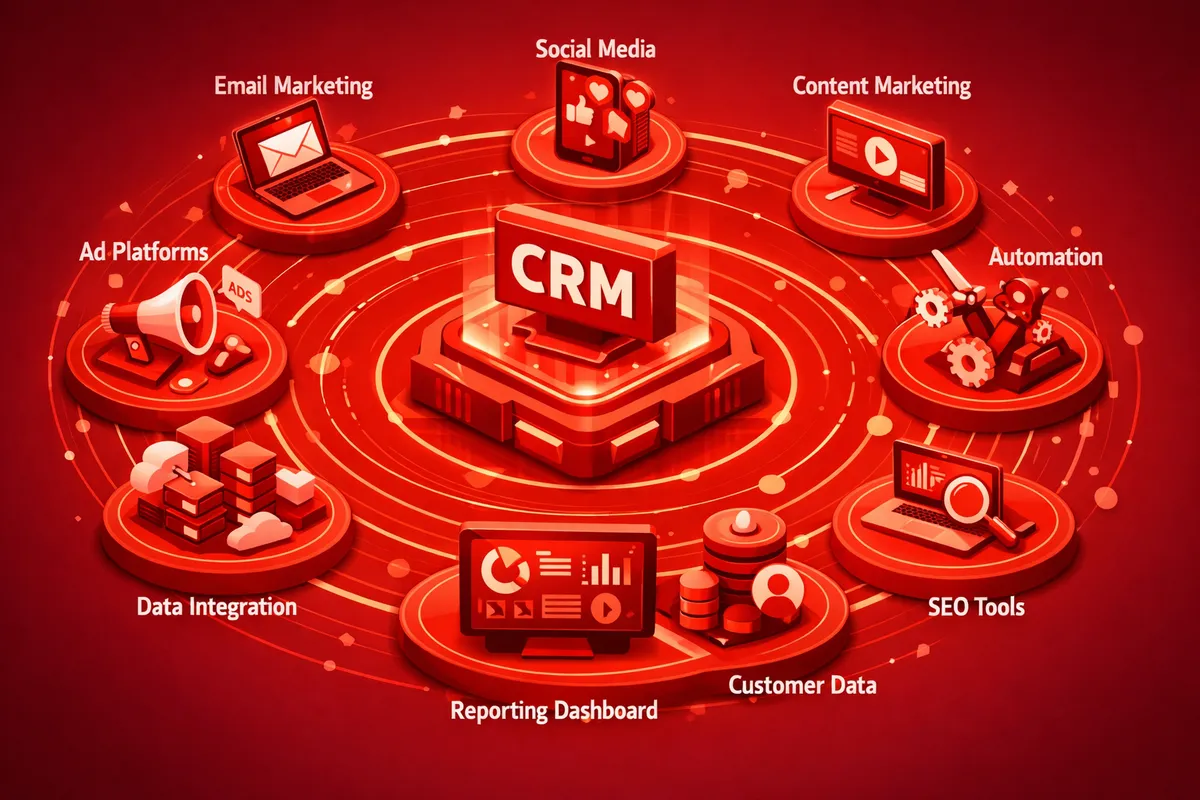
How We Build CRM & Martech Strategy for West Loop
CRM and martech consulting for West Loop businesses starts with customer journey mapping and operational requirements definition. We document how your West Loop business acquires customers, how it manages relationships over time, what data is needed to personalize and improve those relationships, and what marketing activities the technology needs to support. For a Fulton Market restaurant, the customer journey runs from initial discovery through regular guest visits to special occasion bookings and direct marketing outreach. For a West Loop startup, it runs from initial awareness through evaluation, trial, purchase, onboarding, and expansion. The CRM and martech requirements follow from the journey, not from a list of desired features.
From the requirements, we evaluate the technology options that fit your West Loop business's specific situation. Selection criteria include: technical fit with your existing systems and data, operational fit with your team's workflow and technical sophistication, cost fit with your investment capacity and the expected return, and vendor fit with your business's growth trajectory and support requirements. We make recommendations with explicit reasoning about fit rather than recommending based on familiarity with a preferred platform.
Implementation planning ensures that the selected technology is configured to support your actual West Loop business operations from day one. For CRM implementation, this means building the sales process your team actually uses, not a generic sales process. For marketing automation implementation, it means building the customer journeys your business needs to run, not default templates adapted loosely to your use case.
Post-implementation review is part of the engagement. CRM and martech systems that are launched and left without review accumulate data quality problems and configuration gaps that undermine their value over time. We conduct post-implementation reviews at sixty and ninety days to identify and resolve the gaps that emerge when the system encounters real operational use.
Industries We Serve in West Loop
Tech companies and startups on Lake Street and Fulton Market use CRM and martech consulting to select and implement the sales and marketing technology that supports their B2B go-to-market strategy. For West Loop startups at Series A and beyond, the CRM configuration is a sales operations foundation that the growing sales team depends on. Getting it right before the team doubles requires different configuration decisions than configuring it correctly for a team of five.
Restaurant and hospitality groups on Randolph Street and Fulton Market use CRM and martech consulting to build the guest data foundation that supports personalized marketing, private dining relationship management, and the direct communication channels that reduce platform dependence. A restaurant group with a well-configured guest data system operates a marketing program that is unavailable to groups working from reservation platform data alone.
Legal and professional services firms along Madison Street use CRM consulting to implement the client relationship management that supports both client retention and business development. Legal CRM configuration reflects the specific relationship structures of law firm business development: the individual attorney relationships with clients, the referral relationships that drive new business, and the practice area expertise that determines which attorneys are appropriate contacts for which client situations.
Creative and advertising agencies in West Loop use CRM and martech consulting for their own new business development and as a service they deliver to clients. Agencies that have built sophisticated internal martech infrastructure have both a more efficient new business operation and a more credible demonstration of the capability they are selling.
Financial technology companies near Halsted Street use CRM consulting to implement the customer data management that fintech sales and customer success operations require. Fintech CRM configuration has specific requirements around data security, audit trails, and the integration with financial transaction systems that support customer success operations.
Real estate development and commercial leasing in West Loop uses CRM consulting to implement the prospect management and relationship tracking that supports a leasing operation's pipeline management. Commercial real estate CRM needs to track prospects across long evaluation cycles, manage relationships with multiple stakeholders in each tenant organization, and connect to the property management systems where active lease relationships are managed.
What to Expect Working With Us
1. Customer journey mapping and requirements definition. We map the customer journeys your West Loop business needs to support and define the CRM and martech requirements that follow from those journeys. Requirements are the evaluation framework for all technology decisions that follow.
2. Technology selection and evaluation. We evaluate the technology options that fit your requirements and make specific recommendations with explicit reasoning about fit. For West Loop businesses considering multiple systems, we help structure the evaluation process so decisions are made on the factors that matter rather than on the factors the vendor's sales process emphasizes.
3. Implementation planning and execution support. We plan the implementation sequence, develop the configuration specifications, and provide hands-on support during the implementation. For West Loop businesses without in-house technical implementation capacity, we manage the implementation directly. For businesses with technical teams, we provide the strategic direction and configuration standards that the technical team implements.
4. Post-implementation review and optimization. We conduct reviews at sixty and ninety days to identify and resolve the configuration gaps and data quality issues that emerge from real operational use. CRM and martech implementations that are reviewed and optimized after launch produce significantly better long-term outcomes than those that are launched and left without review.