How We Build Computer Vision for West Loop
Computer vision development starts with use case specification for your West Loop business. We define precisely what the system needs to see, what it needs to identify or measure, and what action or data output it needs to produce. Use case specificity is the foundation of a system that works reliably in your West Loop operational environment rather than one that performs well in demos but fails in the real conditions of a Randolph Street restaurant or a Fulton Market construction site.
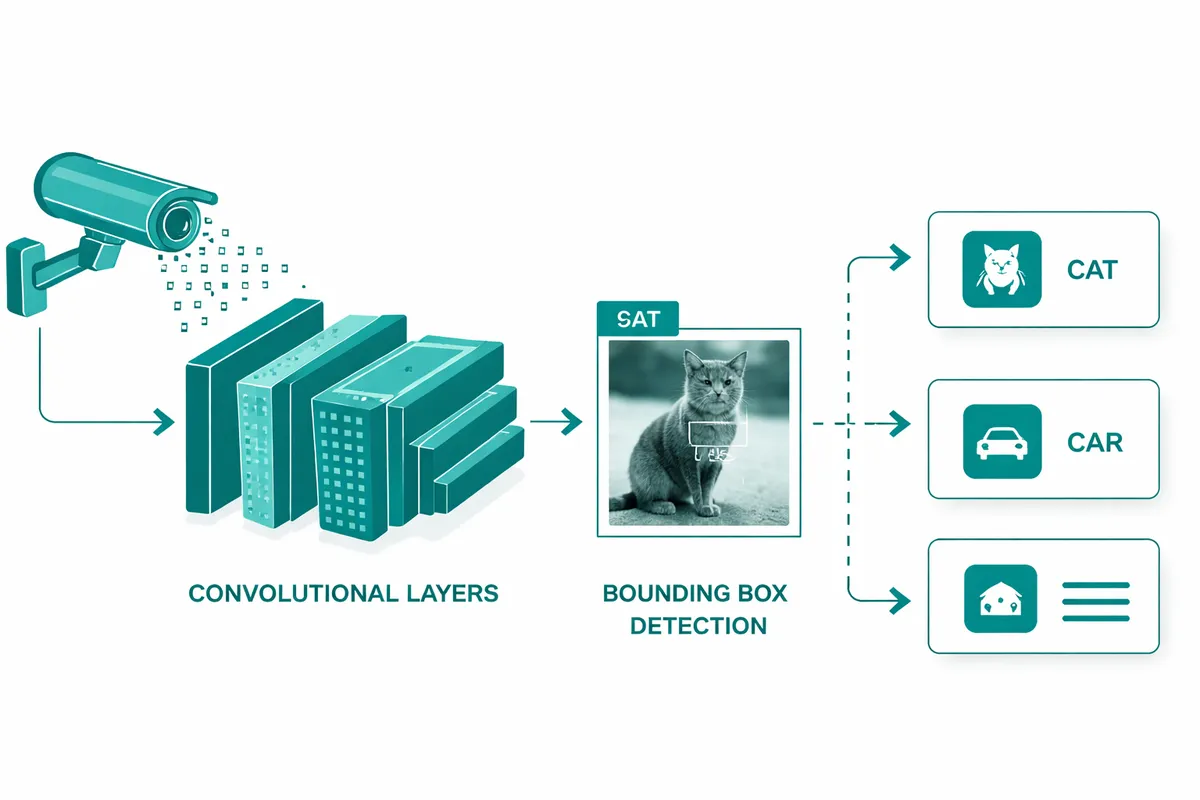
From the use case specification, we design the computer vision architecture: the camera or imaging infrastructure required to capture the visual data the system needs, the AI model architecture appropriate for the detection or classification task, the inference infrastructure that processes visual data at the speed the application requires, and the output integration that delivers results to the systems or people who act on them.
Model development and training uses data from your West Loop operational environment whenever possible. A computer vision model trained on images from your specific restaurant, your specific construction site, or your specific retail environment will outperform a generic model applied to those contexts because it has learned the visual characteristics of your specific setting rather than a generic version of that setting type.
Testing in production conditions before full deployment is a standard part of our computer vision development process. A system that performs well on test images and fails on real operational footage because of lighting conditions, camera angle, or the visual complexity of a real environment is not ready for production deployment. We test against real operational conditions and iterate until performance meets the requirements.
Industries We Serve in West Loop
Tech companies and startups on Lake Street and Fulton Market building AI products use computer vision development services for the visual intelligence components of their products: image classification, object detection, video analysis, and the specialized visual tasks that their specific product applications require. For West Loop product companies, computer vision development that produces production-grade, reliable models is what makes the product competitive rather than experimental.
High-end restaurants and restaurant groups on Randolph Street and Fulton Market use computer vision for dining room occupancy monitoring, service quality observation, and the kitchen operations monitoring that helps managers maintain the standards that destination dining requires. Computer vision that provides continuous operational intelligence without requiring continuous manager attention on the floor changes the management model for a busy service.
Real estate development and commercial leasing operations in West Loop use computer vision for construction progress monitoring, safety compliance verification, property condition assessment, and the occupancy analytics that help property managers understand how their spaces are used. For West Loop's active development corridor, construction site computer vision provides the continuous monitoring that periodic inspections cannot.
Boutique hotels and hospitality properties near Morgan Street use computer vision for lobby occupancy monitoring, public space condition assessment, and the property security applications that visual intelligence supports. For hospitality properties, operational visibility that does not require staff observation time is both more comprehensive and more efficient than manual monitoring.
Creative and advertising agencies in West Loop that develop marketing technology products for clients use computer vision for audience measurement in physical spaces, advertising effectiveness measurement through visual attention tracking, and the product demonstration applications where visual AI is central to the client's technology narrative.
Retail and commercial properties along Halsted Street and Lake Street use computer vision for customer traffic analysis, conversion rate measurement in physical retail environments, and the occupancy intelligence that building managers use for operational optimization. Physical retail that uses computer vision to understand how customers move through the space and where engagement happens is making data-informed display and layout decisions rather than intuition-based ones.
What to Expect Working With Us
1. Use case specification and feasibility assessment. We define the computer vision task with the precision that makes development feasible and evaluate whether the visual conditions of your West Loop operational environment support reliable computer vision performance. Not every visual intelligence use case is feasible under real operational conditions, and honesty about this prevents investment in systems that cannot achieve reliable performance.
2. Infrastructure and model architecture design. We design the camera and imaging infrastructure required to capture usable visual data and the AI model architecture appropriate for your specific detection or classification task. Infrastructure design is as important as model design because the quality of the input image determines the ceiling on model performance.
3. Model development, training, and production testing. We develop and train the computer vision model using data from your West Loop operational environment, evaluate performance under real operational conditions, and iterate until the system meets the performance requirements specified in the use case definition. Production testing is not optional for systems that need to be reliable in live West Loop operations.
4. Deployment, integration, and ongoing monitoring. We deploy the computer vision system, integrate its outputs with the systems and workflows that use the information it produces, and establish monitoring that tracks performance over time. Computer vision systems deployed in real environments require ongoing monitoring because visual conditions change, and model performance should be tracked rather than assumed to be stable.