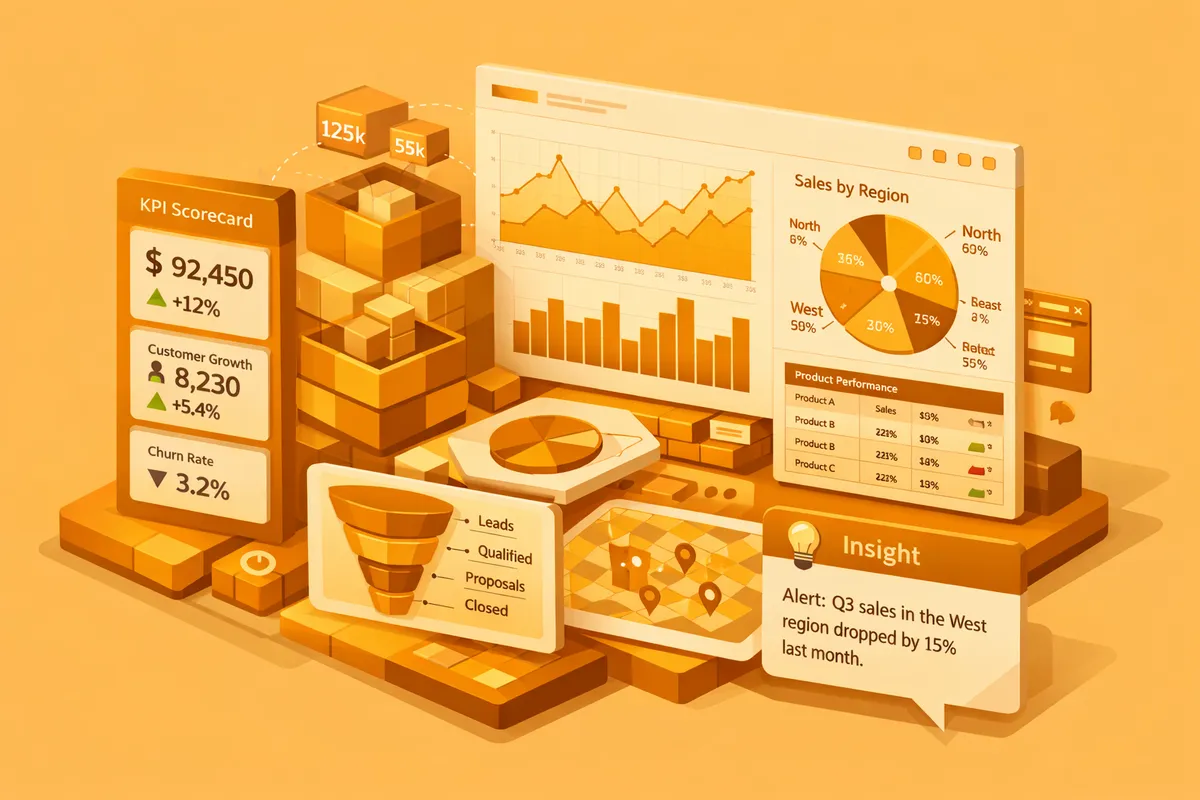
How We Build Business Intelligence for West Loop
West Loop BI engagements begin with a clear separation of problem types. Technology company analytics and restaurant group analytics require different architectures, different data sources, and different dashboard philosophies, even when both operate in the same neighborhood.
For technology companies, we start by mapping the customer journey from acquisition through expansion and churn. Which marketing channels produce customers with the highest lifetime value? Which product events predict 90-day retention? Where does the pipeline thin between qualified lead and closed deal? We connect the data systems that hold answers to these questions, build the transformation layer that creates consistent definitions across systems, and surface the consolidated metrics in dashboards that product, sales, and finance teams actually use.
For restaurant groups, we build around location-level contribution margin as the organizing metric. Every other operational metric, from labor cost percentage on Randolph Street to food cost ratio on Fulton Market, connects back to its impact on margin per location. We pull POS data, reservation system data, and labor scheduling data into a unified view that general managers and ownership groups review daily rather than weekly.
Dashboard governance matters in West Loop more than in most Chicago neighborhoods because the teams using these tools are analytically sophisticated and will break a poorly designed dashboard within a week. We build with clear metric definitions documented in the BI layer, role-based access controls that limit data exposure by function, and change management processes so the dashboard represents one version of truth rather than competing interpretations.
Industries We Serve in West Loop
Technology companies and startups near Morgan Street and Fulton Market use BI to track product-qualified leads, feature adoption cohorts, churn prediction signals, and go-to-market funnel health. When a growth team at a West Loop SaaS company can see in real time that a specific acquisition channel is producing customers with 40 percent higher lifetime value than the channel receiving the largest marketing budget, budget decisions change quickly.
Restaurant groups operating on Randolph Street and Lake Street deploy BI to monitor covers per server, average check by daypart, food cost percentage by menu category, and location-level contribution margin. The Fulton Market corridor's concentration of high-volume restaurants means that even a one-point improvement in food cost ratio across multiple locations represents meaningful annual profit.
Venture capital and private equity firms in West Loop's office towers build BI around portfolio company performance tracking, fund deployment metrics, and deal pipeline velocity. When a managing director can review a single dashboard showing portfolio company KPIs rather than compiling data from individual quarterly reports, the quality of portfolio monitoring conversations improves.
Creative agencies and marketing firms in West Loop use BI to track client campaign performance, billable utilization by team, and project margin by account. For a creative agency where utilization directly drives revenue and margin, real-time visibility into how hours are being spent across active engagements is the difference between proactive staffing decisions and reactive firefighting.
Real estate development and property management firms active in West Loop's ongoing transformation from warehouse district to mixed-use commercial neighborhood use BI to track occupancy, lease velocity, rent roll performance, and construction cost variance across their development pipeline.
Legal services firms serving West Loop's technology and restaurant industry clients build BI around matter profitability, associate utilization, billing realization, and client concentration. A boutique firm serving technology clients near Bartelme Park that can identify which client relationships are profitable and which are not makes very different business development investments.
What to Expect Working With Us
1. Industry-specific scoping call. Technology company BI and restaurant group BI are different enough that we scope them separately. We begin by understanding which category your operations fall into, then map the specific decisions your leadership makes regularly and which data sources currently hold the relevant information. For a West Loop tech company, this means mapping product, CRM, and financial systems. For a restaurant group on Fulton Market, it means mapping POS, reservation, and labor platforms.
2. Data pipeline architecture and quality review. We inventory every source system, assess data quality, and design the extraction and transformation logic before any dashboard work begins. West Loop technology companies frequently have cleaner API-accessible data than restaurant groups operating legacy POS systems; we adjust pipeline design to match what your systems actually produce.
3. Staged dashboard delivery with team review. We build in two-week sprints and review working dashboards with the intended users at the end of each cycle. For a Randolph Street restaurant group, that means general managers reviewing daily operational dashboards before we build out executive reporting. We catch usability problems early rather than delivering a system nobody wants to open.
4. Self-service training and documentation. Your team should be able to add new metrics, adjust date ranges, and build their own views without waiting for us. We train the people who will use the dashboards most frequently and document metric definitions in the BI layer so there is no ambiguity about what any number means.