Your Cart (0)

Your cart is empty

West Loop, Chicago

Booking Scheduling in West Loop

Booking Scheduling for businesses in West Loop, Chicago. We know the neighborhood, the customers, and what it takes to compete locally.

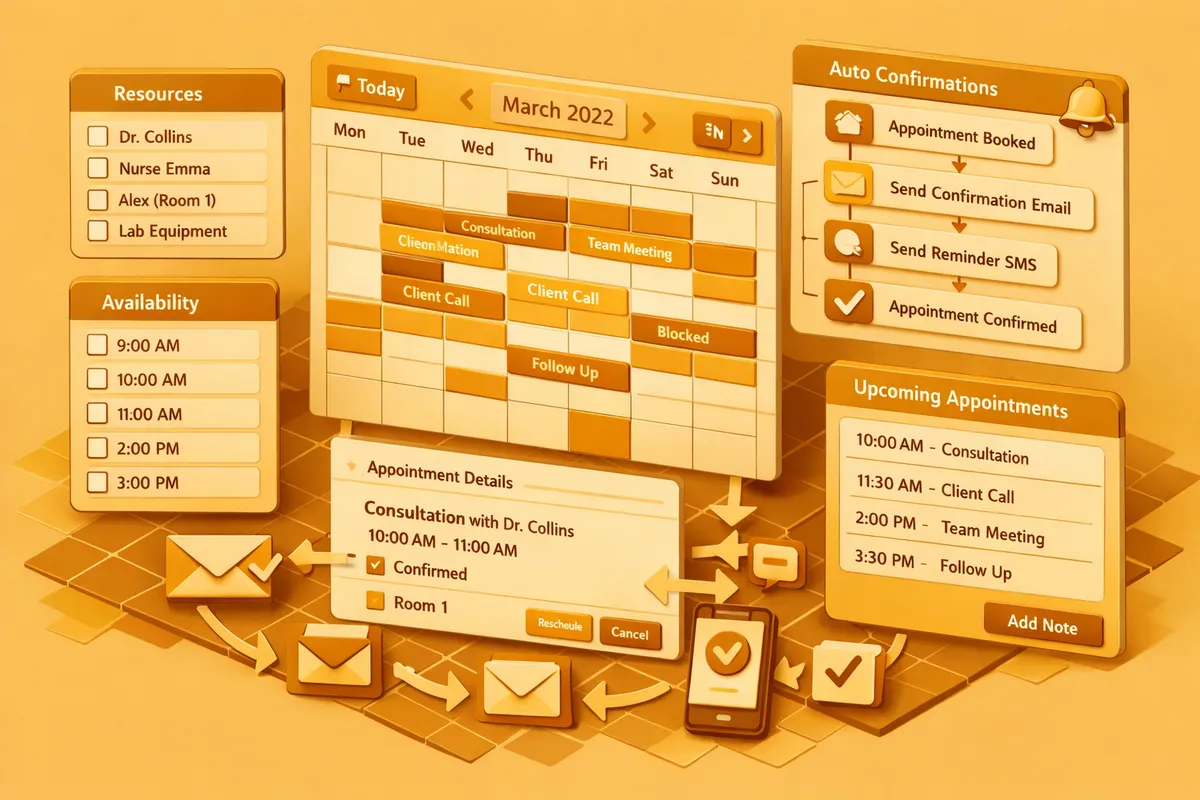
Booking Scheduling in West Loop service illustration

How We Build Booking Systems for West Loop Businesses

Discovery and Channel Mapping

We start by mapping every way customers currently book with your business. For a Randolph Street restaurant, this typically includes the reservation platform, phone calls, private event inquiries, large party requests, and walk-ins. For a Fulton Market wellness studio, we document the booking app, social media DMs, phone reservations, class pack purchases, and drop-in walk-ups. For a Lake Street professional services firm, we inventory the scheduling tool, phone calls, email appointment requests, referral introductions, and in-person follow-up bookings.

We measure the volume through each channel, the staff time spent managing each one, the error rate (double bookings, missed appointments, scheduling conflicts), and the revenue lost to no-shows and unfilled capacity. This data establishes the baseline that we measure improvement against.

Platform Selection and Configuration

We select or configure booking software based on your specific business model. Restaurant reservation management has different requirements than a wellness studio class schedule, which differs from a professional services consultation calendar. We work with platforms including Acuity, Square Appointments, Mindbody, Jane App, Calendly, and custom-built solutions depending on the complexity of your scheduling needs.

Configuration goes beyond basic setup. We build your service menu with accurate durations, buffer times between appointments, staff assignments, room or equipment allocations, and pricing tiers. For a Fulton Market yoga studio, this means configuring class types with capacity limits, instructor certifications matched to class requirements, room assignments based on class format, and waitlist rules that automatically promote members when spots open. For a Lake Street law firm, this means configuring consultation types with appropriate durations, attorney availability rules, conflict-of-interest screening prompts, and intake form requirements that vary by practice area.

Integration With Existing Systems

The booking system connects to everything it needs to share data with. For restaurants, that means POS integration so the reservation count informs prep volume, CRM integration so returning guests get recognized, and email or SMS integration for confirmations and reminders. For wellness studios, the booking system connects to the membership management platform, payment processing, and marketing automation so class bookings trigger the right follow-up sequences. For professional services firms, the calendar syncs with the CRM, billing system, and internal project management tools.

These integrations eliminate the manual data transfer that consumes staff hours. When a booking happens, every downstream system updates automatically. No one copies reservation counts into a spreadsheet. No one manually enters new client information into the CRM. No one reconciles the booking calendar with the billing system at the end of the month.

Automated Communications

Every booking triggers a communication sequence tailored to your business. Confirmation messages go out immediately with relevant details: parking instructions for a Randolph Street restaurant, what to wear for a Fulton Market fitness class, documents to bring for a Lake Street consultation. Reminder messages send at intervals you define, typically 24 hours and one hour before the appointment. Post-visit follow-ups request reviews, offer rebooking incentives, or deliver relevant content based on the service the customer received.

For businesses with high no-show rates, we implement deposit requirements, cancellation policies enforced through the booking system, and waitlist management that automatically fills cancelled slots. A West Loop restaurant that implemented automated confirmations with a 15-minute hold policy reduced no-shows from 18 percent to 4 percent within six weeks.

Industry Applications Across West Loop

Restaurants and Hospitality on Randolph Street

Restaurant Row's reservation management challenges go beyond basic table booking. Private dining coordination, large party requests, special event bookings, bar seating versus dining room preferences, seasonal patio management, and chef's table experiences all require different booking workflows. We build reservation systems that handle this complexity while presenting a simple booking experience to the guest.

The system manages floor plans dynamically. When a six-top cancels at 7 p.m. on a Friday, the system can either open the table for a new six-top reservation or split it into a two-top and four-top based on the waitlist demand and the restaurant's preference for that service. Turn times adjust based on party size and day of week. The host knows exactly what is coming, when tables will turn, and where to seat each party without consulting three different systems.

Private event bookings flow through a dedicated workflow: inquiry form captures the details, automatic response sends the events package with availability and pricing, follow-up sequences nurture the inquiry, contract generation and e-signature happen within the system, and deposit processing confirms the booking. The events coordinator manages the pipeline in one dashboard instead of hunting through email threads.

Wellness and Fitness Studios in Fulton Market

Fulton Market's concentration of yoga studios, Pilates reformer shops, personal training facilities, meditation centers, and hybrid wellness spaces creates intense competition for member bookings. The studios that make booking effortless capture more of the available demand. The ones that rely on DMs, phone calls, and clunky third-party apps lose members to competitors with smoother booking experiences.

We build class scheduling systems that handle recurring schedules, substitute instructors, capacity management, waitlists, late cancellation policies, and dynamic pricing for peak versus off-peak classes. Members see real-time availability across all class types and locations. They book, cancel, and manage their schedule from their phone without calling or messaging the studio. The front desk focuses on the in-studio experience instead of managing a chaotic booking queue.

Membership integration ensures that class bookings respect the member's package. An unlimited member books freely. A 10-class pack member sees their remaining credits. A drop-in visitor pays at the time of booking. The system enforces these rules automatically, eliminating the front-desk confusion of checking what each person is entitled to.

Professional Services on Lake Street

Therapists, financial advisors, attorneys, CPAs, and consultants along the Lake Street corridor all depend on efficient scheduling to maximize billable hours. Every unfilled appointment slot is lost revenue that cannot be recovered. Every scheduling conflict erodes client trust. Every manual booking process adds overhead that reduces the effective hourly rate.

We implement scheduling systems for professional services that manage availability rules (some advisors block Mondays for internal work, some therapists reserve Friday afternoons for supervision), appointment type configurations (initial consultations differ from follow-up sessions), intake requirements (forms that must be completed before the appointment), and automated reminders that reduce no-shows.

For multi-practitioner firms, the system manages shared resources like conference rooms, shared support staff, and specialized equipment. When an attorney books a client meeting, the system reserves the conference room, notifies the paralegal, and blocks the attorney's calendar for preparation time before the meeting.

Creative Agencies and Co-Working Spaces

Fulton Market's creative agencies book client meetings, internal reviews, and production sessions. Co-working spaces manage meeting room reservations, hot desk bookings, and event space scheduling. We build booking systems that handle resource allocation, ensuring that a meeting room is not double-booked, a production studio has the right equipment staged, and shared spaces accommodate the needs of multiple tenants without conflicts.

Reducing No-Shows and Maximizing Utilization

No-shows cost West Loop businesses thousands of dollars monthly. A restaurant losing two tables per night to no-shows at an average ticket of $85 per person loses over $10,000 per month. A wellness studio with a 15 percent no-show rate across 28 weekly classes with 18 spots each loses roughly 75 member visits per week that could have been filled from the waitlist. A professional services firm with three no-shows per week at $200 per session loses $2,400 monthly.

Our booking systems attack no-shows from multiple angles. Automated confirmation requests sent 24 hours in advance give customers an easy way to confirm or cancel, opening the slot for someone else. Reminder messages one hour before the appointment reduce forgetfulness. Cancellation policies enforced through the system, requiring cancellation 24 hours in advance or forfeiting a deposit, change customer behavior over time. Waitlist automation fills cancelled slots instantly, often recovering revenue that would have been lost entirely.

Utilization reporting shows exactly where your schedule has gaps. If Tuesday mornings consistently run at 40 percent capacity, the system can trigger targeted promotions for those time slots. If Friday afternoons are overbooked while Thursday afternoons sit empty, pricing incentives or availability adjustments can rebalance demand. The data removes the guesswork from capacity management.

What to Expect Working With Us

1. Booking channel audit. We document every way customers currently schedule with your business, measure volume through each channel, and identify the friction points, lost bookings, and operational costs of your current process.

2. System design and platform selection. We recommend a booking platform based on your business model, integration requirements, and growth trajectory. Configuration accounts for your specific service types, capacity constraints, staffing model, and communication preferences.

3. Integration and migration. We connect the booking system to your existing tools, migrate historical customer data, and set up the automated communication sequences. Existing bookings transfer cleanly so there is no disruption during the transition.

4. Staff training and launch. Your team learns the system through hands-on training with their actual workflows. We launch in a controlled rollout, typically starting with online bookings while keeping phone and walk-in processes running in parallel until the team is confident.

5. Optimization and reporting. After launch, we monitor booking patterns, no-show rates, utilization, and revenue impact. Monthly reports show exactly how the system is performing, and we make ongoing adjustments to improve results.

Frequently Asked Questions

Yes. We configure separate booking workflows within the same system. Guest reservations flow through the standard availability calendar with table management and turn time logic. Private event inquiries enter a dedicated pipeline with proposal generation, contract management, and deposit processing. Both workflows share the same calendar, so a private dining buyout automatically blocks those tables from the reservation system. The host and events team both see accurate, real-time availability.

When a member cancels a class booking, the system immediately checks the waitlist and promotes the next person in line. The promoted member receives an instant notification confirming their spot. If the promoted member does not confirm within a timeframe you set, the system moves to the next person on the list. Late cancellation policies apply automatically based on rules you define, whether that is forfeiting a class credit, charging a fee, or restricting future booking privileges for repeat offenders.

We migrate all relevant historical data: customer contact information, booking history, membership status, payment records, and communication preferences. The migration is verified before launch so your team sees complete customer profiles from day one. Returning customers experience a seamless transition because their history and preferences carry over to the new system.

Yes. We configure client-facing booking pages with available appointment types, intake forms, and self-scheduling options. Internal scheduling handles staff meetings, resource allocation, and administrative time blocks separately. Both systems share one calendar, so client appointments and internal commitments never conflict. Attorneys, advisors, and therapists see their complete schedule in one view.

Most businesses see measurable improvement within the first month. No-show rates typically drop 40 to 60 percent once automated confirmations and reminders are active. Staff time spent on scheduling and manual coordination decreases immediately. Revenue impact from better utilization and reduced no-shows compounds over the first 90 days as the system captures data and we optimize based on actual booking patterns.

Yes. We embed the booking widget on your website and configure the "Book Now" button on your Google Business profile so customers can schedule directly from search results. The booking experience matches your brand visually and works seamlessly on mobile devices. Bookings from Google, your website, social media, and any other channel all flow into the same calendar with real-time availability updates.

Ready to get started in West Loop?

Let's talk about booking scheduling for your West Loop business.