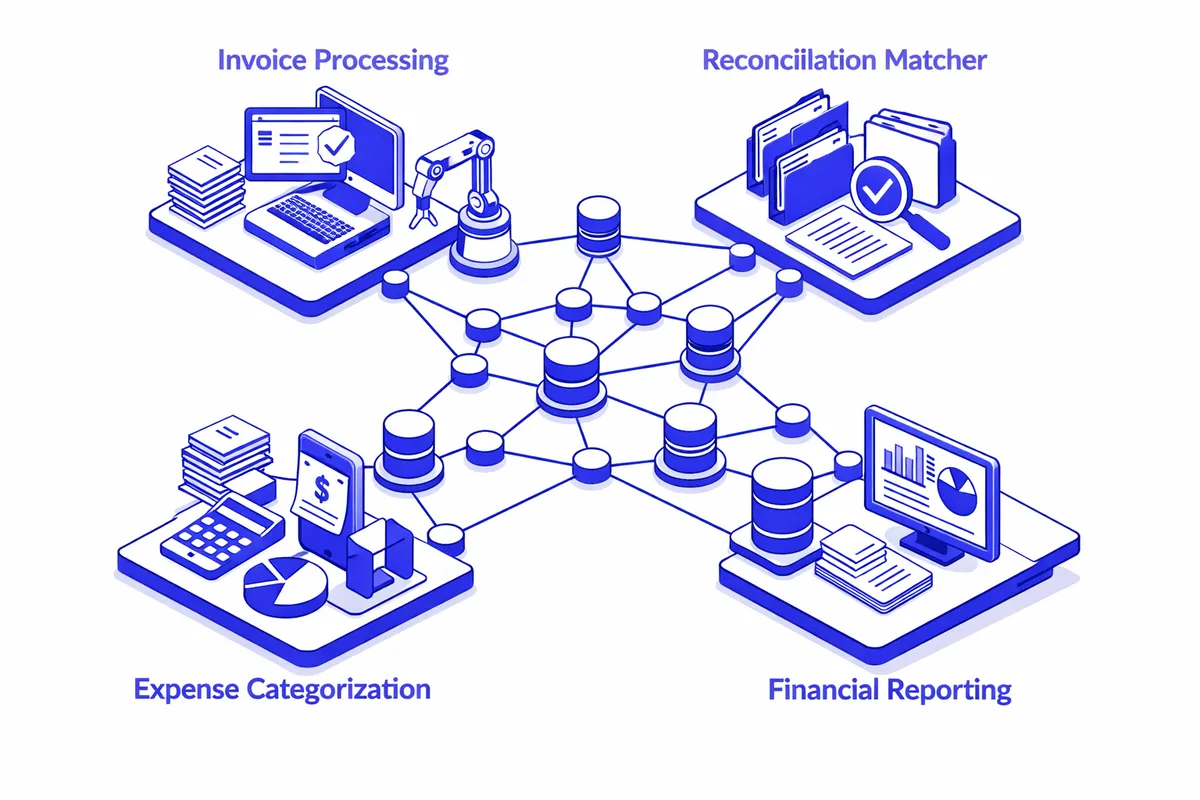
How We Build Accounting Automation for West Loop
Every engagement starts with a process map specific to your business model, not a generic accounting review. For a Fulton Market restaurant group, that means tracing the nightly reconciliation from POS close-out through payment processor settlement through general ledger posting, identifying exactly where human hours go. For a West Loop tech company, it means documenting the revenue recognition schedule update process, the billing cycle, and how sales data enters the financial system. For a creative agency near Bartelme Park, it means following a client engagement from signed proposal through final invoice.
From the process map, we identify which steps follow a deterministic rule. If a step produces the same output every time given the same input, it is an automation candidate. Most West Loop businesses find that 60 to 75 percent of their manual close work falls into this category once they see it mapped.
We build the automation layer on top of your existing accounting software. For restaurant groups, that typically means connecting your POS system, payment processor, and QuickBooks or Restaurant365 through automated workflows that run nightly. For tech companies, it means building revenue recognition schedules that update automatically when a deal closes in Salesforce or HubSpot. For agencies, it means integrating project management tools with billing platforms and financial systems so project hours flow into invoices without manual re-entry.
Testing happens against real historical data before any automation touches live transactions. For a Randolph Street restaurant group, we run three months of historical nightly reconciliations through the automated process and compare outputs against your actual records. Only after the automated process matches your actuals across that sample do we move to live operation.
Industries We Serve in West Loop
Technology companies and startups near Google's campus at 1000 West Fulton Market use accounting automation for subscription revenue recognition, sales commission calculations, and monthly SaaS metric reporting. Deferred revenue schedules that previously required a day of spreadsheet work each month run automatically when deal data is updated in your CRM, and commission calculations trigger the moment a deal is marked closed-won.
West Loop's restaurant and hospitality operators along Randolph Street and Fulton Market deploy automation to handle nightly POS reconciliation, tip allocation journal entries, and food and beverage cost variance reporting. A multi-location restaurant group using automation for nightly close reduces reconciliation time per location from over an hour to under ten minutes, with exceptions flagged automatically for manager review.
Creative and advertising agencies converting warehouse space near Union Park automate their project accounting: timesheet data flows automatically from project management tools into billing, retainer drawdowns post without manual entry, and monthly client profitability reports generate on schedule rather than requiring an analyst to assemble them.
Legal services firms that have relocated to West Loop from the Loop corridor use automation for trust accounting reconciliation, matter billing cycle generation, and partner compensation distribution. The three-way trust account reconciliation that compliance requires runs on schedule without a paralegal manually pulling and cross-referencing records.
Real estate development and investment firms operating near Halsted Street use accounting automation to manage entity-level financials across development projects at different stages. Draw request calculations, investor reporting packages, and intercompany loan tracking all lend themselves to systematic automation that reduces month-end close time and improves accuracy across the portfolio.
Venture capital and private equity offices that have established West Loop presences use automation for fund accounting: capital call and distribution calculations, LP reporting packages, and management fee billing. These high-value, low-frequency processes are exactly the type that automation handles reliably.
What to Expect Working With Us
1. Process mapping before any builds. The first week is documentation. We trace your current close cycle from first data pull to final report, mapping every manual step and every system handoff. Most West Loop clients discover the process takes significantly longer than estimated and involves more judgment-free steps than anyone realized.
2. Business model-specific sequencing. A restaurant group's most painful automation is different from a SaaS company's. We build in the order that delivers the most time savings relative to build cost for your specific model, starting with the process that consumes the most staff hours.
3. Historical data testing before live operation. Every automation runs against three months of real historical transactions and produces outputs we compare against your actual records. You do not approve go-live until the automated outputs match your actuals consistently.
4. Team handoff with full documentation. We document every automation at the workflow level so your controller or operations team can maintain, modify, and extend the system. We train your team on monitoring exception reports and adjusting automation rules as your business changes.