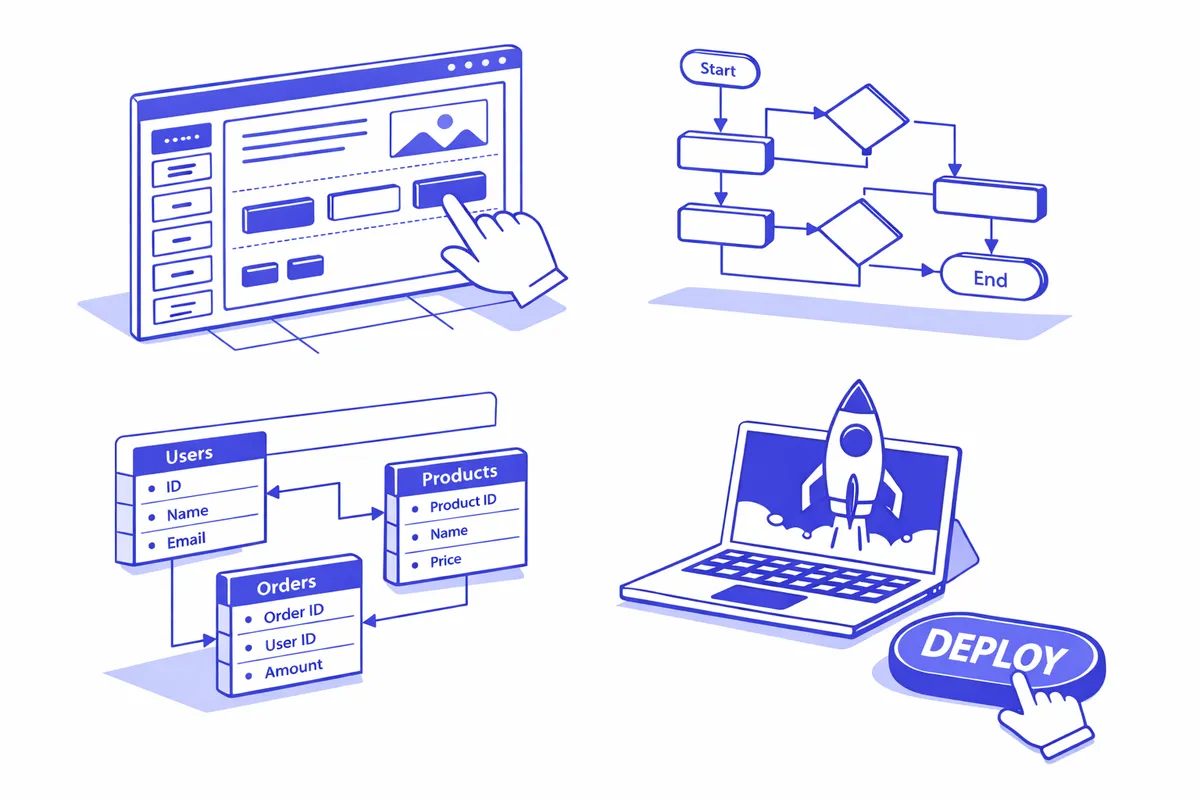
How We Build No-Code Solutions for Ukrainian Village
Every no-code engagement starts with a problem statement, not a platform choice. The most common mistake in no-code implementation is starting with the tool and forcing the problem to fit it, rather than starting with the problem and selecting the tool that solves it most cleanly. A Ukrainian Village business owner who has heard that Airtable is powerful and decides to put everything in Airtable ends up with a database that does half of what they need and creates new friction where there was none before.
We start by mapping the specific workflow that is causing pain. A yoga studio near Eckhart Park that is managing teacher training applications through email has a specific problem: intake, tracking, communication, and scheduling are all happening in separate places. The solution might be an Airtable base with form submissions, automated status emails via Zapier, and a Notion-based calendar for the training schedule. Or it might be a Webflow site with a custom application flow. The answer depends on the studio's specific workflow, not our preference for a particular platform.
Configuration quality is the differentiator in no-code work. Most small business owners who attempt no-code implementations in tools like Airtable end up with flat databases rather than relational ones, which limits what the tool can actually do. We configure relational data models from the start so your Airtable base can answer questions like "which instructor taught the most classes in March" rather than just "how many classes were there in March."
We document every system we build in plain language. If you or your staff can understand the documentation and make minor changes without calling us, we have done our job.
Industries We Serve in Ukrainian Village
Independent coffee shops and roasters along Chicago Avenue frequently need no-code solutions for wholesale account management. A roaster supplying twelve local cafes manages order intake, invoicing, delivery scheduling, and account notes for twelve separate relationships. An Airtable-based wholesale CRM with a form-to-record workflow, automated invoice generation, and a delivery calendar eliminates the email chaos that typically manages this at the cost of missing orders and frustrated accounts.
Restaurants and hospitality businesses on Division Street use no-code platforms to manage private event inquiries, build catering request pipelines, and create internal operations documentation in Notion. A private dining coordinator managing twelve concurrent event inquiries in Gmail is losing information that a properly configured Airtable CRM would capture and track automatically.
Yoga and fitness studios near Smith Park build Webflow landing pages for new class offerings and workshops, Airtable databases for tracking student progress and certification records, and Notion-based instructor handbooks that keep training documentation current without a full content management system. These tools are maintainable by the studio owner without ongoing developer involvement.
Boutique retailers on Hoyne Avenue and throughout the neighborhood use no-code platforms for wholesale buyer portals, where accounts log in to see current inventory, place orders, and access their invoice history without the shop's retail staff being the bottleneck. Webflow's membership functionality makes this possible at a fraction of the cost of custom portal development.
Design and creative studios throughout Ukrainian Village manage client projects in Notion-based project management systems, build intake forms in Webflow that feed directly to Airtable project trackers, and automate client onboarding email sequences through Zapier. The creative process stays in the studio. The administrative infrastructure runs itself.
Salons and personal care businesses across the neighborhood benefit from no-code tools for team scheduling management, service menu maintenance on Webflow sites, and retail product inventory tracking in Airtable. A salon owner who can update her own service menu without waiting for a developer has operational independence that pays for the setup cost many times over.
What to Expect Working With Us
1. Problem mapping and platform selection. The first session is purely about your workflow problem: what you are trying to accomplish, what is currently failing, and what constraints matter to you (cost, technical complexity, maintenance burden). We recommend a platform combination from that session, with a clear explanation of why each tool is the right fit for each part of the problem. We do not recommend Webflow for a problem that Airtable solves better.
2. Build and configuration. We build your no-code solution to a production-ready standard, which means relational data models rather than flat tables, permission configurations that prevent staff from accidentally breaking things, and user interfaces that a non-technical team member can navigate without a tutorial. For Ukrainian Village businesses with seasonal staff turnover, this standard matters.
3. Training session and documentation. We train your team in a live session, walk through the system from a user perspective, and record the session for onboarding future staff. The written documentation we produce covers every workflow the system supports and what to do when something does not behave as expected.
4. Ongoing support and expansion. No-code systems need to evolve as businesses grow. We offer quarterly check-ins for Ukrainian Village clients to review what is working, what is hitting the limits of the platform, and whether any new workflows would benefit from tooling. The goal is that you are never managing operational friction that a two-hour build session would eliminate.