How We Build Document Management for Ukrainian Village
We begin where the paper lives. For a Ukrainian Village business that usually means a walk-through of the actual back room: the cabinets behind the counter on Chicago Avenue, the box under the desk, the binder by the register. We need to see the volume and the categories before we design anything, because a yoga studio near Eckhart Park has a different document mix than a contractor working out of a space off Western Avenue.
Then we sort and digitize. We scan the backlog, and the AI layer does the heavy lifting: it reads each document, classifies it as a contract, an invoice, a permit, an intake form, or a tax record, pulls the key fields, and files it where it belongs. A vendor agreement near Damen Avenue lands in the contracts library tagged with the counterparty and the renewal date. Nobody on your team types that in by hand.
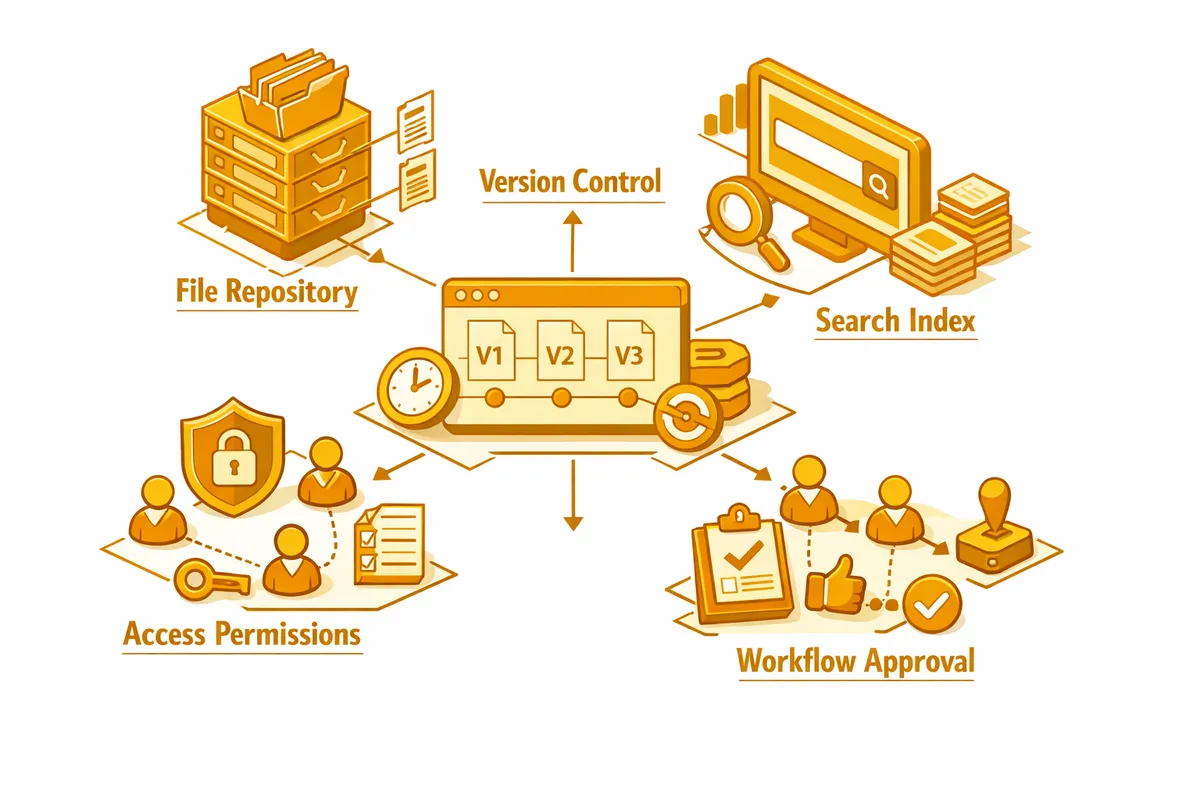
We design the structure around how you actually retrieve things. The question is never "where did we file this," it is "show me everything tied to this client" or "find the lease for this address." We build the categories, the tags, and the search to answer the questions a Division Street owner actually asks, then connect the system so new documents flow in automatically: email attachments, scanned mail, signed forms. Finally we train your staff in the space they work, and we set retention rules so the archive stays clean instead of becoming a digital version of the cabinet it replaced.
Industries We Serve in Ukrainian Village
Independent coffee shops and cafes along Chicago Avenue and Division Street accumulate vendor contracts, equipment warranties, health permits, and lease paperwork that all live in different places. A document management system pulls them into one searchable library, so when a cafe near Hoyne Avenue needs its espresso machine warranty or its current health inspection record, it is a search and not a cabinet dig.
Restaurants and bars near Eckhart Park and Smith Park carry a heavy compliance load: liquor licenses, food-handler certifications, supplier agreements, and inspection histories. With document management, a restaurant on Division Street keeps every required record current and tagged by expiration date, so renewals never sneak up and an inspector's request is answered in seconds.
Boutique retail shops around Damen Avenue and Western Avenue manage consignment agreements, supplier terms, and a steady flow of receipts and purchase orders. A document management system gives a shop near the Ukrainian National Museum a clean record of what was bought, from whom, and under what terms, which matters when a vendor relationship or a return is in question.
Design studios and creative agencies off Chicago Avenue and Hoyne Avenue live on client contracts, statements of work, licensing paperwork, and project files. Document management lets a studio near the Flat Iron arts corridor in nearby Wicker Park find any client's full paper trail instantly, and keeps signed agreements separated from drafts so the binding version is never in doubt.
Yoga studios and fitness businesses near Eckhart Park handle waivers, membership agreements, instructor certifications, and insurance documents for every person who walks in. A document management system stores each signed waiver tied to the member, so a studio off Western Avenue can confirm coverage on a specific client without paging through a folder.
Salons and personal-care businesses along Chicago Avenue and Division Street keep client intake forms, service records, product supplier agreements, and stylist licensing on file. Document management gives a salon near St. Nicholas Cathedral a searchable client history and a current record of every stylist's credentials, replacing the intake binder that lived at the front desk.
What to Expect Working With Us
1. Back-room walk-through. We visit your business and look at where documents actually accumulate, from the cabinet behind your Chicago Avenue counter to the boxes a previous tenant left behind. Seeing the real volume and categories tells us how to structure the system before we scan a single page.
2. Backlog digitization. We scan and process your existing paper, and the AI layer classifies and tags each document automatically. You watch the archive take shape, with contracts, permits, and records sorted into a structure you can navigate, rather than a flat pile of scanned files.
3. Retrieval-first design. We build the categories, tags, and search around the questions you actually ask during a busy stretch near a holiday or a feast-day rush. The test is simple: you name a document, the system finds it, and you confirm the structure holds before we connect the inflow.
4. Inflow and handoff. We connect email, scanned mail, and signed-form sources so new documents file themselves, set retention rules so the archive stays clean, and train your staff in your space. The result is an archive your business keeps using and can hand to the next owner intact.