How We Build Customer Portals for Ukrainian Village
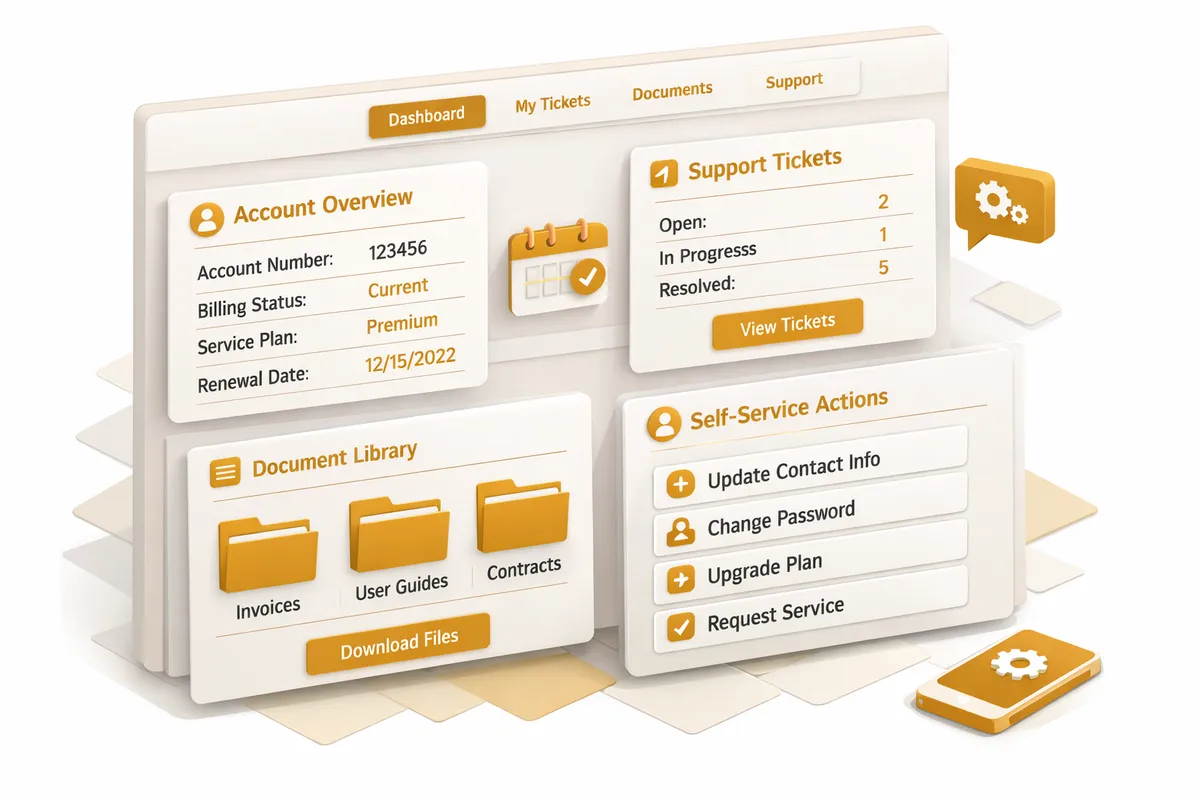
Portal design for Ukrainian Village businesses starts with the same question we ask every client: what should your customers be able to do without calling you? The answer in a neighborhood of independent shops and service providers tends to cluster around a few categories: appointment or session history, current membership or subscription status, invoice access and payment, active project or service status, file or document delivery. Each category maps to a feature set that we scope specifically to the business type and client base.
For a boutique design studio on Damen Avenue, the portal typically covers active project status, deliverable sharing and feedback collection, invoice access and payment, and a communication log that keeps correspondence within a structured environment rather than scattered across email threads. For a wellness studio near Smith Park, it covers class or session booking history, membership renewal status, payment history, and document delivery for waivers and health intake forms. For an independent retailer with a custom-order or wholesale component on Chicago Avenue, it covers order status, tracking information, invoice history, and reorder workflows.
Security for Ukrainian Village business portals is built to the actual sensitivity of the data involved. Most neighborhood business portals are not handling regulated financial data or attorney-client communications. They are handling client contact information, purchase history, appointment records, and payment receipts. That profile still requires encryption at rest and in transit, secure authentication with optional multi-factor, and access scoping that shows each client only their own records. We design the security architecture to the actual risk profile of the business, which keeps the portal appropriate and avoids over-engineering that would slow down the user experience.
Design for Ukrainian Village portals reflects the visual identity and tone of the business. A design studio on Damen Avenue has clients with strong aesthetic sensibilities; the portal interface needs to be as considered as the studio's other client-facing work. An independent coffee shop on Chicago Avenue has clients who value warmth and personality; the portal should carry that warmth rather than feeling like a sterile enterprise application. We build portal interfaces that match the brand the business has built in the neighborhood, because the portal is part of the client experience just like the physical space is.
Industries We Serve in Ukrainian Village
Independent coffee shops and cafes along Chicago Avenue that have developed loyalty programs, catering relationships, or wholesale coffee accounts can use a portal to give those commercial clients access to order history, account statements, and reorder workflows without involving the counter staff in administrative work. A Ukrainian Village cafe with a dozen active wholesale accounts is maintaining those relationships through email and phone calls that a portal could automate entirely.
Boutique retail shops on Division Street and Chicago Avenue that handle custom orders, layaway, or client-specific sourcing work benefit from a portal where clients can track the status of their order, receive shipment notifications, access past purchase history, and pay invoices for held items without requiring staff to respond to individual status requests. For shops that have built a loyal following in Ukrainian Village over many years, the portal reinforces that loyalty by making every transaction more transparent and convenient.
Design studios and creative agencies on Damen Avenue use client portals as the primary workspace for active project relationships. When a design studio's client base includes other businesses and creative professionals, the expectation for project communication and deliverable handling is high. A portal that consolidates project status, file sharing, approval workflows, revision requests, and invoice management replaces a fragmented email relationship with a structured professional interface that reflects well on the studio.
Yoga studios and fitness businesses near Eckhart Park use portals for member account management: class booking history, membership status and renewal, session package balances, payment receipts, and digital versions of liability waivers and intake forms. For a Ukrainian Village fitness studio that retains members through instructor relationships and community feel, the portal reduces administrative friction without disrupting the personal dynamic that drives retention.
Salons and personal care businesses on Chicago Avenue and Western Avenue use portals for appointment history access, product purchase records, and personalized service notes that clients appreciate having visible between visits. A client who can log in and see their appointment history and care preferences has a more confident relationship with the practitioner than a client who has to call and ask before each visit.
Independent contractors and freelancers who serve the Ukrainian Village business community and the broader Near West Side use portals to give their clients professional-grade access to project status, deliverable sharing, contract and invoice management, and communication logs. For a freelancer working with Ukrainian Village-based clients who expect a polished experience, a portal positions them alongside agencies rather than alongside the generic PDF-and-email workflow.
What to Expect Working With Us
1. Scope and workflow mapping. We start by cataloging every type of client-facing administrative request your business currently handles manually. Appointment confirmations, invoice lookups, status updates, document delivery: each category becomes a candidate for portal automation. The output is a scoped portal feature list that addresses the actual requests your clients make, not a generic feature set borrowed from a different business type.
2. Design calibrated to your client relationship. Ukrainian Village businesses have distinct visual identities and client relationships. The portal interface should extend both. We design portal experiences that match the aesthetic and tone your clients already associate with your business, so the portal feels like a natural part of working with you rather than a generic self-service tool grafted onto the side of the relationship.
3. Integration with your existing tools. Your client data already exists in a booking system, POS, accounting platform, or project management tool. We connect the portal to your existing data sources so that information stays current automatically rather than requiring manual updates. For Ukrainian Village businesses using tools like Square, Acuity, QuickBooks, or Asana, integration work is straightforward.
4. Phased launch with real client feedback. We launch portals in stages: internal testing, a small group of trusted clients for a pilot period, then full rollout. The phased approach surfaces usability issues before they affect your entire client base and gives you a chance to refine the onboarding experience based on feedback from the clients you trust most.