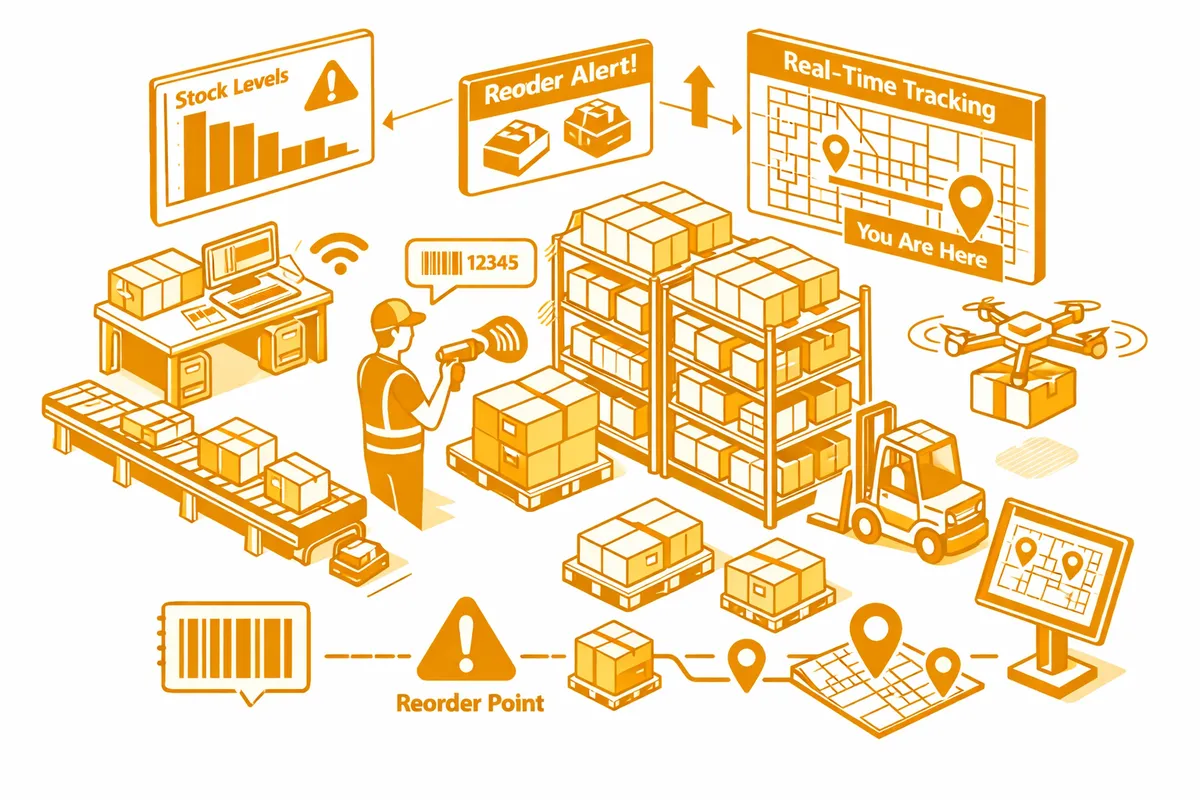
Inventory Management by Streeterville Business Type
Healthcare and Medical Practices
Medical inventory management in Streeterville requires lot-level tracking from the moment supplies arrive at the receiving area through storage, dispensing, and patient use. Every unit of every product carries a lot number, expiration date, and storage location. When a manufacturer issues a recall, the system identifies every affected unit: which are still in storage, which were used, and which patients received them. This recall response capability is not optional for practices operating under FDA and Joint Commission requirements.
We build medical inventory systems that integrate with practice management software and electronic health records. When a nurse pulls supplies for a procedure, the system records which lots were used and links consumption to the patient record. Reorder triggers account for supplier lead times, minimum order quantities, and contract pricing tiers. Expiration alerts surface products approaching end-of-life with enough lead time to use or return them.
For clinical research operations near the Feinberg campus, study supply management adds protocol-specific tracking. Each clinical trial has its own inventory tracked independently with chain-of-custody documentation. The system maintains separation between standard practice supplies and study materials while providing audit trails that sponsors and regulatory bodies require.
Hotels and Hospitality
Hotel inventory management in Streeterville spans at least four distinct supply categories, each with its own procurement cycle and consumption drivers. We build unified inventory platforms that give operations managers visibility across all categories while allowing department-level management by housekeeping, F&B, maintenance, and front desk teams.
Housekeeping inventory ties consumption directly to room occupancy. The system calculates daily linen requirements based on occupied rooms, expected checkouts, and stayover schedules. Par levels adjust dynamically based on occupancy forecasts rather than static thresholds. When a supervisor flags damaged linens, the system updates active inventory and generates a replacement order when the buffer drops below threshold.
Food and beverage inventory operates on shorter cycles with perishability constraints. The system enforces FIFO, tracks waste by category and outlet, and forecasts demand based on covers, menu mix, and event bookings. A hotel restaurant preparing for a 200-person banquet on Saturday sees exactly what to order by Wednesday based on the banquet menu and current stock. Waste reporting identifies items consistently over-ordered or improperly stored.
Event Operations at Navy Pier
Navy Pier event inventory management operates on a project basis layered over continuous commercial operations. Each event creates a temporary inventory context: the materials, supplies, and equipment needed for that specific event, tracked from staging through execution through post-event reconciliation.
We build event inventory systems that maintain a master equipment catalog with real-time availability. When a coordinator plans a July corporate event, they see which staging materials, AV equipment, and furniture are available for those dates based on existing commitments. Equipment condition tracking records damage and maintenance needs so coordinators never book equipment that is out of service.
Consumable event inventory gets its own procurement workflow tied to the event timeline. The system generates purchase orders based on event specifications and vendor lead times, ensuring materials arrive with enough buffer for setup without arriving so early that storage becomes a problem in Navy Pier's limited back-of-house space.
Luxury and Premium Retail
Luxury retail inventory in Streeterville demands unit-level precision. Every item has a unique identity: SKU, serial number or unique identifier, location, status, and client association. The system tracks whether an item is on the sales floor, in the back room, on hold for a client, in transit between locations, or reserved for a personal shopping appointment.
Client-specific inventory management supports the consultative sales model that luxury retail depends on. A sales associate preparing for a VIP appointment can reserve specific items, note client preferences, and ensure those items are available when the client arrives. The system prevents another associate from selling a reserved item while making the reservation visible to the entire team.
Transfer management between Streeterville locations and other Chicago stores enables rapid fulfillment. When a client requests an item not in the Streeterville store, the system locates available units at other locations, initiates a transfer, and provides an accurate arrival estimate.
Professional Services Offices
Streeterville's professional services firms, law offices, consulting firms, and financial services companies in the neighborhood's high-rises, manage inventory that is lower in volume but critical to operations. Technology equipment, client-facing materials, and specialized tools require tracking that prevents the slow erosion of assets that happens when nobody is formally responsible for inventory.
Technology asset management is particularly important for firms with employees working across office, home, and client site locations. Laptops, monitors, and mobile devices need lifecycle tracking from procurement through assignment through retirement. The system records which employee has which device, its warranty status, and its refresh eligibility. When an employee departs, the system generates a return checklist ensuring every assigned asset is recovered.
Our Approach to Streeterville Inventory Solutions
Step 1: Inventory environment assessment. We document your current inventory state across every category you manage: what you track, where tracking breaks down, what reconciliation effort looks like, and what operational problems recur because of inventory gaps. For Streeterville businesses, this assessment accounts for the multi-floor, multi-department, and multi-supplier complexity that defines the neighborhood's operations.
Step 2: System architecture designed for your operation. Based on the assessment, we design the inventory system around your specific product types, storage configurations, compliance requirements, and procurement relationships. A Streeterville medical practice gets a different architecture than a Streeterville hotel, even though both need inventory management. The system design reflects your operational reality, not a generic template.
Step 3: Build, integrate, and validate with your data. We build the system and integrate it with your existing platforms: practice management software, hotel property management systems, POS platforms, ERP tools, and procurement portals. Testing uses your actual product catalog, your supplier relationships, and your operational scenarios. We validate with your team before any live data migration.
Step 4: Launch with training and ongoing support. Your team launches on a working system with training built around their actual workflows. Post-launch, we monitor early operational cycles and adjust configurations based on real-world performance. Reorder parameters, alert thresholds, and forecasting models are refined as the system accumulates your operational data.