How We Build Employee Portals for Streeterville
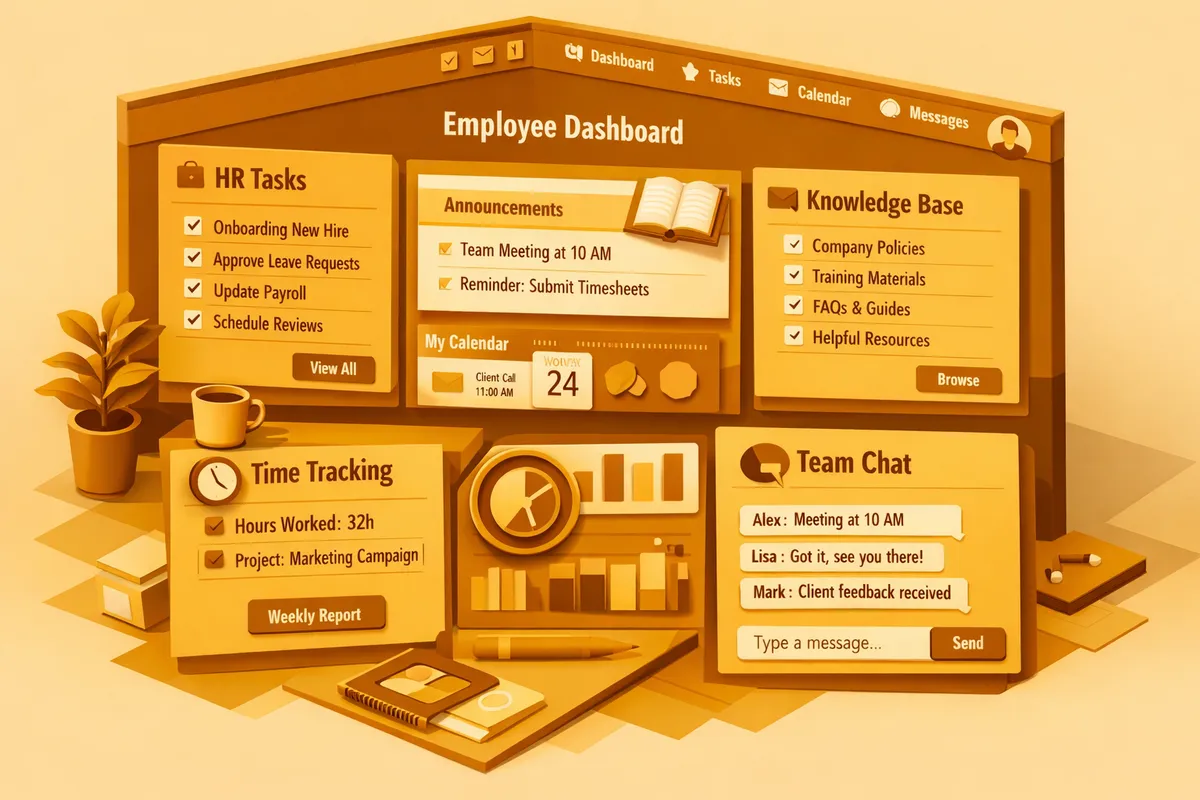
The functional specification for an employee portal depends entirely on the operational role it serves in your organization. Before designing anything, we spend two weeks auditing the most friction-heavy interactions between your employees and your administrative and HR functions. We interview staff members at multiple levels, map the most common administrative tasks, and identify where the current process requires unnecessary back-and-forth between employees and the HR or operations team.
For a Streeterville healthcare organization, that audit typically surfaces three or four high-volume administrative interactions that consume significant HR staff time: benefits enrollment and changes, schedule request and approval workflows, credentialing document collection and renewal tracking, and CME hour reporting. Each of these becomes a portal module with a workflow designed around how your employees actually need to interact with it.
For a hospitality property on Lake Shore Drive, the operational priorities are different. The portal's primary value is mobile accessibility for a workforce that is physically distributed across the property during working hours. We design the mobile experience first and desktop second, because a housekeeper checking their shift schedule or a restaurant employee reviewing their upcoming assignments is doing it from a phone, not a laptop.
Security and data privacy requirements vary by industry and are designed in from the start. Healthcare employee portals with HIPAA-adjacent data, such as employee health records or vaccination documentation, require encrypted storage and role-based access controls. Legal and professional services portals with sensitive client matter assignments require access controls that prevent cross-matter data exposure.
Industries We Serve in Streeterville
Medical practices and clinical operations groups near Northwestern Memorial Hospital on East Erie Street and Fairbanks Court deploy employee portals for physician and staff scheduling, credentialing document management and renewal tracking, CME hour recording, benefits enrollment, and performance review workflows. For practices that employ both clinical and administrative staff, the portal serves as the single place both employee types access HR and operational information without routing everything through a central HR coordinator.
Luxury hotels and extended-stay properties on Lake Shore Drive and Michigan Avenue near Navy Pier build employee portals centered on shift management, schedule visibility, shift swap requests, and internal communications. The portal's mobile architecture allows a housekeeping supervisor to push urgent schedule changes to the entire floor team and receive confirmations before the shift begins. During the MCA Chicago exhibition opening season and Navy Pier summer programming, rapid internal communication is an operational necessity.
Law firms and management consulting practices in the Illinois Center office complex between Columbus Drive and Lake Shore Drive use employee portals for matter assignment visibility, billable hour tracking, CLE requirement monitoring, document library access, and HR workflow management. Associates and paralegals who can see their own matter load and utilization metrics in real time self-manage more effectively than those who rely on periodic partner feedback.
Healthcare staffing and placement organizations serving the Northwestern Memorial campus use employee portals to manage placement schedules, credential documentation submissions, timesheet approvals, and direct deposit and payroll information for contract staff working across multiple facilities. The portal replaces the email-and-attachment workflows that create compliance and record-keeping risks for organizations managing large healthcare worker populations.
Real estate and property management companies with buildings along McClurg Court and the Illinois Center complex use employee portals for maintenance technician scheduling, work order assignment and completion tracking, building access credential management, and vendor documentation. A building manager who can see all open maintenance requests, their current status, and the technician assignment from a single portal view makes better decisions faster than one managing the same information across text messages and spreadsheets.
Professional service boutiques and high-end retail operations along Michigan Avenue near the John Hancock Center (875 North Michigan) use employee portals for sales associate scheduling, commission tracking, product training materials, and internal communications that keep a distributed team aligned on seasonal campaigns and Michigan Avenue holiday corridor priorities.
What to Expect Working With Us
1. Workflow audit and priority mapping. We document the most time-consuming administrative interactions between your employees and your HR and operations functions. For each workflow, we calculate the approximate time cost on both sides of the interaction and prioritize portal modules by the efficiency gain they deliver. Healthcare clients near Northwestern Memorial typically prioritize scheduling and credentialing. Hospitality clients on Lake Shore Drive typically prioritize mobile shift management.
2. Architecture design and security review. We design the portal architecture with your industry's data governance requirements built in from the start. For healthcare organizations, that means HIPAA-compliant data handling and access control architecture reviewed with your compliance team before development begins. For law firms, that means access controls scoped to prevent unauthorized matter information exposure.
3. Phased development and staff testing. We build the portal in priority order and test each module with actual staff members before moving to the next. Staff feedback from real users during development is incorporated before deployment rather than after launch. We specifically test the mobile experience for any workforce role that performs their job away from a desk, which in Streeterville hospitality means essentially everyone on the operations floor.
4. Rollout and adoption support. Portal adoption requires more than an announcement email. We design a rollout plan that includes in-person or video onboarding for each employee group, manager training on portal administration functions, and a 90-day monitoring period that identifies adoption barriers early. For large operations with multiple employee categories, such as a Lake Shore Drive hotel with front desk, housekeeping, F&B, and management staff, we stage the rollout by employee group to allow each group's feedback to inform the next rollout phase.