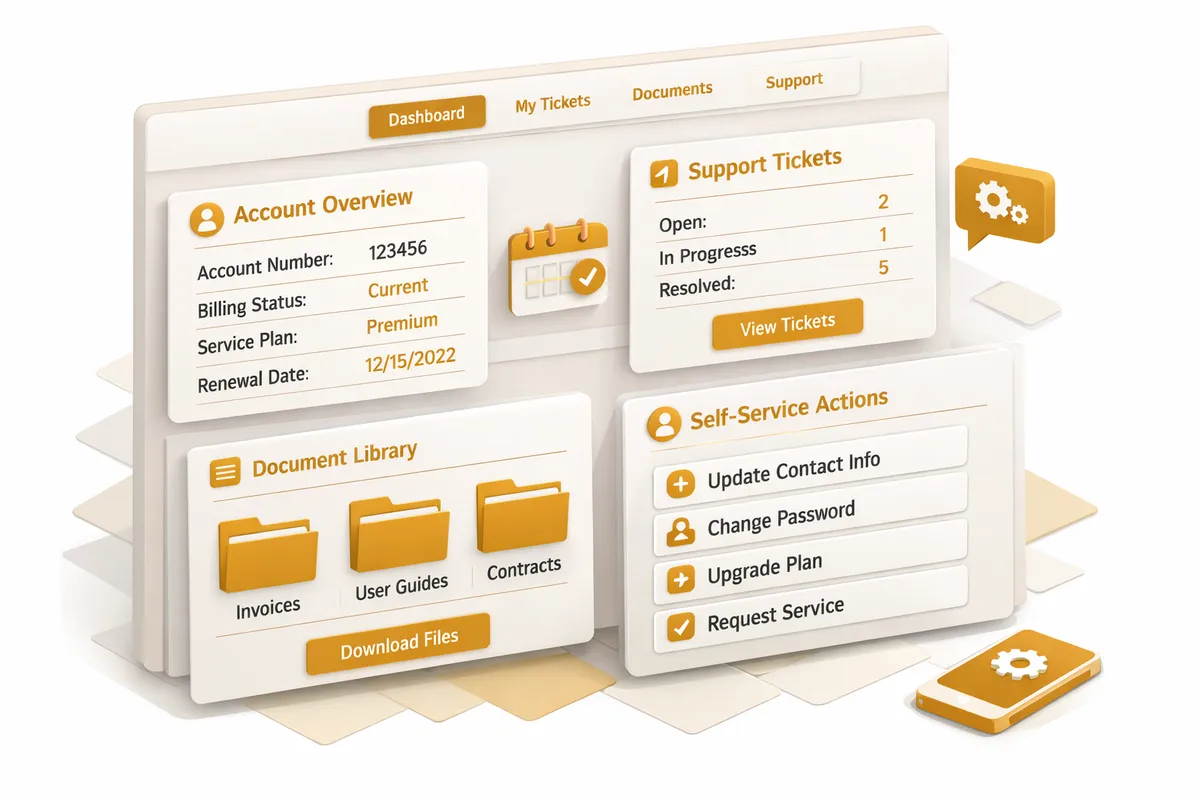
How We Build Customer Portals for Streeterville
The design of a customer portal starts with a specific question: what do your clients most frequently need access to that currently requires them to contact a staff member? For a Streeterville law firm, the answer is usually billing statements, matter status updates, and document sharing. For a medical practice, it is appointment scheduling, test results, and prescription renewal requests. For a hotel, it is reservation management, room preferences, and concierge requests. For a residential property management company, it is maintenance requests, lease documents, and payment history.
We spend two weeks conducting user research with your actual clients and staff members before designing anything. We want to understand not just what tasks clients need to perform, but the context in which they perform them. A law client reviewing billing is doing it on a laptop at 10 PM before a morning meeting. A hotel guest requesting amenities is doing it on a phone from inside the room. A patient scheduling a follow-up is doing it from their office on their lunch break. The interface design, authentication flow, and notification architecture all change depending on the real context of use.
Security architecture is non-negotiable for every portal we build in Streeterville. The client base in this neighborhood includes individuals whose legal and financial information is sensitive enough to warrant serious access controls. Healthcare portals operate under HIPAA. Legal portals handle privileged communications and confidential matter information. Real estate portals hold lease terms and financial records. We design role-based access controls, session management, two-factor authentication, and audit logging into every portal from the ground up, not as additions to a less secure base architecture.
Industries We Serve in Streeterville
Medical practices and specialist groups near Northwestern Memorial Hospital on East Erie Street and Fairbanks Court build patient portals for appointment scheduling, secure lab result delivery, prescription renewal requests, insurance document uploads, and billing statement access. The portal reduces inbound phone volume on administrative tasks, freeing clinical staff for interactions that require human judgment. Integration with your existing EHR ensures data consistency without manual re-entry.
The law firms along Grand Avenue and the Illinois Center office complex deploy client portals that provide secure matter status visibility, billing statement access, document sharing with full version history, and encrypted messaging for privileged communications. Clients who can check invoice status and review the status of their matter at any hour arrive at quarterly review meetings better prepared and less likely to raise billing disputes that result from information asymmetry.
Luxury hotels and extended-stay properties facing the lakefront on Lake Shore Drive build guest portals covering pre-arrival preference collection, room selection from available inventory, in-stay service requests, local recommendation delivery, and post-stay feedback. The guest portal extends the service interaction beyond the front desk and into every device the guest carries, which is exactly where the highest-satisfaction touchpoints can happen if the portal is well designed.
Real estate and residential property management companies with buildings along McClurg Court and the Illinois Center complex offer resident portals for maintenance request submission with photo uploads, lease document access, payment history, community announcements, and move-in and move-out scheduling. For high-rise residential buildings in Streeterville, a resident portal reduces the administrative load on building management teams significantly.
Healthcare staffing and professional service organizations serving the Northwestern Memorial campus use client portals to provide placement status updates, credentialing document collection and tracking, timesheet submission, and billing visibility to the healthcare systems and practices they serve. The portal replaces email chains and attachment-heavy document workflows with a structured, auditable system.
Luxury retail and professional service boutiques along Michigan Avenue near the John Hancock Center (875 North Michigan) build loyalty and account portals that give high-value clients access to purchase history, order status, appointment scheduling for personal shopping sessions, and early access to new collections timed around MCA Chicago exhibition openings and Michigan Avenue holiday season events.
What to Expect Working With Us
1. Client journey mapping and task inventory. We begin by identifying the ten to fifteen most common tasks your clients currently need staff assistance to complete. For each task, we document the current process, the time it takes for both the client and the staff member, and the friction points that make the experience worse than it needs to be. This inventory becomes the functional specification for the portal's first release.
2. Security architecture and compliance review. Before writing a line of interface code, we design the authentication, authorization, data storage, and audit logging architecture. For healthcare clients near Northwestern Memorial, this phase includes a HIPAA gap analysis and business associate agreement. For legal clients, it addresses privilege protection and access control requirements. Security architecture cannot be retrofitted without rebuilding the foundation.
3. Portal development and integration. We build the portal interface, connect it to your existing backend systems through APIs or direct database integration, and configure the notification and communication workflows. Testing covers the full range of user scenarios including edge cases, device types, and failure modes. We test specifically on the mobile devices your clients actually use, since Streeterville professionals are predominantly accessing portals on phones.
4. Launch, training, and adoption support. We launch with a communication plan designed to drive adoption among your existing client base. Portals fail when clients do not know they exist or do not know how to get started. We help you design the onboarding email sequence, the staff scripts for encouraging clients to register, and the first 90 days of monitoring to identify friction points that need refinement before they become adoption barriers.