How We Build Business Intelligence for Streeterville
Every engagement starts with a data inventory rather than a dashboard mockup. We spend the first two weeks documenting every system your organization uses to generate operational records: your EHR or practice management software, your property management system, your billing platform, your CRM, your scheduling tool. For a Streeterville medical practice, that inventory might span four or five disconnected systems that have never been queried together. We identify what each system holds, what APIs or export capabilities it offers, and where the record-keeping gaps are.
From that inventory, we design the data model. Rather than building one dashboard that tries to show everything, we define three or four distinct operational views that match how different roles in your organization actually make decisions. The physician group administrator needs different visibility than the CFO, and the department head scheduling surgical time has a different information need than the managing partner tracking billable realization across associates.
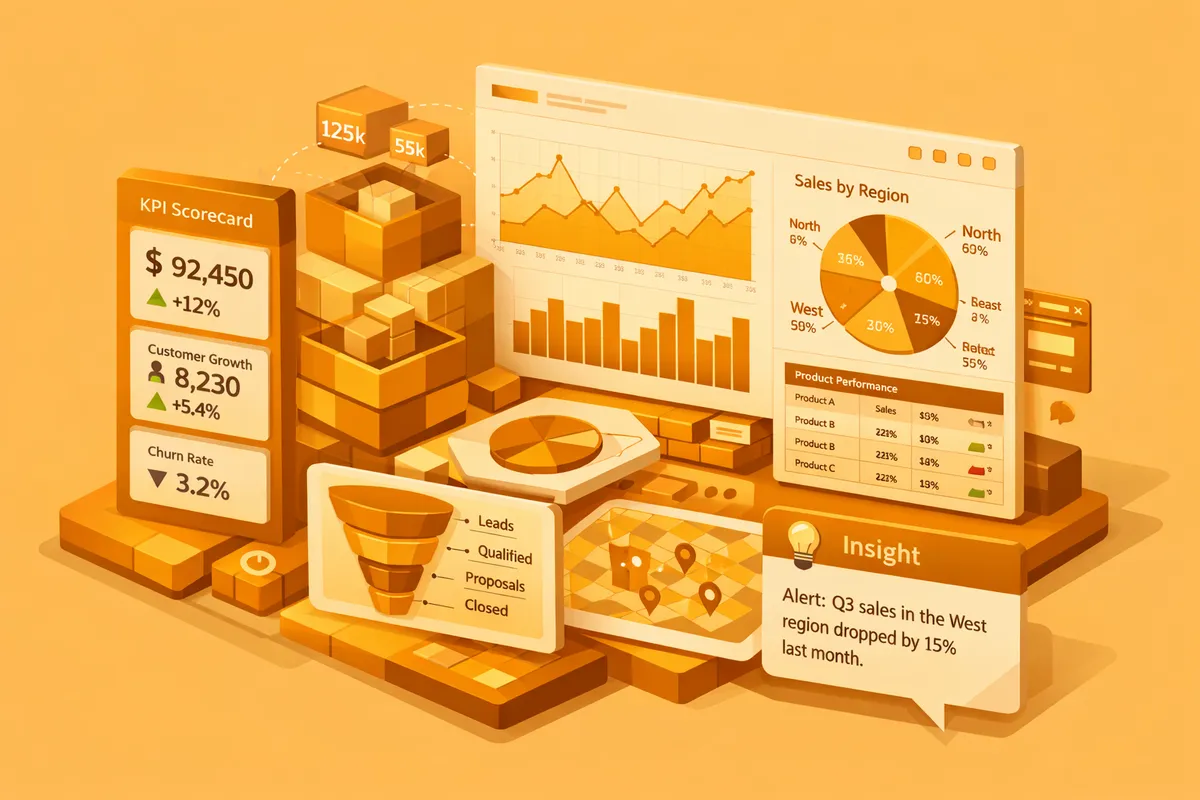
The build phase connects your source systems to a centralized data warehouse, applies the transformation logic that makes cross-system comparisons valid, and surfaces the results through dashboards your team can navigate without a data analyst in the room. We train every role-specific dashboard set with your actual data so the first time you open it, the numbers are familiar and the anomalies are immediately legible. For Streeterville clients with Navy Pier events calendars or MCA Chicago exhibition opening dates affecting their traffic patterns, we build those external signals into the context layer so seasonal variances read correctly.
Industries We Serve in Streeterville
Medical specialty practices and outpatient clinics operating in the shadow of Northwestern Memorial Hospital along Fairbanks Court and Erie Street use BI to track referral source performance, payer mix trends, scheduling utilization by provider, and revenue cycle metrics that identify claims bottlenecks before they affect cash flow. The competitive proximity to one of Chicago's largest health systems makes operational precision a survival skill.
Luxury hotels and extended-stay properties on Lake Shore Drive and Michigan Avenue deploy BI dashboards to consolidate revenue management data across booking channels, track RevPAR by room type and season, measure the lift from loyalty programs versus OTA traffic, and compare performance against the Gold Coast comp set. Real-time occupancy visibility during the Navy Pier summer event calendar is especially high-value during July and August when demand forecasting errors carry the largest revenue consequence.
Real estate firms and property management companies with offices along McClurg Court and the Illinois Center complex use operational dashboards to track lease renewal pipelines, maintenance ticket resolution times, tenant satisfaction scores, and net operating income across portfolios that span multiple asset classes. The concentration of high-rise residential and commercial inventory in Streeterville makes portfolio-level visibility non-negotiable.
Law firms and professional services practices between Grand Avenue and Ohio Street deploy BI to track matter profitability, associate utilization, realization rates, and collection cycles across client segments. When the data is connected correctly, a managing partner can see in real time which client relationships are growing, which are drifting toward write-offs, and which practice areas have capacity the firm is not marketing effectively.
Healthcare administrative and staffing organizations that serve Northwestern Memorial and the broader Near North medical campus use BI to manage workforce deployment metrics, credentialing pipeline status, contract utilization rates, and billing compliance dashboards that surface documentation gaps before audits occur.
Luxury retail and professional service boutiques on Michigan Avenue near the John Hancock Center (875 North Michigan) use BI to consolidate point-of-sale data, customer lifetime value metrics, and traffic pattern analysis from multiple locations into a single view that drives buying decisions, staffing models, and promotional timing tied to the Michigan Avenue holiday corridor and Navy Pier summer programming.
What to Expect Working With Us
1. Data inventory and source mapping. We document every operational system your organization uses and assess what data each one holds, how it can be accessed, and where the critical connections between systems are missing. For a Streeterville medical practice or law firm, this phase typically takes two weeks and produces a clear picture of which business questions can be answered immediately and which require new data capture.
2. Warehouse architecture and pipeline build. We design and build the data infrastructure that connects your source systems, standardizes record formats, and stores clean historical data for trend analysis. The architecture is designed around your industry's compliance requirements, whether HIPAA for healthcare organizations or standard financial data governance for law firms and professional services.
3. Dashboard design and role calibration. We build dashboards for each operational role in your organization, calibrated to the decisions that role actually makes. Every dashboard goes through a review cycle with the team members who will use it daily before launch. We tune metric definitions, date range defaults, and alert thresholds based on feedback from actual users rather than assumed needs.
4. Ongoing support and expansion. After launch, we monitor data pipeline performance, investigate anomalies, and expand dashboard coverage as your team identifies new questions the system should answer. Most Streeterville clients add two or three new reporting modules in the first six months as the habit of using data to make decisions surfaces use cases that weren't visible at the start of the engagement.