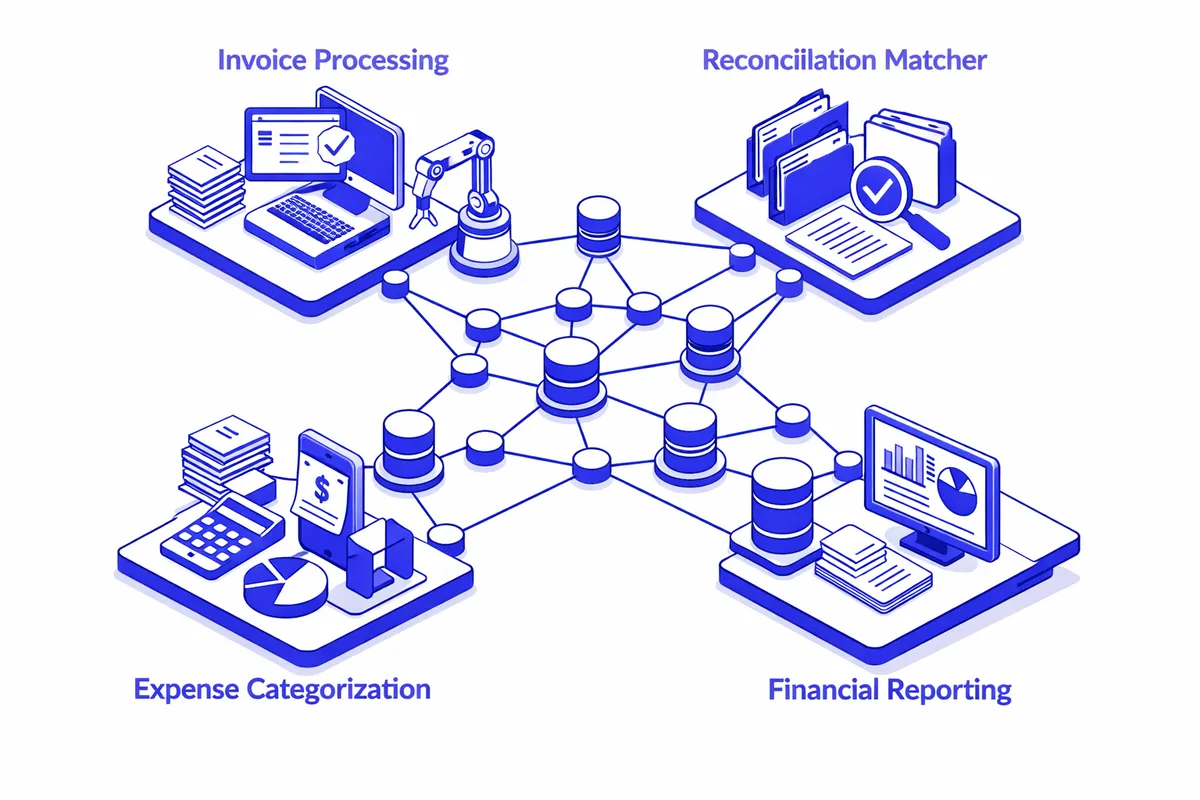
How We Build Accounting Automation for Streeterville
Every Streeterville engagement starts with a detailed process inventory. We ask accounting staff to walk us through their close cycle step by step, from the first data pull of the month to the final report submission. Most practices and firms discover during this exercise that their close cycle includes fifteen to twenty distinct manual steps, and that twelve or more of those steps involve no judgment. They involve moving data from one system to another, applying a formatting rule, and storing the result. That is automation work.
From the process inventory, we identify the automations that deliver the highest time savings relative to build cost. For a medical practice near Northwestern Memorial Hospital, that is often insurance claim status monitoring and denial routing: a workflow that checks the status of submitted claims daily, flags denials with their denial codes, and routes them to the correct staff member with the claim history already assembled. For a hotel near Navy Pier, it is the nightly revenue audit. For a law firm, it is trust reconciliation.
We build automation using integration layers that connect to your existing accounting software. We do not replace QuickBooks, NetSuite, Sage Intacct, or your practice management system. We build workflows on top of those systems that move data automatically, apply transformation rules, and flag exceptions for human review. Testing runs against three months of historical data before any live transactions are touched. Every automation produces an audit trail: what ran, when, what it processed, and what it flagged.
Industries We Serve in Streeterville
Medical specialty practices clustered along Ohio Street and Grand Avenue near Northwestern Memorial Hospital use accounting automation to handle insurance claim batch submissions, remittance advice posting, denial management routing, and monthly patient statement generation. These practices often use electronic health record platforms that produce billing data but do not natively connect to their accounting systems. Automation bridges that gap without requiring a new EHR.
Boutique law firms near Michigan Avenue and the John Hancock Center at 875 North Michigan use accounting automation to handle trust account reconciliation, client billing cycle generation, matter cost disbursement postings, and year-end financial statement preparation. The three-way trust reconciliation that Illinois bar compliance requires is a natural candidate for rule-based automation that produces a complete audit trail every month.
Hotel and hospitality finance departments along Lake Shore Drive and near Navy Pier use accounting automation to handle daily revenue audits, occupancy tax remittance calculations, banquet and event revenue reconciliation, and monthly owner distribution reporting. Hotels running high occupancy through convention season generate transaction volumes that strain manual reconciliation processes. Automation absorbs the volume without adding staff.
Luxury residential property management firms operating along McClurg Court and Fairbanks Court use accounting automation to handle monthly assessment posting, reserve fund transfer scheduling, vendor invoice approval routing, and board reporting package preparation. Association accounting involves predictable recurring cycles that are ideal automation candidates.
Healthcare vendors and medical suppliers servicing the Northwestern Memorial Hospital campus use accounting automation to handle purchase order matching, invoice reconciliation against delivery confirmations, and vendor payment scheduling. Multi-location healthcare vendors often have accounts payable processes that run manually because their ERP systems do not connect natively to hospital procurement platforms.
Real estate and professional services firms with offices along Michigan Avenue and Grand Avenue use accounting automation for recurring client billing, expense report processing, intercompany transfer postings, and monthly close package preparation. The close cycle for a multi-entity real estate firm involves the same journal entries every month. Automation executes them on schedule without controller involvement for routine postings.
What to Expect Working With Us
1. Process inventory before any builds. The first two weeks are documentation only. We map your current close cycle in precise detail, identify every manual step, and quantify the time each step consumes weekly. The process map becomes the project scope. You know exactly what is being automated and why before we write a line of code.
2. Priority sequencing based on your revenue cycle. Not every automation delivers equal value. For a medical practice, denial management automation often delivers faster ROI than anything else. For a hotel, the nightly revenue audit is the obvious first target. We sequence builds based on your specific close calendar and where staff time is most concentrated.
3. Historical data testing before any live transactions. Every automation runs against three months of actual historical data before touching current-period transactions. We compare automated outputs to your actuals line by line. You approve the match before the automation goes live.
4. Documentation and team training at handoff. Every automation we build is documented at the workflow level. Your controller or accounting manager can read the documentation and understand exactly what each workflow does, what triggers it, and what exceptions it routes for review. We train your team on monitoring exception reports and interpreting results. No black boxes.