How We Build Progressive Web Apps for South Shore
Our process starts with understanding how your actual customers behave, not a generic persona. We spend time with your existing data: your website analytics, your phone logs, your Instagram DMs, your booking patterns. For a 71st Street salon, that might reveal that 85% of traffic is mobile, 60% of visitors come through Instagram, and appointment requests peak on Sunday evenings. That insight shapes every design decision we make.
We build your PWA on a modern foundation: Next.js for the app shell, service workers for offline behavior, and a lean asset strategy that keeps your first load under 200KB. The architecture is progressive in every sense. A customer with a new iPhone and fast home WiFi gets a snappy, animated experience. A customer on an older Android device walking down Stony Island on a weak signal still gets a functional app that loads, responds to taps, and completes the core tasks.
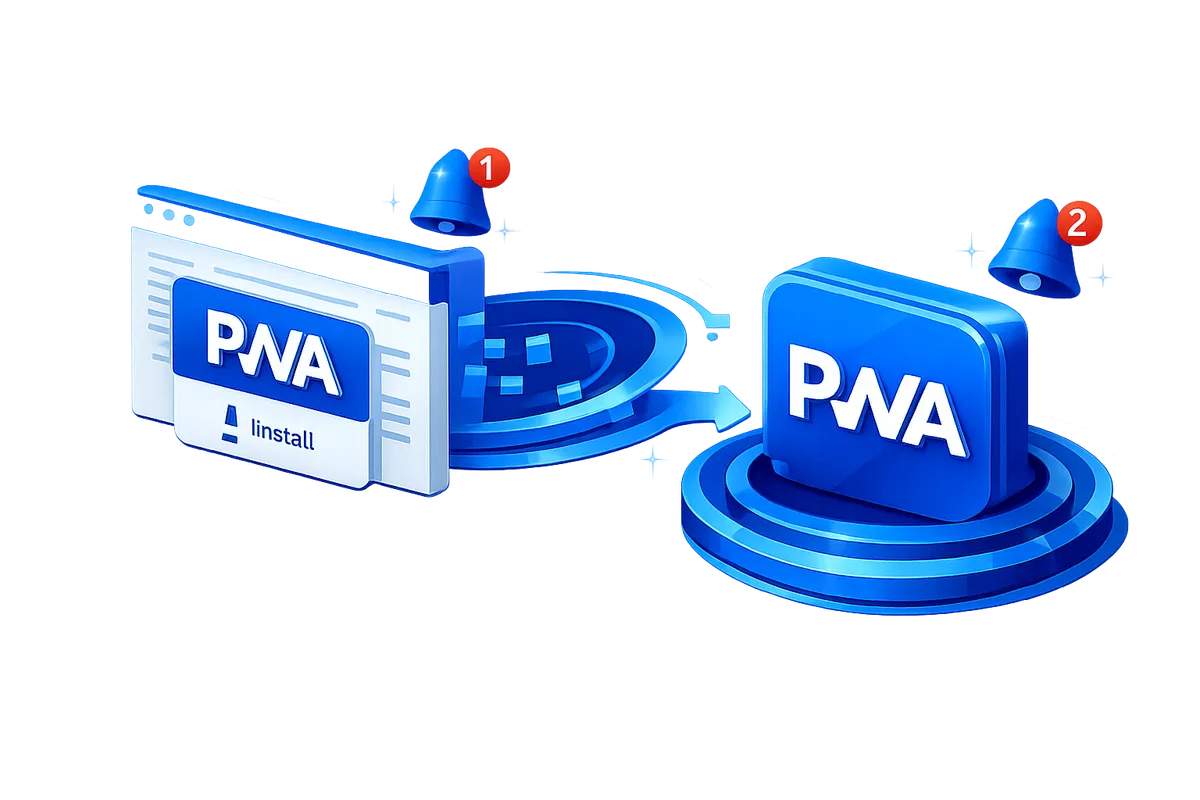
Installability is a first-class feature, not an afterthought. When a customer visits your PWA two or three times, the browser prompts them to add it to their home screen. Once installed, it launches like a native app with your branding, no URL bar, and full-screen presence. For a catering business near the South Shore Cultural Center, that means repeat clients have your menu and booking flow one tap away on their phone, the same as Instagram or their banking app.
Offline support is calibrated to your business. A gym on 79th might cache class schedules so members can check them in buildings with poor signal. A community organization on 71st might cache event flyers and donation forms for use during outreach at Rainbow Beach Park. A retail shop might cache product catalogs for customers browsing on the Metra Electric ride home. We decide what gets cached based on what your customers actually do, not what is technically possible.
We also connect your PWA to the systems you already use: your booking platform, your POS, your email list, your Instagram business account. The PWA is not a separate island of data. It is the front door that unifies everything into a single experience for your customer.
Industries We Serve in South Shore
Barbershops, salons, and personal care businesses along 71st Street and 79th Street use PWAs to handle online booking, stylist selection, service menus, and loyalty programs. The installed experience means regulars book appointments with one tap from their home screen, skipping phone calls entirely.
Restaurants and catering operations near the South Shore Cultural Center and along Jeffery Boulevard use PWAs for menu display, online ordering, private event inquiries, and catering requests. Offline-ready menus mean a customer can pull up your offerings even in a basement dining room with poor signal.
Community organizations and nonprofits working out of storefronts on 75th and 79th use PWAs for event promotion, volunteer signups, donation flows, and program registration. Push notifications keep a neighborhood engaged without relying on Facebook's reach algorithms.
Faith communities and cultural institutions in the 71st corridor and around Jackson Park use PWAs for service schedules, sermon archives, giving platforms, and ministry resources. An installable app on a congregant's phone delivers a more direct connection than a newsletter email.
Health, wellness, and professional services serving South Shore residents use PWAs for appointment booking, intake forms, telehealth access, and client portals. The offline-ready shell means patients can access their appointment details and directions even when cell service is inconsistent.
Retail and specialty shops preparing for the Obama Presidential Center visitor influx use PWAs as mobile-first storefronts with inventory browsing, click-and-collect ordering, and customer loyalty built in.
What to Expect Working With Us
1. Discovery and audit. We review your current site, analytics, customer feedback, and competitive landscape. For South Shore businesses, we pay particular attention to mobile performance, since that is where the overwhelming majority of your traffic lives. We document exactly what is slow, what is broken, and what is missing, then prioritize what to fix first.
2. Design and architecture. We design the PWA around your actual customer flows, not a generic template. Booking, ordering, contact, and content are structured so the most common tasks complete in two or three taps. The visual design reflects your brand and the character of the neighborhood, not a stock template that could belong to anyone.
3. Build and launch. We develop the PWA on a modern stack with offline support, installability, and push notification capability built in from day one. We integrate your booking system, payment processor, and content sources. Launch includes performance testing on real devices and real network conditions, including the kind of spotty 4G you get riding the Metra Electric along the lakefront.
4. Ongoing optimization. After launch, we monitor real user performance, conversion rates, and installation behavior. We update the service worker strategy as your business grows, add new features as customer behavior reveals them, and keep the PWA performing at Core Web Vitals thresholds that help you rank in local search.