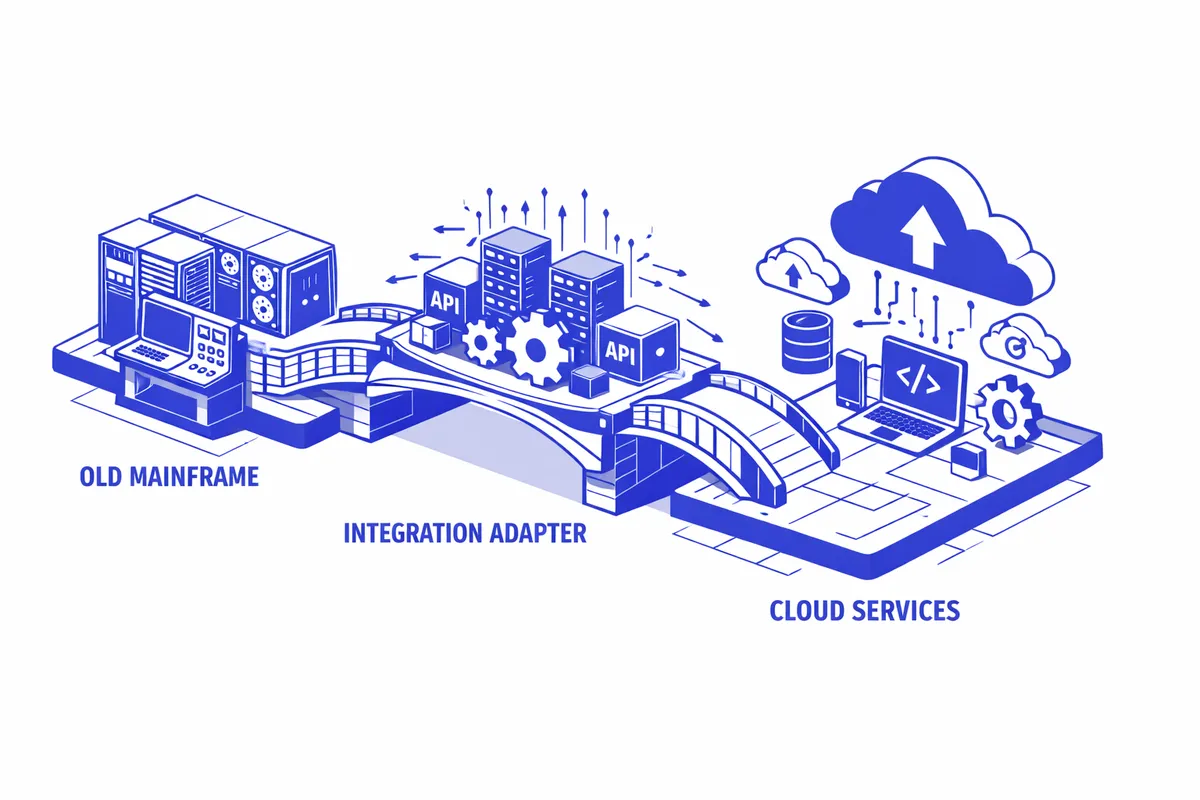
How We Build Legacy System Integration for South Shore
The first step is always honest discovery. We do not assume we know what a system does or how it behaves based on its name or age. We sit with the people who use it daily and document exactly how data flows through it, what it can export, what integration points exist or can be created, and what business logic is embedded in its custom configurations. For South Shore organizations with limited documentation, this discovery work often surfaces institutional knowledge that was never written down and would be lost in a replacement project.
From that discovery, we design the right integration approach. Some systems can be connected through direct database access, reading and writing data at the database level without touching the application itself. Others expose file-based export and import capabilities that allow batch data exchange on a schedule. Systems with no integration path at all can be connected through screen automation that operates the legacy interface programmatically. The approach depends on what the system actually supports, not on what we wish it would support.
We build transformation logic that handles the format differences between old and new systems. A legacy database that stores dates in one format, addresses in another, and customer identifiers in a third must have its data translated cleanly before it arrives in a modern platform. We design reconciliation processes that cross-check data between systems and alert on any discrepancy so nothing is silently lost.
Data integrity is treated as non-negotiable throughout. Every integration transaction is logged. Error handling catches failures and queues them for retry or manual review. Nothing disappears without a record. For South Shore's community organizations, where program participant records may be required by funders or government contracts, this level of reliability is essential.
Industries We Serve in South Shore
Nonprofits and social services organizations near Rainbow Beach, the Obama Presidential Center construction zone, and throughout the neighborhood manage program participant records, donor databases, and funder reporting systems that span multiple generations of software. Integration connects these systems to modern case management platforms, grant tracking tools, and communication systems without disrupting programs or requiring full database replacement.
Restaurants and food businesses along the Bryn Mawr restaurant row and the 71st Street corridor use POS systems, accounting tools, and inventory management software that often cannot talk to each other. Integration eliminates the manual data re-entry that costs owners hours every week and creates errors.
Contractors and construction businesses serving Jackson Park Highlands and the surrounding residential neighborhoods manage job costing, scheduling, and billing across tools that were never designed to connect. Integration links these systems so job data flows from estimate to invoice without manual duplication.
Community churches and faith-based organizations maintain member management systems, financial systems, and ministry tracking databases built decades apart. Integration creates unified views of constituent records and automates the reporting that boards and denominational affiliates require.
Multi-generational family businesses throughout South Shore carry software histories that reflect each generation's purchasing decisions. Integration layers allow newer tools to coexist with older ones, preserving the institutional knowledge in established systems while enabling modern capabilities.
What to Expect Working With Us
1. Legacy system discovery. We document your system's actual capabilities, data structures, existing integration points, and the business logic embedded in its configurations. For systems without documentation, we build the understanding needed to design reliable integration from direct examination.
2. Integration architecture design. We select the right approach for your specific system and requirements, whether API wrapper, database-level access, file-based exchange, or screen automation. We design data transformation logic and error handling before writing a line of code.
3. Development and testing. We build the integration layer and test it against real data volumes, covering normal operations and error conditions. We validate that data arriving in your modern systems matches what left your legacy system with precision.
4. Deployment and ongoing monitoring. We deploy with monitoring that alerts on errors, inconsistencies, or performance issues. Legacy systems contain behaviors that only surface under specific conditions, and we stay engaged post-launch to address anything that emerges.